White Names vs. Black Names: Freakonomics Movie
17 May 2017 Leave a comment
in applied price theory, discrimination, economic history Tags: economics of oppositional identities

Why Do People Become Islamic Extremists?
18 Oct 2016 Leave a comment
in defence economics, economics of crime, economics of religion, labour economics, law and economics, occupational choice Tags: economics of oppositional identities, war on terror
How religious are so-called “Islamic terrorists”?
15 Jul 2016 Leave a comment
in defence economics, economics, economics of crime, economics of religion, law and economics Tags: economics of oppositional identities, war against terror
Jihadists and the Nisei soldiers
16 Nov 2015 1 Comment
in economic history, economics of religion, occupational choice, politics - Australia, politics - New Zealand, politics - USA, war and peace Tags: British politics, counter-signalling, economics of oppositional identities, game theory, ISIS, New Zealand Greens, war against terror, World War II
Japanese Americans interned during World War II jumped at the chance to volunteer to fight. They saw it as their last chance to prove their undivided loyalty to their country.
One Japanese father, when saying goodbye to his son, stressed that showing his loyalty to his country, if necessary through the last full measure of devotion was far more important that his returning safely to his family.
The 442nd Combat Regiment Team was the most decorated unit in World War II. Its motto was “Go for Broke”. The 4,000 Nisei soldiers in April 1943 had to be replaced nearly 2.5 times. In total, about 14,000 men served, earning 9,486 Purple Hearts.
Migrants are a cut above regarding initiative and judgement. They pass many of these traits on to their children. These Japanese Americans, both migrants and native born knew that counter-signalling was required. They had to go out of their way to show their loyalty no matter how unfair any suspicions of disloyalty among Japanese Americans might have been at the time.
I am reminded of that counter-signalling by Japanese Americans during the darkest days of World War II when I read the remarks of Julie Anne Genter and Jeremy Corbyn. Both focused their pleas on the need to be inclusive and understanding why people join violent, radical groups. They and the rest of the Twitter Left had nothing to contribute regarding strategies to deter the next attack and disrupt those that are in the planning stage, but that is not new.
The notion that bad behaviour towards minority communities leads to more recruitment to the terrorists is overrated. There will be a few wind-bags who say harsh things after each terrorist attack, but if they cross the line, they will be dealt with by the police and courts in a democracy governed by the rule of law.
Acrimony towards your community following the latest terrorist attacks has little to do with the level of recruitment to these terrorist groups either now or in the past. As Alan Krueger explains:
One of the conclusions from the work of Laurence Iannaccone—whose paper, “The Market for Martyrs,” is supported by my own research—is that it is very difficult to effect change on the supply side. People who are willing to sacrifice themselves for a cause have diverse motivations. Some are motivated by nationalism, some by religious fanaticism, some by historical grievances, and so on. If we address one motivation and thus reduce one source on the supply side, there remain other motivations that will incite other people to terror.
Malcontents join the jihadists today for the same reasons they joined the Red Brigade, the Japanese Red Army Faction and Baader-Meinhof gang in the 1970s and 1980s.
Plenty of young people were attracted to communism in previous generations as a way of sticking it to the man. Now as then economic conditions were good as were political freedoms. Italy, Japan and Germany were all at the peak of recoveries from war. Japanese incomes are doubled in the previous decade. Germany and Italy were rich countries. As Alan Krueger explains:
Despite these pronouncements, however, the available evidence is nearly unanimous in rejecting either material deprivation or inadequate education as important causes of support for terrorism or participation in terrorist activities. Such explanations have been embraced almost entirely on faith, not scientific evidence.
Each generation has its defining oppositional identity. Radical Islam is the oppositional identity of choice for today’s angry young men and women. Mind you, they have to buy Islam for dummies to understand what they’re signing up for.
In previous generations, it was communism, weird Christian sects, eco-terrorism, animal liberationist terrorism and a variety of domestic terrorists of the left and right with conspiratorial motivations. Look at the level of diversity of the angry young men and women on the domestic terrorists list of the FBI. One jihadists when interviewed said that 30 years ago he would probably have become a Communist as his vehicle for venting his frustrations.
There is always an ample supply of troubled and angry people so trying to redress their grievances is overrated as Alan Krueger explains:
…it makes sense to focus on the demand side, such as by degrading terrorist organizations’ financial and technical capabilities, and by vigorously protecting and promoting peaceful means of protest, so there is less demand for pursuing grievances through violent means. Policies intended to dampen the flow of people willing to join terrorist organizations, by contrast, strike me as less likely to succeed.
The current appeal of radical Islam rests on what psychologists call personal significance. The quest for personal significance by these angry young men and women is the desire to matter, to be respected, to be somebody in one’s own eyes and in the eyes of others.
A person’s sense of significance may be lost for many reasons, including economic conditions. The anger can grow out of a sense of disparagement and discrimination; it can come from a sense that one’s brethren in faith are being humiliated and disgraced around the world.
Extremist ideologies, be they communism, fascism or extreme religions are effective in such circumstances because it offers a quick-fix to a perceived loss of significance and an assured way to regain it. It accomplishes this by exploiting primordial instincts for aggression, sex and revenge. MI5’s behavioural science unit found that
“far from being religious zealots, a large number of those involved in terrorism do not practise their faith regularly. Many lack religious literacy and could… be regarded as religious novices.” The analysts concluded that “a well-established religious identity actually protects against violent radicalisation”
Most evidence point to moral outrage, disaffection, peer pressure, the search for a new identity, for a sense of belonging and purpose as drivers of radicalisation. Anthropologist Scott Atran pointed out in testimony to the US Senate in March 2010:
“. . . what inspires the most lethal terrorists in the world today is not so much the Quran or religious teachings as a thrilling cause and call to action that promises glory and esteem in the eyes of friends, and through friends, eternal respect and remembrance in the wider world”. He described wannabe jihadists as “bored, underemployed, overqualified and underwhelmed” young men for whom “jihad is an egalitarian, equal-opportunity employer . . . thrilling, glorious and cool”.
Chris Morris, the writer and director of the 2010 black comedy Four Lions – which satirised the ignorance, incompetence and sheer banality of British Muslim jihadists – said “Terrorism is about ideology, but it’s also about berks”.
John Cleese vs Extremism
14 Sep 2015 Leave a comment
in Marxist economics, occupational choice, Public Choice Tags: economics of identity, economics of oppositional identities, extermism, John Cleese, political psychology
HT: David Lopez

Radical Islam is the defining oppositional identity of our generation
13 Jan 2015 Leave a comment
in applied price theory, economics of religion, human capital, occupational choice Tags: economics of oppositional identities, Jihadists, radical Islam
Each generation has its defining oppositional identity.

Radical Islam is the oppositional identity of choice for today’s angry young men and women. Mind you, they have to buy Islam for dummies to understand what they’re signing up for in the most crude way.
In previous generations, it was communism, the Red Brigade, weird religious sects, eco-terrorism, animal liberationist terrorism and a variety of domestic terrorists of the left and right with conspiratorial motivations. Look at the level of diversity of the angry young men and women on the domestic terrorists list of the FBI.

Plenty of young people were attracted to communism in previous generations as a way of sticking it to the man.

The appeal of radical Islam Islamic State rests on what psychologists call personal significance. The quest for personal significance by these angry young men and women is the desire to matter, to be respected, to be somebody in one’s own eyes and in the eyes of others.
A person’s sense of significance may be lost for many reasons, including economic conditions. The anger can grow out of a sense of disparagement and discrimination; it can come from a sense that one’s brethren in faith are being humiliated and disgraced around the world.
Extremist ideologies be they communism, fascism or extreme religions are effective in such circumstances because it offers a quick-fix remedy to a perceived loss of significance and an assured way to regain it. It accomplishes this by exploiting primordial instincts for aggression, sex and revenge.
The Islamic State is using a social-networking website to answer mundane questions from aspiring militants. They want answers on what to wear, how cold it gets, access to medical and dental services, if they have to buy their own weapons, whether there is wi-fi, and how soon they can capture women to rape. the answer to the last question is “Dawlah [ISIS] sorts that out”.
The two brothers responsible for the attacks in Paris were known to French intelligence but were not seen as not much of a threat because they were judged to be dope smoking, 30 something has been Jihadists. They were thought by the French intelligence services to have aged out of radical jihad.
The main difference between the two brothers in France and a common garden spree killer is their grievance was given a narrative of radical Islam rather than just the plain old hate that drives other spree killers.
Radical Islam is a magnet for wannabe spree killers who need a support network and a bit of rationalisation to pluck up the courage to kill unarmed people who can’t fight back.
Thomas Babington Macaulay on the banality of the latest jihadists
08 Jan 2015 Leave a comment
in economics of crime, economics of media and culture, economics of religion, liberalism Tags: economics of oppositional identities, Thomas Babington Macaulay, war on terror

HT: Daniel Hannan, MEP
Jihad for Dummies buyers get 12 years
07 Dec 2014 Leave a comment
in economics of crime, war and peace Tags: economics of oppositional identities, Jihad, terrorism, war on terror
No sleeping-in for wannabe jihadists
28 Nov 2014 Leave a comment
in labour economics, war and peace Tags: economics of oppositional identities, Jihadists
 g
g

British terrorists bought ‘Islam for Dummies’ book before travelling to Syria to join rebel fighters in jihad
23 Oct 2014 Leave a comment
in economics of crime, politics, war and peace Tags: economics of oppositional identities, The war on terror
 Two British terrorists who fled the UK to fight in Syria ordered Islam For Dummies, The Koran For Dummies and Arabic For Dummies from Amazon ahead of their trip.
After eight months fighting in Syria they were arrested on their return to Heathrow Airport in January after their relatives tipped off counter-terrorism detectives.

They told officers they had been doing humanitarian work but a camera including images of them posing with guns on the front line, was found in their luggage. Traces of ‘military-grade explosives’, including TNT and nitro-glycerine were on the men’s clothes and trainers.

Each admitted one count of engaging in conduct in preparation of terrorism acts contrary to Section 5 of the Terrorism Act. They pleaded guilty after the judge indicated a reduced sentence if they were to plead guilty early in proceedings.
The families of both men put pressure on them to return to the UK once they discovered where they were.
HT: dailymail
Why mass electronic surveillance is so important in the war on terror
10 Oct 2014 1 Comment
in defence economics, war and peace Tags: David Hicks, economics of oppositional identities, electronic surveillance, Jihadists, security and intelligence, war on terror

Islamic Jihadists seem to be a bunch of windbags. First thing they do is tell their friends, acquaintances and everyone down at the local mosque what they plan to do. Out of a spirit of public duty or hope of reward, someone informs the police or their chatter is picked up through electronic eavesdropping.

A surprising number of Jihadists, including Bin Laden’s courier, have been located by listening in on their mum. Jihadists tend to be mummies boys.
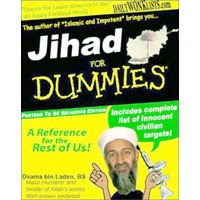 One of the strengths of the Jihadists terrorist networks, their decentralised and spontaneous nature, is also one of their weaknesses. There appears to be no recruitment standards or admission criteria or any other mechanism for screening out the indiscreet and those prone to big talk.
The fact that idiot David Hicks got into Al Qaeda and the Taleban in Afghanistan indicates that they seem to be not in any way suspicious of infiltration.
What the jihadists who bought “Islam for Dummies” tell us about radicalisation
10 Sep 2014 1 Comment
in economics, economics of crime, labour economics, occupational choice Tags: economics of oppositional identities, Jihadists, Terrorism is an occupational choice

Sarwar and Ahmed, who pleaded guilty to terrorism offences, purchased Islam for Dummies and The Koran for Dummies. MI5’s behavioural science unit found that
“far from being religious zealots, a large number of those involved in terrorism do not practise their faith regularly. Many lack religious literacy and could . . . be regarded as religious novices.” The analysts concluded that “a well-established religious identity actually protects against violent radicalisation”
Most evidence point to moral outrage, disaffection, peer pressure, the search for a new identity, for a sense of belonging and purpose as drivers of radicalisation. Anthropologist Scott Atran pointed out in testimony to the US Senate in March 2010:
“. . . what inspires the most lethal terrorists in the world today is not so much the Quran or religious teachings as a thrilling cause and call to action that promises glory and esteem in the eyes of friends, and through friends, eternal respect and remembrance in the wider world”. He described wannabe jihadists as “bored, underemployed, overqualified and underwhelmed” young men for whom “jihad is an egalitarian, equal-opportunity employer . . . thrilling, glorious and cool”.
Chris Morris, the writer and director of the 2010 black comedy Four Lions – which satirised the ignorance, incompetence and sheer banality of British Muslim jihadists – said:
Terrorism is about ideology, but it’s also about berks.
 Utopia, you are standing in it!
Recent Comments