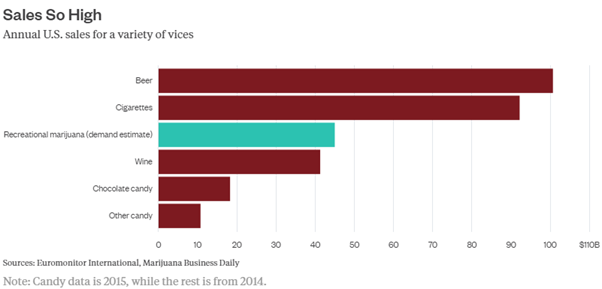
How big are the vice industries?
01 Jun 2016 Leave a comment
in economics of regulation, financial economics, health economics Tags: alcohol regulation, economics of smoking, entrepreneurial alertness, marijuana decriminalisation
Price Plays an Important Role in Smoking
26 May 2016 Leave a comment
in applied price theory, health economics Tags: Ban-it left, economics of smoking, metals and preferences, nanny state, rational addiction, rational irrationality, tobacco taxation
Different forms of tobacco were tax differently in the USA from 2009. Tobacco taxation is the only time that the Ban-it Left left believes in supply-side economics and the economics of rational addiction.
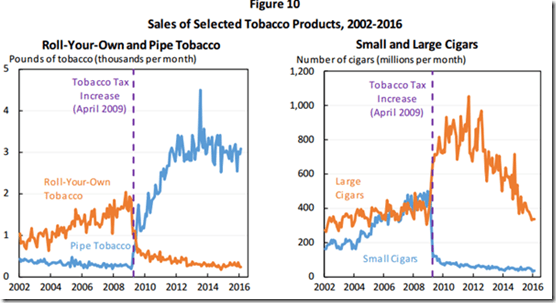
Source: Jason Furman speaking at the World Bank via Incentives in Action – Marginal REVOLUTION.
E-cigarettes as a way of reducing obesity?
23 Apr 2016 Leave a comment
in economics of regulation, health economics Tags: E-cigarettes, economics of obesity, economics of smoking, expressive voting, meddlesome preferences, nanny state, rational irrationality
One of the many interesting things that Maori Party MP Marama Fox said at a panel discussion for the launch of the New Zealand Initiative’s Health of the State report was that the Maori women she knew who smoked did so out of stress relief.
It is also well known that there is a weight gain after stopping smoking. If people cannot smoke because of higher taxes but still need to have an outlet for their stress, they look elsewhere and seek comfort in food.

Source: Weight Gain After Quitting Smoking – Quit Smoking Community.
This is before you consider the general pleasure seeking aspect of smoking. Some people find smoking pleasurable; I find it disgusting.
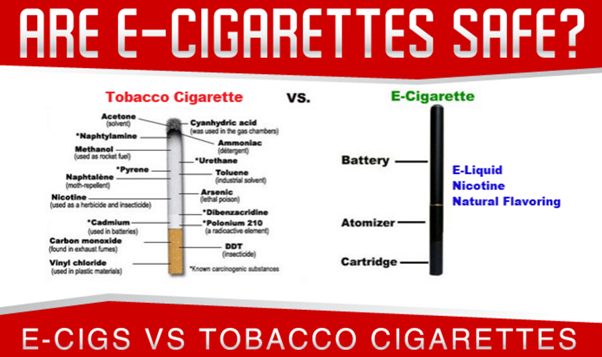
This suggests to me that the restrictions on E-cigarettes are the worst of both worlds. If people are going to smoke, you may as well let them have access to a technology that is safer.

Instead, the do-gooders prefer to put an extra bullet in the chamber as smokers play Russian roulette.
#MorganFoundation errors about @nzinitiative’s Health of the State – part 1
22 Apr 2016 3 Comments
in economics of information, economics of regulation, health economics, law and economics, politics - New Zealand Tags: Aaron Director, alcohol regulation, economics of obesity, economics of prohibition, economics of smoking, meddlesome preferences, Morgan Foundation, nanny state
The Greens have joined that Morgan Foundation in playing the man rather than the ball on the recently published report of the New Zealand Initiative on sin taxes. Green Party health spokesperson Kevin Hague said:
The New Zealand Initiative cares more about junk-food barons’ bottom lines than it cares about Kiwis who are getting sick and dying because of obesity-related illnesses
The Morgan Foundation was just as keen to argue that their opponents on sin taxes are both ignorant and steeped in moral turpitude as a way of avoiding substantive argument:
The New Zealand Initiative are not interested in reducing obesity, or preventing the looming diabetes crisis where 1 in 3 Kiwis will have the disease. They make no attempt to understand the causes, and don’t propose any way to deal with these issues…
Is there no room for honest disagreement and different views on the ability of further government intervention to be a net benefit? As Aaron Director said:
Laissez-faire is no more than a slogan in defence of the proposition that every extension of state activity should be examined under the presumption of error.
One of the specific claims by the Morgan Foundation that seems to be in error is:
In fact, the report seems devoid of any research outside a narrow economic focus. The food industry has funded an enormous amount of psychological research on how to influence people to eat more junk food through packaging, advertising, product placement etc, much of which is publicly available, but which the New Zealand Institute has roundly ignored. Ironic, given that they funded by the same organisations that funded this psychological research.
The Food industry’s own research shows our choices are hugely influenced by the environment that surrounds us, but the New Zealand Institute conveniently prefers to cling to the oversimplification that we are all rational economic units – known as homo economicus.
The report of the New Zealand Initiative has a nice discussion of the limitations of rationality which did not weigh as heavily as it should in the critique by the Morgan Foundation part of which is in the snapshot below:

Source: Jenesa Jeram, The Health of the State, The New Zealand Initiative ( April 2016, p.10).
Dukes cigarettes: Norman Gunston – Australian TV commercial
09 Apr 2016 Leave a comment
in economics, health economics, television Tags: economics of smoking, Norman Gunston
Somehow this commercial was supposed to make smoking more appealing.
#EarthHour 10 great public health achievements of 20th century #HAH2016
19 Mar 2016 Leave a comment
in applied welfare economics, economic history, health economics Tags: economics of smoking, fluoridation, public health, The Great Escape, vaccines
The impact of changes in behaviour on life expectancy since 1960
25 Feb 2016 Leave a comment
in economic history, health economics Tags: economics of obesity, economics of smoking, life expectancies, offsetting behaviour, The Great Escape
British e-cigarette usage by current smoking status
21 Feb 2016 Leave a comment
in economics of regulation, health economics Tags: economics of smoking, meddlesome preferences, nanny state
The majority of smokers try an e-cigarette. To the extent to which an e-cigarette is a gateway drug to giving up smoking, that is important development.

Source: Office of National Statistics, E-cigarette use in Great Britain, 2015.
British e-cigarette usage, 2015
20 Feb 2016 Leave a comment
in economics of regulation, health economics Tags: economics of smoking, meddlesome preferences, nanny state
A many young people have tried an e-cigarette or have used one in the past.

Source: Office of National Statistics, E-cigarette use in Great Britain, 2015.
The rise and fall of smoking, 1920-2010
13 Feb 2016 Leave a comment
in economic history, health economics Tags: economics of smoking

Teen smoking rates in one and two parent households in USA, UK, Canada, Germany, France, Italy and Scandinavia
23 Dec 2015 Leave a comment
in health economics Tags: economics of smoking, single mothers, single parents
Not only do smoking rates differ greatly across the Atlantic and the English Channel, the influence of a single parent household seems to be large in the Anglo-Saxon countries but much less important elsewhere.
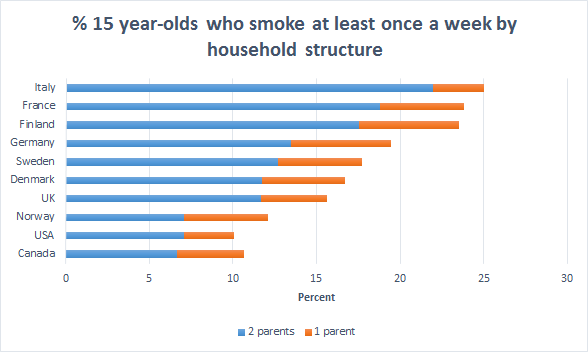
Source: OECD Family Database.
Teenage smoking rates by family affluence in the USA, Germany, France, Canada and UK
22 Dec 2015 Leave a comment
in health economics, politics - USA Tags: economics of smoking
Not only are there large differences in teen smoking rates by family affluence in North America, there are large differences in teen smoking rates between across the Atlantic and the English Channel.
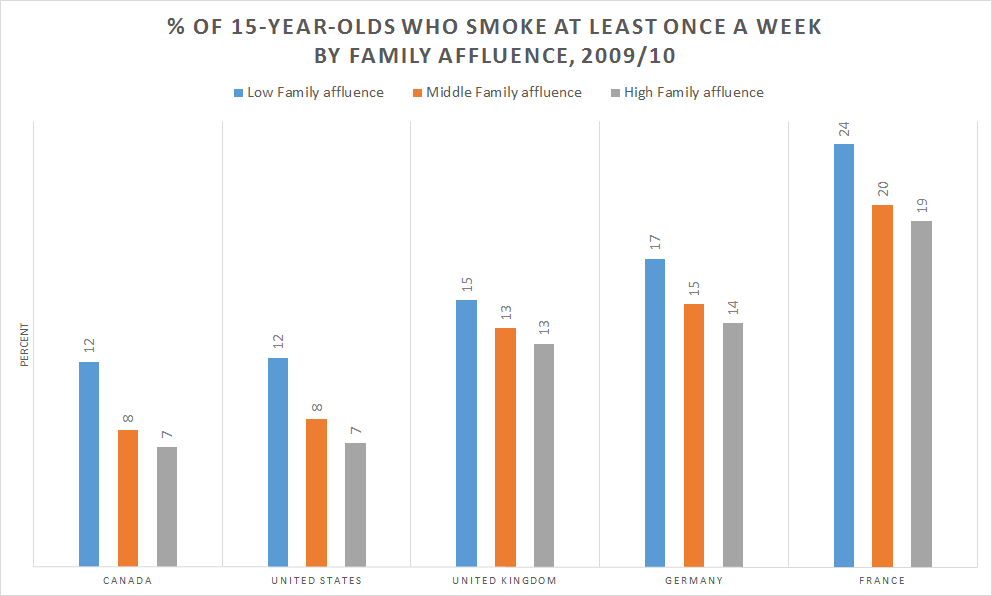
Source: OECD Family Database – OECD.
Smoking and lung cancer in the USA
07 Nov 2015 Leave a comment
in economic history, health economics Tags: economics of smoking, meddlesome preferences, nanny state
@MaxCRoser Actually did an update to 2010, but still same message http://t.co/R3Euppxhtq—
Bjorn Lomborg (@BjornLomborg) April 16, 2015
 Utopia, you are standing in it!
Recent Comments