Income by educational attainment in the USA
10 May 2015 Leave a comment
in economics of education, human capital, labour economics, labour supply, occupational choice Tags: College premium, education premium, labour demographics
New Zealand is on top of the world for education spending
08 May 2015 Leave a comment
in economics of education, politics - New Zealand Tags: College premium, education premium, schools
#Education expenditure in selected OECD countries –
1st NZ 21.6%
statista.com/chart/3398/whi… http://t.co/xgoHKsjNxu—
Statista (@StatistaCharts) April 20, 2015
College graduates don’t really notice recessions
02 May 2015 Leave a comment
in business cycles, economics of education, great recession, human capital, labour economics, macroeconomics, occupational choice, politics - USA, unemployment Tags: College premium, education premium, labour demographics
Our monthly update on the question: should I stay in school? blogs.wsj.com/economics/2015… http://t.co/IaVxoAJmqe—
Josh Zumbrun (@JoshZumbrun) April 03, 2015
The payoff from investing in education is large in developing countries
30 Apr 2015 Leave a comment
in development economics, economics of education, growth disasters, growth miracles Tags: College premium, education premium, educational attainment
Should everybody go to college? Could everybody go to college?
22 Apr 2015 Leave a comment
in economics of education, human capital, labour economics, labour supply, occupational choice Tags: College premium, economics of personality traits, education premium, IQ
New Zealand spends a lot in education for a pretty average education premium in return
15 Apr 2015 Leave a comment
in economics of education, human capital, labour economics Tags: College premium, education premium, graduate premium
#Education makes up 12.9% of public #spending in OECD area; how does your country compare? bit.ly/1ang3Rj http://t.co/cUgf7fnj8F—
(@OECD) April 13, 2015

@OECD More college grads nationally= a smaller wage premium for young workers bit.ly/1rJ8bz9 #highereducation http://t.co/IWjetA6znw—
Dr. Eugene Kowch (@ekowch) September 17, 2014
Whitlam’s curse – How higher education drives inequality among the bottom 99%
30 Mar 2015 Leave a comment
in economics of education, human capital, labour economics, labour supply, occupational choice, politics - Australia, politics - USA Tags: David Autor, education premium, Gough Whitlam, top 1%
Gough Whitlam abolished tuition fees at Australian universities in 1972. The idea was to reduce inequality. He entrenched it instead, and gave a flying start to those of already above-average talents.
David Autor in a recent paper has illustrated how the gap between the highly educated and the less educated is growing at a far faster rate than the gap between the top 1% in the bottom 99% in the USA. David Autor argues that
a single minded focus on the top 1% can be counterproductive given that the changes to the other 99% have been more economically significant.

- since the early 1980s, the earnings gap between workers with a high school degree and those with a college education has become four times greater than the shift in income during the same period to the very top from the 99%.
- Between 1979 and 2012, the gap in median annual earnings between households of high-school educated workers and households with college-educated ones expanded from $30,298 to $58,249, or by roughly $28,000.
- If the incomes of the bottom 99% are grown at the same pace as the top 1% their incomes would have increased by $7000 per household.
Autor argues that the growth of skill differentials among the other 99% is more consequential than the rise of the 1% for the welfare of most citizens.

via How Education Drives Inequality Among the 99% – Real Time Economics – WSJ.
The key driver of inequality is…
08 Mar 2015 Leave a comment
in economics of education, human capital, labour economics, poverty and inequality Tags: education premium

The Upside of Income Inequality » Gary Becker and Kevin Murphy
01 Feb 2015 Leave a comment
in economics of education, human capital, labour economics, liberalism, occupational choice, poverty and inequality Tags: education premium, educational attainment, graduate premium, The Great Enrichment


The top 10% are a bunch of bludgers in New Zealand too
16 Dec 2014 Leave a comment
in economics of education, income redistribution, politics - Australia, politics - New Zealand, politics - USA Tags: education premium, top 1%
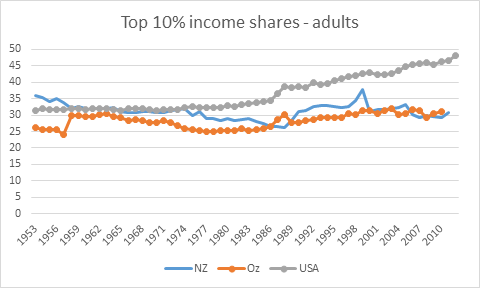
Source: topincomes-parisschoolofeconomics
One reason why the top 10% in New Zealand have been a pretty ordinary lot compared to the USA is New Zealand’s university graduate premium – the college premium as it is known in the USA – is at the very bottom of the OECD ladder at about 18% – rock bottom 32nd out of 32 – the wooden spoon.
The College premium in the USA is about 64%, as shown in the OECD data below from OECD Education at Glance. Naturally, this high College premium in the USA should show up in well educated, highly skilled people earning a lot more than those that don’t go to college and don’t go to graduate school.
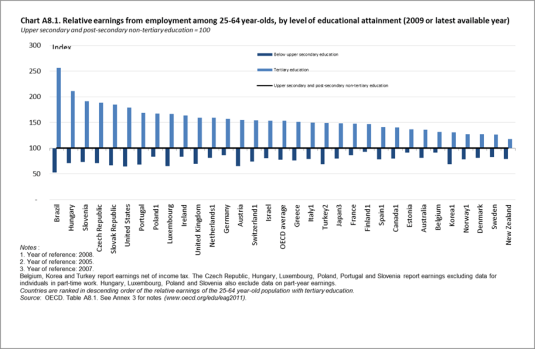
Stats link: http://dx.doi.org/10.1787/888932460515
Little wonder that the USA top 10% are breaking away from the pack. This slow increase in the income share of the top 10% since the early 1970s coincided with large numbers, including many more women in long duration professional degrees, going to university.
Prior to the mid-1970s, the College premium in the USA had been falling for about a decade because of large numbers of people going on to College and many of these two graduate school to get a draft deferment.
People married younger then so by the time people were at the end of College or graduate school, they were usually married with children and got of further draft deferment and aged out of the draft system.
 Utopia, you are standing in it!
Recent Comments