The Centre for American Progress recently published an excellent survey of the costs to employers of hiring and training new recruits. As the paper notes:
it is costly to replace workers because of the productivity losses when someone leaves a job, the costs of hiring and training a new employee, and the slower productivity until the new employee gets up to speed in their new job.
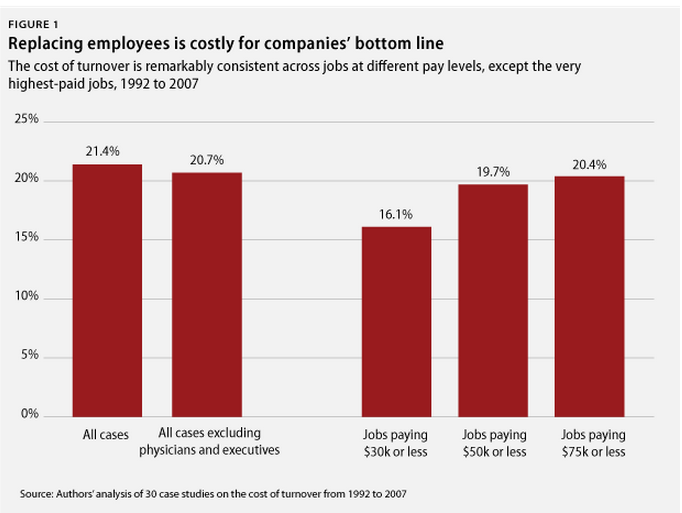
Our analysis reviews 30 case studies in 11 research papers published between 1992 and 2007 that provide estimates of the cost of turnover, finding that businesses spend about one-fifth of an employee’s annual salary to replace that worker.
The purpose of the research published by the Centre for American Progress was to argue there were large costs to employers from replacing even low paid workers and there are a workplace policies such as paid family leave and workplace flexibility will reduce these job turnover costs to employers.
Similar arguments are used to justify a living wage on efficiency grade wage grounds. A living wage would reduce job turnover and therefore the costs to employers of job turnover in the jobs.
The research published by the Centre for American Progress also illustrates the bargaining power of workers. Employers who failed to treat workers fairly and pay them the going wage risk an increase in job quit rates. These large costs of job turnover have been carefully documented by the Centre for American Progress.
Beyond jobs data: Industries w/ better pay have lower worker turnover rates equitablegrowth.org/news/looking-b… http://t.co/gug33EbYy3—
Equitable Growth (@equitablegrowth) July 03, 2015
Employers incur fixed costs of employment when they recruit and train new employees. These recruits must be expected to stay long enough to work sufficient hours for the firm to expect to recover these investments (Oi (1962, 1983a, 1990), Idson and Oi (1999), Hutchens (2010), Hutchens and Grace-Martin (2006)).
These costs are fixed costs because they do not vary with how many hours the employee works or with how long an employee stays with their employer. These fixed employment costs must be recouped over the expected job tenure of the employee with the firm. Employers will not hire an additional worker unless they anticipate recovering the costs of doing do including fixed employment costs and other overheads.
Central to arguments such as by Richard Epstein for employment at will is the threat of the employee to quit imposes a real cost on employers which the employer will seek to avoid by treating their employees well.
The best way to prevent exploitation of workers is to make hiring and firing easy, facilitate new entry by firms into all markets and promote full employment – a worker with other available job opportunities is difficult to exploit.
With large fixed costs of recruitment and training, employers cannot afford to behave whimsically if they wish to survive in competition with the rival firms with more competitive wage and employment policies.
By the same token, the large fixed costs of employment documented by the Centre for American Progress illustrate the large investments employers must risk to recruit a new employee.
If this large investment in recruitment doesn’t turn out well, but is difficult to get out of because of strict employment laws, employers will be more reluctant in the first instance to risk this investment because they are risking several months wages in fixed costs of employment. As Richard Epstein explained:
A second great advantage of the at-will system is that it supplies an informal method of bonding that keeps both sides in line.
The employer who tries to take advantage of the employee by altering working conditions for the worse will be met by the threat to quit, for now the deal is worth less to the employee than the wage received.
So long as markets are competitive the switching costs will be relatively low – lower in fact than they are in a highly regulated world where employers have to think twice before taking on a worker whom they may be unable to fire if things do not work out.
Yet on the other side, the employee who takes it easy on the job is faced with dismissal because he is no longer worth his wages.
But even here management will hesitate to dismiss for good reasons. One is the very substantial costs of recruiting and training a replacement who might or might not turn out to be better than the worker who was dismissed. The second is that unjust dismissals could induce other workers to leave while the going is good, thereby compounding the problem of recruitment and retention.
The Centre for American Progress was good enough to document the very substantial costs of recruiting and training a replacement employee. As the Centre for American Progress explained in their paper, employers have every reason to protect their investments in training and recruitment by minimising job turnover costs.

 Utopia, you are standing in it!
Recent Comments