Does the Equilibrium Model Work?
27 Oct 2016 Leave a comment
in applied price theory, history of economic thought, industrial organisation Tags: experimental economics
Richard Posner on behavioural economics and its real-world applications
19 Nov 2014 Leave a comment
in applied price theory, behavioural economics, comparative institutional analysis, labour economics, occupational choice, Richard Posner Tags: behavioural economics, experimental economics, Richard Posner

The central role of the market in the emergence of fairness
04 Jul 2014 Leave a comment
in applied price theory, liberalism Tags: evolution of cooperation, experimental economics, game theory

Experiments in psychology and economics find that in market societies all over the world, a substantial fraction of individuals will be fair in anonymous interactions and will punish unfairness more.
In the dictator game , when played by participants in industrialized societies, the dictators gave away nearly half the prize — a division that probably sounds fair.

As for the noble savage, not corrupted by civilization and symbolising humanity’s innate goodness.what they do in the dictator game: hunter- gatherers, foragers, pastoralists and subsistence farmers were much less willing to share the prize, apparently because they didn’t feel an obligation to someone they didn’t know.

Success in the market correlates with the following characteristics:
- Be nice: cooperate, never be the first to defect.
- Be provocable: return defection for defection, cooperation for cooperation.
- Don’t be envious:: be fair with your partner.
- Don’t be too clever: or, don’t try to be tricky.
Being nice and not too clever or too tricky becomes ingrained to success in market societies so that is why in market societies people are fair in the dictator game as a matter of course.
Why drop your standards because some silly experiment by psychologists? After all, you may have future dealings with members of the experiment, and even if you don’t, such as in anonymous computer-based experiments of interaction, you don’t want risk picking up bad habits just to please a psychologist.
Adam Smith, in his study of religion, noticed was that religious sects with stricter codes of honesty and intense mutual monitoring by co-congregants for the slightest moral lapses proliferated in cities. Many successful businessmen belonged to these strict religions. These highly religious businessmen were successful in their businesses because they were looked upon by the public as reliable trading partners in a time of weak law enforcement.
Smith viewed participation in religion as a rational device by which individuals enhanced the value of their human capital.These businessmen did not know that this was profit maximising but the businessmen with religious backgrounds slowly gained market share over rivals that had less efficient ways of communicating both their reliability and that their personal honesty was under daily scrutiny.
Ethnic minorities are advantaged in the same way in business. Because of their extensive social interactions with each other because of their language, religious practices and inter-marriage, the costs of bad business behaviours are much higher due to the risk of social ostracism by everyone you know. This greater trustworthiness gives them a cost advantage in the marketplace even though they may be unaware of its source.
The rationality postulate is under attack from the other people are stupid fallacy-updated
14 Apr 2014 Leave a comment
in applied price theory, behavioural economics, economics of crime, entrepreneurship, experimental economics, industrial organisation, market efficiency, survivor principle Tags: behavioural economics, crime and punishment, criminal deterrence, experimental economics, Gordon Tullock, token economies, Vernon Smith
The rationality postulate is under attack from the other people are stupid fallacy: not you, not me, not present company, of course, but the nameless them over there; the perpetually baffled, every man jack of them.
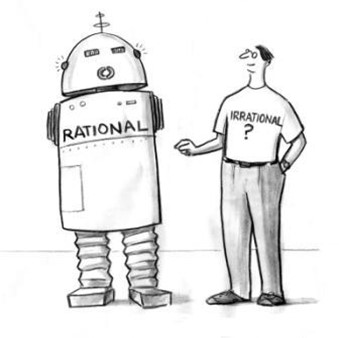
These no-hopers are deemed competent to vote and DRIVE CARS, but they cannot get their head around a credit card. How the them over there find their way to work every morning must be a mystery to behavioural economists. One summary of behavioural labour economics is this:
The key empirical findings from field research in behavioural economics imply that individuals can make systematic errors or be put off by complexity, that they procrastinate, and that they hold non-standard preferences and non-standard beliefs
I found the chapter in Tullock and McKenzie’s book on token economies in mental hospitals to be most enlightening.
The tokens were for spending money at the hospital canteen and trips to town and other privileges. They were earned by keeping you and your area clean and helping out with chores.
The first token economies were for chronic, treatment-resistant psychotic inpatients.
In 1977, a major study, still considered a landmark, successfully showed the superiority of a token economy compared to the standard treatments. Despite this success, token economies disappeared from the 1980s on.
Experiments which would now be unethical showed that the occupational choices and labour supply of certified lunatics responded to incentives in the normal, predictable way.
For example, tokens were withdrawn for helping clean halls and common areas. The changes in occupational choice and reductions in labour supply was immediate and as predicted by standard economics.
Some patients would steal the tokens for other patients, so the token individually marked, and the thefts almost stopped. Crime must pay even for criminally insane inpatients.
Kagel reported that:
The results have not varied with any identifiable trait or characteristic of the subjects of the token economy – age, IQ, educational level, length of hospitalization, or type of diagnosis.

Behavioural economics is an excellent example of how engaging in John S. Mill’s truth that engaging with people who are partly or totally wrong sharpens your arguments, improves their presentation and deepens your analysis.
People have a better understanding of rationality such as through the work of Vernon Smith on ecological and constructivist rationality and of how people deal with human frailties and correct error through specialisation, exchange and learning.
- George Stigler in his Existence of X-inefficiency paper opposed attributing behaviour to errors because error can explain everything so it explains nothing until we have a theory of error.
- Kirzner in “X–Inefficiency, Error and the Scope for Entrepreneurship” wrote that error is pervasive in economic processes. Rational Misesian human actors are human enough to err.
What is inefficient about the world, said Kirzner, is at each instant, an opportunity for improvements, in one way or another and is yet simply not yet noticed. The lure of pure entrepreneurial profits harnesses the systematic elimination of errors and points the way to the market generated institutions necessary for steady social improvements to emerge. Brand names are an obvious example of an institution to overcome doubts about product quality. Middle-men and brokers specialise in performing much of the calculation burdens in their markets.
Many still compare real-world marketplaces to idealised regulation overseen by bureaucrats free of the very biases they are nudging us along to overcome. There are real constraints that limit the options available to fix what are seen as problems to be solved.
Vernon Smith when asked about behavioural economics, wondered how so cognitively flawed a creature made it out of the caves. Vernon Smith argued that the answer had a lot to do with the institutions that emerged to overcome human limitations:
Markets are about recognizing that information is dispersed in all social systems and that the problem of society is to find, devise, and discover institutions that incentivize and enable people to make the right decisions without anyone having to tell them what to do.
Smith and Hayek both posit that market institutions rather than individuals bear the primary cognitive burden in coordinating economic activity. To quote Vernon Smith:
What we learn from experiments is that any group of people can walk into a room, be incentivized with a well-defined private economic environment, have the rules of the oral double auction explained to them for the first time, and they can make a market that usually converges to a competitive equilibrium, and is 100 per cent efficient—they maximize the gains from exchange—within two or three repetitions of a trading period.
Yet knowledge is dispersed, with no participant informed of market supply and demand, or even understanding what that means.
This strikingly demonstrates what Adam Smith called ”a certain propensity in human nature . . . to truck, barter, and exchange one thing for another”
These double oral auctions converged to the competitive price even with as few as three or four sellers with neither the buyers nor sellers knowing anything of the values or costs of others in the market. Price-taking behaviour was not necessary to reach these competitive outcomes.
Behavioural economics is a clumsy way of discussing the pervasiveness of errors because insufficient attention is paid to decentralised, emergent market processes that correct them, often long ago.
 Utopia, you are standing in it!
Recent Comments