The GOP problem: Voters think raising the minimum wage is more pro-growth than business tax cuts http://t.co/Ciziz4xsMy
— James Pethokoukis ⏩️⤴️ (@JimPethokoukis) May 9, 2014
Celebrating humanity's flourishing through the spread of capitalism and the rule of law
24 May 2015 Leave a comment
24 May 2015 Leave a comment
in economics of regulation, politics - Australia, politics - New Zealand, politics - USA, urban economics Tags: British general election, expressive voting, offsetting behaviour, rational irrationality, rent controls, The fatal conceit, UK politics, unintended consequences
17 May 2015 Leave a comment
in macroeconomics, minimum wage, politics - USA Tags: 2016 presidential election, economics fallacies, expressive voting, quackery, rational irrationality, Robert Reich
15 May 2015 Leave a comment
in Public Choice Tags: British general election, expressive voting, rational irrationality
A lovely defence of London and champagne socialism, by @hugorifkind spectator.co.uk/columnists/hug… via @HKesvani http://t.co/GonSadNFva—
Tom Chivers (@TomChivers) May 14, 2015
12 May 2015 Leave a comment
A 2012 poll found that 62% of British voters agreed that “politicians tell lies all the time” econ.st/1ANQGPS http://t.co/3oH0FsHf0V—
The Economist (@EconEconomics) May 10, 2015
10 May 2015 Leave a comment
in Public Choice Tags: European politics, expressive voting, rational ignorance, rational irrationality, right-wing populism
Is Europe drifting to the right? Right-wing populists and Euro sceptics are gaining traction statista.com/markets/8/topi… http://t.co/iMNmXZ9Skl—
Statista (@StatistaCharts) November 20, 2013
09 May 2015 1 Comment
in constitutional political economy, politics - Australia, politics - New Zealand, politics - USA, Public Choice Tags: British general election, British Labour Party, expressive voting, Leftover Left, New Zealand general election, New Zealand Labour Party, opinion polls, rational ignorance, rational irrationality, UK politics, voter demographics
The go left young man, go left strategy is a view of many in the Labour Party in New Zealand, Australia and the UK is if they present hard left policies to the electorate, they will mobilise many more votes from people who are currently don’t vote or who are mysteriously parking their vote with the Tory party or other centre parties.

Michael Foot’s attempt at to get out shy Labour voters with a hard left campaign in the 1983 British general election, which lead to his manifesto earning the title the longest suicide note in history.
The eight foot high stone monolith Ed Miliband planned to erect in the garden of number 10 Downing Street, if he could get planning permission, was dubbed the heaviest suicide note in history.
The heaviest suicide note in history http://t.co/1xDQlnnWU7—
Phil Rodgers (@PhilRodgers) May 03, 2015
The New Zealand Labour Party went left at the 2014 general election and for its troubles earned its lowest party vote since the party was founded in 1919.
Central to the strategy of the New Zealand Labour Party in the 2014 general election was mobilising non-voters in their working-class electorates.

The median voter theorem be dammed! The New Zealand Labour Party in the 2014 general election honestly believed that hard left policies would induce these non-voters to vote.
These non-voters are called the missing million by the New Zealand left . Almost one million people did not vote in 2014; 250,683 were not enrolled, while 694,120 were enrolled but did not turn out to vote. Many of these voters were thought to be just parking their vote pending the arrival of true believers to lead the Labour Party if the Left over Left is to be believed! Many of these non-voters are younger voters who generally are more likely to vote left.
The Internet – Mana party also spent an immense amount of the $4 million donated by Kim.com in trying to turn out to the youth voter as well.
Chris Trotter was wise and prophetic on go left young man, go left and the shy Labour voters will come:
[T]he Left has been given an extraordinary opportunity to prove that it still has something to offer New Zealand …..
If Cunliffe and McCarten are allowed to fail, the Right of the Labour Party and their fellow travellers in the broader labour movement (all the people who worked so hard to prevent Cunliffe rising to the leadership) will say:
“Well, you got your wish. You elected a leader pledged to take Labour to the Left. And just look what happened. Middle New Zealand ran screaming into the arms of John Key and Labour ended up with a [pitiful] Party Vote …
So don’t you dare try peddling that ‘If we build a left-wing Labour Party they will come’ line ever again! You did – and they didn’t.”
Be in no doubt that this will happen – just as it did in the years after the British Labour Party’s crushing defeat in the general election of 1983. The Labour Right called Labour’s socialist manifesto “the longest suicide note in history” and the long-march towards Blairism … began.
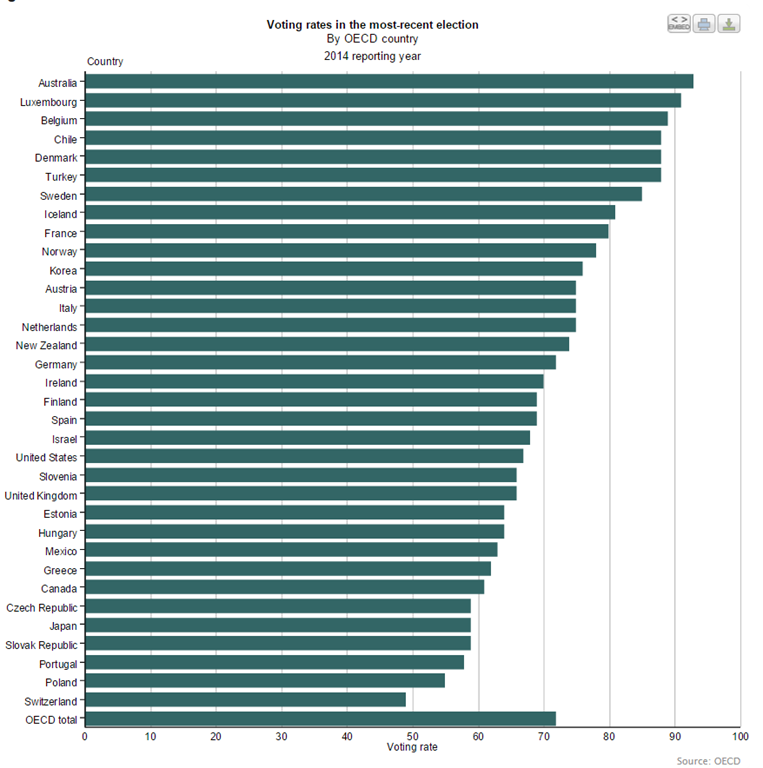
The most obvious flaw in the missing million and non-voter argument where they are waiting for true believers to offer hard left policies is a countries with much higher rates of voter turnouts and compulsory voting are not more likely to have left-wing governments.
There is much more evidence of shy Tory voters rather than shy Labour voters.
Shy Tory voters is a name invented by British opinion polling companies in the 1990s. The share of the vote won by the Tories in elections was substantially higher than the proportion of people in opinion polls who said they would vote for the party.
The final opinion polls gave the Tories between 38% and 39% of the vote – 1% behind the Labour Party. In the final results, the Conservatives had a lead of 7.6% over Labour and won their fourth successive general election.
Because of this turnout of shy Tory voters, the Tories won 3 million more votes than the Labour Party. This 14 million votes was more votes than they or any other British political party is ever won in a British general election, breaking the record set by Labour in 1951.
In a subsequent marketing research port, it was found a significant number of Tory party supporters refusing to disclose their voting intentions both the opinion poll companies, and exit polls.
This shy Tory factor is so large that opinion poll companies attempt to account for it in the weights they assign in their opinion polls surveys.
One of the explanations behind the turnout of the shy Tory vote in the 2015 British general election was a fear that a Labour Party minority government would be be holding to the hard left Scottish nationalists.
A number of British media commentators talked about running into many ordinary people expressing that very fear and they were undecided voters. About 20% of British voters were undecided on the eve the election, which is an unusually high amount.
Ironically, Neil Kinnock, the British Labour Party leader in the 1992 election, warned of a shy Tory factor a few days before the current British general election.
Tony Blair was much blunter a few months before the British general election about the relevance of the median voter theorem to British politics and the future of the British Labour Party. The most electorally successful politician in Labour history said that May’s general election risks becomes one in which a
traditional left-wing party competes with a traditional right-wing party, with the traditional result.
Asked by the Economist magazine if he meant that the Conservatives would win the general election in those circumstances, Mr Blair replied: “Yes, that is what happens.”
The post-mortem by the New Statesman called “10 delusions about the Labour defeat to watch out for” equally blunt about the role of Tony Blair in rescuing British labour from permanent oblivion:
Many of your drinks will be prompted by variations on this perennial theme. Labour accepted the austerity narrative. Labour weren’t green enough. Labour weren’t radical (which has somehow come to be used as a synonym for left-wing).
Given that the last time Labour won an election without Tony Blair was 1974 it’s hard to believe people still think the answer is to move left. But people still do. I sort of love these people for their stubbornness. But I don’t want them picking the next leader.
The shy Tory vote stirred by the fears of a hard left government happened in the 2014 New Zealand general election. On the Monday night for the election that Saturday, the Internet – Mana party board had an hour of television for their Moment of Truth. This included Edward Snowden beamed in from Moscow put forward a whole range of bizarre conspiratorial theories about NASA surveillance of New Zealand and analysis by base in Auckland.
David Farrar reported that in Tuesday night opinion polling, the National party’s party vote rose from 44% to 47%. In the subsequent general election that Saturday, the national party led all night for the first time. It won as many votes as it did in the previous election when it was expected to lose votes because the national party government was going into its third term.
One reason for shy Tory voters is expressive voting. People obtain more sense of identity by proclaiming themselves to be a left-wing voter than they do from saying that they are a right-wing voter.
The expressive aspect of voting is “action that is undertaken for its own sake rather than to bring about particular consequences” (Brennan and Lomasky 1993, 25). There is almost never a causal connection between an individual’s vote and the associated electoral outcome. Hence, a vote is not disciplined by opportunity cost.

With no opportunity cost of how you vote in terms of deciding the outcome, people vote expressively to affirm their identity. Voting is about who and what you boo and cheer for and how you present yourself to the world.

Through the fatal conceit and the pretence to knowledge, a left-wing vote allows people to identify with doing good and changing the world for the better. No point in voting that way if you don’t go around thumping your chest proclaiming yourself as doing good for others by voting Left including telling the truth to polling companies.
09 May 2015 Leave a comment
in politics - New Zealand, politics - USA, Richard Posner, Public Choice, constitutional political economy Tags: compulsory voting, expressive voting, Internet, Joseph Schumpeter, Labour Party, nanny state, non-voting, rational ignorance, rational irrationality, Richard Posner, Robert McCormick, Robert Tollison, voter demographics, William F. Shughart

Extraordinary. Political junkies don’t realise that there are people out there that have better things to do with their lives than take an interest in politics.

It’s a free society. They are free not to listen, not engage and not vote for anyone. Free speech includes a right not to speak and not to participate. If you disappointed with that political apathy, put forward a party platform that excites them enough to vote. Get out the vote by being worth voting for.
What is more extraordinary is a party that claims to speak for the working class first opposed obligations on welfare benefit receipt regarding looking more intensively for work and paying court fines and so forth, but it is happy to use the same provisions for their own political advantage because they are on the ropes. The New Zealand Labour Party’s party vote at the last election was at record low levels. It is still at the same level in the opinion polls.
As for voter registration drives in working-class electorates, the New Zealand Labour Party has no large donors apart from unions. The reason for this is as their former president, Mike Williams says " if you don’t ask, you don’t get ".
Voter registration is voluntary in the USA and for all its flaws, and I think there are far fewer than people say, Richard Posner could still give an excellent defence of political participation in the USA:
American democracy enables the adult population, at very little cost in time, money or distraction from private pursuits commercial or otherwise, to punish at least the flagrant mistakes and misfeasances of officialdom, to assure an orderly succession of at least minimally competent officials, to generate feedback to the officials concerning the consequences of their policies, to prevent officials from (or punish them for) entirely ignoring the interests of the governed, and to prevent serious misalignments between government action and public opinion.
Too many as Richard Posner has argued well in his writing want to remake democracy with the faculty workshop as their model. Such deliberation has demanding requirements for popular participation in the democratic process, including a high level of knowledge and analytical sophistication and an absence, or at least severe curtailment, of self-interested motives.
Much empirical research demonstrates that citizens have astonishingly low levels of political knowledge. Most lack very basic knowledge of political parties, candidates and issues, much less the sophisticated knowledge necessary to meet the demands of a deliberative democracy.
One reason for these low levels of political knowledge is a large number of people are simply not interested in politics even if they have the time to take an interest.
Because of this political ignorance and apathy, Posner championed Schumpeter’s view of democracy. Schumpeter disputed the widely held view that democracy was a process by which the electorate identified the common good, and that politicians carried this out:
Schumpeter’s theory of democratic participation is that voters have the ability to replace political leaders through periodic elections. Citizens do have sufficient knowledge and sophistication to vote out leaders who are performing poorly or contrary to their wishes.
The power of the electorate to turn elected officials out of office at the next election gives elected officials an incentive to adopt policies that do not outrage public opinion and administer the policies with some minimum honesty and competence.
The outcome of Schumpeterian democracy in the 20th century, where governments are voted out rather than voted in, is that most of modern public spending is income transfers that grew to the levels they are because of support from the average voter.
Political parties on the Left and Right that delivered efficient increments and stream-linings in the size and shape of government were elected, and then thrown out from time to time, in turn, because they became tired and flabby or just plain out of touch.
I wouldn’t revel too much on the higher voter turnout as as yet another saviour on the horizon to bring the Left over Left back from the political wilderness. The most votes ever won by a political party in the UK was 14 million by John Major’s Tory party in 1992 when the shy Tories came out in force to re-elected the incumbent government much the surprise of the opinion polls.
Higher voter turnout is not necessarily always a good thing in terms of good governance. William Shughart found that voter participation increases in gubernatorial elections in the USA when evidence of corruption mounts. Candidates, political parties, and interest groups have incentives to invest in mobilising support on Election Day.
Those who stand to gain from being office through their corruption invest considerable resources in mobilising voter turnout that is in their favour. Corruption increase the value of winning public office and strengthens the demand-side efforts to build winning coalitions.
In a prophetic article at the dawn of the Internet, Robert Tollison, William F. Shughart II, and Robert McCormick wrote in 1999 about how voting is not the only way in which people express their political preferences effectively.
Observers of American democracy complain that voter turnout and voter registration are low and had been low from 50 years. Tollison, Shughart, and McCormick reminded these critics that:
Voters now have more political information available to them than ever before, and they are no longer confined to expressing their political preferences at the polls once every two or four years.
Newly available technologies have lowered voters’ costs of becoming informed about political issues and of communicating with their political representatives.
Voter registration and voter turnout is lowest among young people who also happen to be the most Internet savvy. This is not surprising considered the prophetic observation of Tollison, Shughart, and McCormick in 1999 that:
What is more important, the opinions voters form on the basis of the information available to them can be communicated to policy makers rapidly and effectively.
E-mails, faxes, and phone calls are substitutes for ballots. By the time an election rolls around, politicians and policy makers already know what the voters think and, hence, their wishes have already been incorporated into laws and policies.
Tollison, Shughart, and McCormick asked why vote when you have already influenced political outcomes through alternative means between elections such as social media:
Having affected policy outcomes, voters are naturally less interested in voting on candidates. Low turnout rates on election day may paradoxically be evidence of greater voter participation in the political process.
In fact, we are fast approaching a return to the town meeting, where individuals register their preferences on specific policy proposals and politicians can assess the intensities of those preferences by reading their e-mail. Indeed, voters can vote as much and as often as they want in the information age.
It is not surprising therefore in this prophetic article that Tollison, Shughart, and McCormick predicted that politicians would pay close regard to social media, and if they did, democracy works:
As long as politicians are good agents who read their faxes and e-mails correctly, voters will correspondingly have less need to go to the polls.
Voters will vote only when their representatives ignore their electronic opinions. Indeed, that is the implicit threat.
And because voters don’t have to go to the barricades to voice those opinions, political discourse should become more civil and political protests less frequent and disruptive.
HT: Nick Kearney
08 May 2015 Leave a comment
in Public Choice Tags: British general election, expressive voting, median voter theorem, rational ignorance, rational irrationality, shy Tories
Guardian front page 3.30am http://t.co/tzh0xgqlKq—
Paul johnson (@paul__johnson) May 08, 2015
08 May 2015 Leave a comment
in Public Choice Tags: British general election, expressive voting, opinion polls, voter demographics
Forget 1992. “Shy Tories” may be about to cause their biggest upset yet econ.st/1bBNvEs #GE2015 http://t.co/FpGM8UE0PI—
The Economist (@EconEconomics) May 08, 2015
07 May 2015 Leave a comment
in politics, Public Choice Tags: British general election, expressive voting, rational ignorance, rational irrationality, voter demographics

Peter Kellner’s final seat prediction – y-g.co/1byCjZ4 http://t.co/TFmg7vFUf0—
(@YouGov) May 06, 2015
via General Election 2015: Britain prepares to go to the polls | Daily Mail Online.
Celebrating humanity's flourishing through the spread of capitalism and the rule of law
Scholarly commentary on law, economics, and more
Beatrice Cherrier's blog
Celebrating humanity's flourishing through the spread of capitalism and the rule of law
Celebrating humanity's flourishing through the spread of capitalism and the rule of law
Celebrating humanity's flourishing through the spread of capitalism and the rule of law
Why Evolution is True is a blog written by Jerry Coyne, centered on evolution and biology but also dealing with diverse topics like politics, culture, and cats.
Celebrating humanity's flourishing through the spread of capitalism and the rule of law
Celebrating humanity's flourishing through the spread of capitalism and the rule of law
A rural perspective with a blue tint by Ele Ludemann
DPF's Kiwiblog - Fomenting Happy Mischief since 2003
Celebrating humanity's flourishing through the spread of capitalism and the rule of law
The world's most viewed site on global warming and climate change
Tim Harding's writings on rationality, informal logic and skepticism
A window into Doc Freiberger's library
Let's examine hard decisions!
Commentary on monetary policy in the spirit of R. G. Hawtrey
Thoughts on public policy and the media
Celebrating humanity's flourishing through the spread of capitalism and the rule of law
Politics and the economy
A blog (primarily) on Canadian and Commonwealth political history and institutions
Reading between the lines, and underneath the hype.
Economics, and such stuff as dreams are made on
"The British constitution has always been puzzling, and always will be." --Queen Elizabeth II
Celebrating humanity's flourishing through the spread of capitalism and the rule of law
Celebrating humanity's flourishing through the spread of capitalism and the rule of law
WORLD WAR II, MUSIC, HISTORY, HOLOCAUST
Undisciplined scholar, recovering academic
Celebrating humanity's flourishing through the spread of capitalism and the rule of law
Res ipsa loquitur - The thing itself speaks
Celebrating humanity's flourishing through the spread of capitalism and the rule of law
Researching the House of Commons, 1832-1868
Articles and research from the History of Parliament Trust
Reflections on books and art
Posts on the History of Law, Crime, and Justice
Celebrating humanity's flourishing through the spread of capitalism and the rule of law
Exploring the Monarchs of Europe
Cutting edge science you can dice with
Small Steps Toward A Much Better World
“We do not believe any group of men adequate enough or wise enough to operate without scrutiny or without criticism. We know that the only way to avoid error is to detect it, that the only way to detect it is to be free to inquire. We know that in secrecy error undetected will flourish and subvert”. - J Robert Oppenheimer.
The truth about the great wind power fraud - we're not here to debate the wind industry, we're here to destroy it.
Celebrating humanity's flourishing through the spread of capitalism and the rule of law
Celebrating humanity's flourishing through the spread of capitalism and the rule of law
Economics, public policy, monetary policy, financial regulation, with a New Zealand perspective
Celebrating humanity's flourishing through the spread of capitalism and the rule of law
Restraining Government in America and Around the World

 Utopia, you are standing in it!
Recent Comments