Real and Pseudo-Financial Crises, the Chinese share market crash and Anna Schwartz

If we could take time out from the breathless journalism about the Chinese stock market, which some people may have heard of before this week, it’s crash should be seen through the lens that Anna Schwartz developed in 1987 of a pseudo financial crisis and a financial crisis.

Her paper is written at the same time as the 1987 stock market crash. On financial crises, Anna Schwartz said:
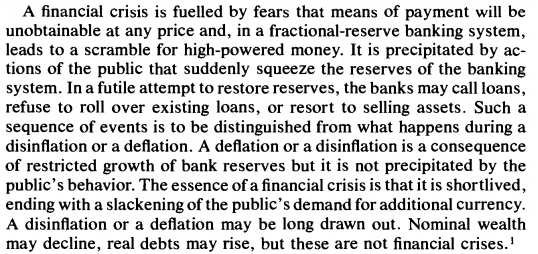
image

As for those pseudo financial crises, she said:
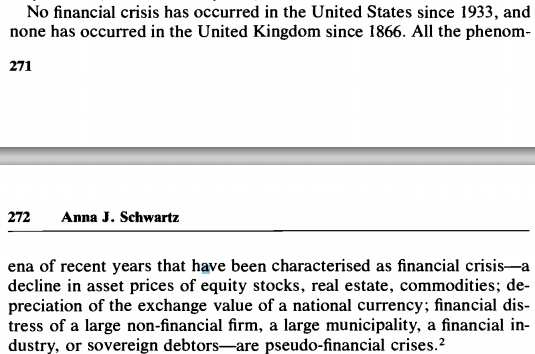
image

Schwartz’s principal concern with regard to pseudo financial crisis was:

proposals to deal with pseudo-financial crises is the perpetuation of policies that promote inflation and waste of economic resources

As we are talking about the Chinese stock market, Anna Schwartz also wrote about the concepts of real systemic international risk and and pseudo international systemic risk.

Once again, and as with pseudo financial crises and real financial crises, what distinguishes real systemic international risk and pseudo international systemic risk is a threat to the payment system. The threat of bank runs, which can easily be eliminated through lender of last resort facilities:
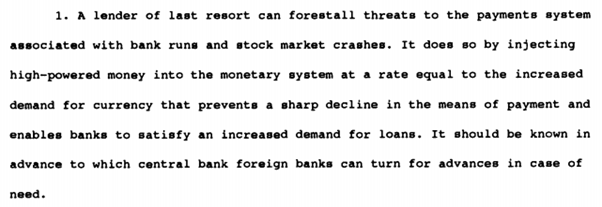
image

As always it is about the security of the payments system – of avoiding bank runs, not private losses:
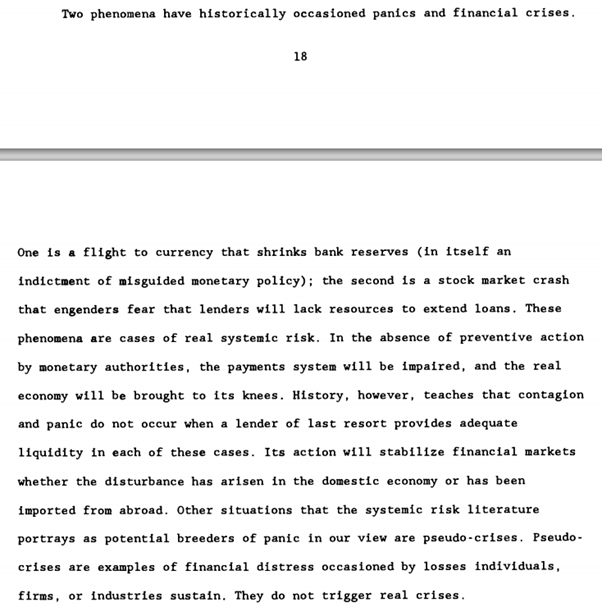
image

The lesson for the day is that when people start panicking about the economy or the stock market or international markets, don’t go to a macroeconomist for advice, go to a monetary historian. They have seen it all before.

2014 Homer Jones Memorial Lecture – Robert E. Lucas Jr.

The first part of his lecture discusses how the Fed can influence inflation and financial stability.

Central banks can control inflation. Can central banks maintain economic stability’s financial stability? This is still an open question as to whether central banks can do that. The quantity theory of money makes certain sharp predictions about monetary neutrality which are well borne out by the cross country evidence.

In the second part of this lecture, Lucas discusses how central banks around the world have used inflation targeting to keep inflation under control.

What is the Fed to do with the stable relationship between money and prices? Inflation targeting is superior to a fixed growth monetary supply growth rule. This always pushes policy in the direction of the inflation rate you want. Central banks around the world have succeeded in keeping inflation low by explicitly or implicitly targeting the inflation rate.

In the last part of his lecture, Lucas discusses financial crises. he agrees with Gary Gordon’s analysis that 2008 financial crisis was a run on Repo. A run on liquid assets accepted as money because they can be so quickly changed into money. The effective money supply shrank drastically when there was a run on these liquid assets.

Lucas favoured the Diamond and Dybvig of bank runs as panics. The logic of that model applies to the Repo markets now was well as to the banking system. How to extend Glass–Steagall Act type regulation of bank portfolios to the Repo market is a question for future research.

Inflation targeting is working well but the lender of last resort function is yet to be fully understood.

Note: The Diamond-Dybvig view is that bank runs are inherent to the liquidity transformation carried out by banks. A bank transforms illiquid assets into liquid liabilities, subject to withdrawal.

Because of this maturity mismatch, if depositors suspect that others will run on the bank, it is optimal for each depositor to run to the bank to withdraw his or her deposit before the assets are exhausted. The bank run is not driven by some decline in the fundamentals of the bank. Depositors are spooked for some reason, panic, and attempt to withdraw their funds before others get in first. In this case, the provision of deposit insurance and lender of last resort facilities reassures depositors and stems the bank run

In the Kareken and Wallace model of bank runs, deposit insurance is problematic because of the incentives it gives to deposit taking institutions that are insured to take much greater risks. When there is deposit insurance, depositors don’t care about the greater risk in the portfolios of their banks. The greater risk taking leads to higher returns at no extra cost because if these risky investments do fail, the deposit insurance covers their losses

It is therefore necessary to regulate the portfolio of insured banks to ensure that they do not do this. That is the great dilemma for banking regulation because quasi-banks and other liquidity transformation intermediaries such as a Repo market spring up just outside the regulatory net.

Image

Bassett, Brash & Hide

Celebrating humanity's flourishing through the spread of capitalism and the rule of law

Truth on the Market

Scholarly commentary on law, economics, and more

The Undercover Historian

Beatrice Cherrier's blog

Matua Kahurangi

Celebrating humanity's flourishing through the spread of capitalism and the rule of law

Temple of Sociology

Celebrating humanity's flourishing through the spread of capitalism and the rule of law

Velvet Glove, Iron Fist

Celebrating humanity's flourishing through the spread of capitalism and the rule of law

Why Evolution Is True

Why Evolution is True is a blog written by Jerry Coyne, centered on evolution and biology but also dealing with diverse topics like politics, culture, and cats.

Down to Earth Kiwi

Celebrating humanity's flourishing through the spread of capitalism and the rule of law

NoTricksZone

Celebrating humanity's flourishing through the spread of capitalism and the rule of law

Homepaddock

A rural perspective with a blue tint by Ele Ludemann

Kiwiblog

DPF's Kiwiblog - Fomenting Happy Mischief since 2003

The Dangerous Economist

Celebrating humanity's flourishing through the spread of capitalism and the rule of law

Watts Up With That?

The world's most viewed site on global warming and climate change

The Logical Place

Tim Harding's writings on rationality, informal logic and skepticism

Doc's Books

A window into Doc Freiberger's library

The Risk-Monger

Let's examine hard decisions!

Uneasy Money

Commentary on monetary policy in the spirit of R. G. Hawtrey

Barrie Saunders

Thoughts on public policy and the media

Liberty Scott

Celebrating humanity's flourishing through the spread of capitalism and the rule of law

Point of Order

Politics and the economy

James Bowden's Blog

A blog (primarily) on Canadian and Commonwealth political history and institutions

Science Matters

Reading between the lines, and underneath the hype.

Peter Winsley

Economics, and such stuff as dreams are made on

A Venerable Puzzle

"The British constitution has always been puzzling, and always will be." --Queen Elizabeth II

The Antiplanner

Celebrating humanity's flourishing through the spread of capitalism and the rule of law

Bet On It

Celebrating humanity's flourishing through the spread of capitalism and the rule of law

History of Sorts

WORLD WAR II, MUSIC, HISTORY, HOLOCAUST

Roger Pielke Jr.

Undisciplined scholar, recovering academic

Offsetting Behaviour

Celebrating humanity's flourishing through the spread of capitalism and the rule of law

JONATHAN TURLEY

Res ipsa loquitur - The thing itself speaks

Conversable Economist

Celebrating humanity's flourishing through the spread of capitalism and the rule of law

The Victorian Commons

Researching the House of Commons, 1832-1868

The History of Parliament

Articles and research from the History of Parliament Trust

Books & Boots

Reflections on books and art

Legal History Miscellany

Posts on the History of Law, Crime, and Justice

Sex, Drugs and Economics

Celebrating humanity's flourishing through the spread of capitalism and the rule of law

European Royal History

Exploring the Monarchs of Europe

Tallbloke's Talkshop

Cutting edge science you can dice with

Marginal REVOLUTION

Small Steps Toward A Much Better World

NOT A LOT OF PEOPLE KNOW THAT

“We do not believe any group of men adequate enough or wise enough to operate without scrutiny or without criticism. We know that the only way to avoid error is to detect it, that the only way to detect it is to be free to inquire. We know that in secrecy error undetected will flourish and subvert”. - J Robert Oppenheimer.

STOP THESE THINGS

The truth about the great wind power fraud - we're not here to debate the wind industry, we're here to destroy it.

Lindsay Mitchell

Celebrating humanity's flourishing through the spread of capitalism and the rule of law

Alt-M

Celebrating humanity's flourishing through the spread of capitalism and the rule of law

croaking cassandra

Economics, public policy, monetary policy, financial regulation, with a New Zealand perspective

The Grumpy Economist

Celebrating humanity's flourishing through the spread of capitalism and the rule of law

International Liberty

Restraining Government in America and Around the World