16 Jun 2014
by Jim Rose
in macroeconomics
Tags: forecasting errors
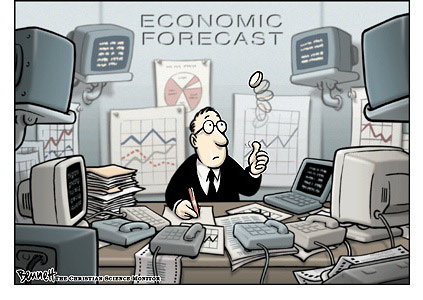
- Forecasts are conditional on a number of variables; there are important unresolved analytical differences about the operation of the economy; and large uncertainties about the size and timing of responses to macroeconomic changes. Shocks to the output, prices, employment and other variables are partly permanent and partly transitory.
- We have very little reliable information about the distribution of shocks or about how the distributions change over time. The same is true for the distribution of real and nominal shocks, of shocks to aggregate demand relative to aggregate supply and so on.
- Forecast errors arise from changes in the parameters in the model; mis-specification of the model, estimation uncertainty, mis-measurement of the initial conditions and error accumulation.
- Forecasting has had a turbulent history. Most early discussions argued against the forecasting in principle. Forecasting was not properly grounded in statistical theory, it presupposed that causation implies predictability and the forecast themselves were invalidated by the reactions of economic agents to them
Next Newer Entries
 Utopia, you are standing in it!
Recent Comments