
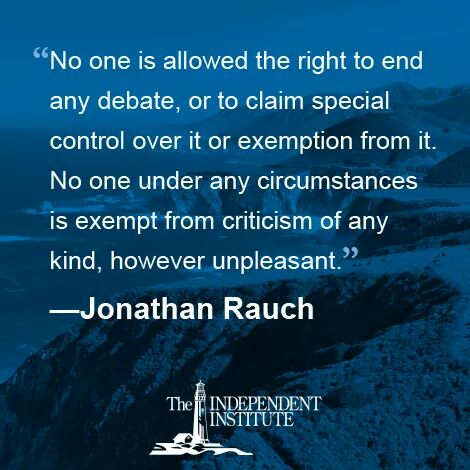
George Orwell on free speech
08 Jan 2015 Leave a comment
#truth http://t.co/9Oe6dqFXOP—
Learn Liberty (@LearnLiberty) December 05, 2014
In praise of anonymous political speech – the old-fashioned name for Internet trolls
08 Oct 2014 Leave a comment
in liberalism Tags: anonymous free speech, conjecture and refutation, free speech, the growth of knowledge, trolls
 The Federalist Papers were written by trolls. These trolls were James Madison, Alexander Hamilton and John Jay. They were not meek men: all three were founding fathers of the United States of America. All had a proven record of sticking their neck out when it really could be chopped off – hung from the gallows for treason against the British Crown as leaders of the American Revolution.
Why were James Madison, Alexander Hamilton and John Jay the modern day equivalent of Internet trolls? At the time of publication, the authorship of the Federalist essays was a closely guarded secret. To this day, who of the three wrote which essay is still unclear.
The publication of political tracts under pseudonyms was standard practice at the time of Madison, Hamilton and Jay. The purpose of the anonymity was to avoid personalities and personal attacks upon the authors.

Those who were disagreeing with an anonymous tract could not attack it by saying that the author was corrupt. Rather critics had to respond to the arguments made in the publication. A brilliant debating tactic.. This tactic is different from using anonymity to avoid arrest in unfree societies.
Much of the Left would be put out of business in terms of their political discourse about global warming if they couldn’t attack the author personally saying he is a lackey of multinational corporations and big carbon.

Imagine what the debate over global warming would be like if everyone had to contribute anonymously. People actually have to start debating the points made by the various sides rather than who their opponent used to work for, might want to work for in the future or might have accepted a small think tank donation or research grant from at some point in human history.
The identity of the speaker is an important component of many attempts to persuade, but the most effective advocates have sometimes opted for anonymity. Anonymous pamphlets, leaflets, brochures and even books have played an important role in the progress of mankind.
Anonymous authors do take the risk of being ignored by not signing their name. Anonymous pamphlets that attack the reputation of others or allege corruption and misconduct are far less credible than those carry the name of the authors.
This costing in credibility of choosing anonymity is even the case in the United States where defamation of public figures must pass a very high bar: shown that the false statement and defamatory statement is made with actual malice – knowledge of the falsity or reckless disregard for the truth.
A frequently cited 1995 Supreme Court ruling in McIntyre v. Ohio Elections Commission reads:
Protections for anonymous speech are vital to democratic discourse. Allowing dissenters to shield their identities frees them to express critical minority views…
Anonymity is a shield from the tyranny of the majority… It thus exemplifies the purpose behind the Bill of Rights and of the First Amendment in particular: to protect unpopular individuals from retaliation . . . at the hand of an intolerant society.
Identification of the author and fear of reprisal might deter perfectly peaceful discussions of public matters of importance. The anonymity may be motivated by fear of economic or official retaliation, by concern about social ostracism, or merely by a desire to preserve as much of one’s privacy as possible.
The most powerful form of political expression is undertaken anonymously and no one questions that anonymity. The secret ballot is a hard won right to vote one’s conscience without fear of retaliation and the need to explain to others for any reason no matter how curious they might be.
The right to remain anonymous may be abused when it shields fraudulent conduct. But political speech by its nature will sometimes have unpalatable consequences, but society accords greater weight to the value of free speech than to the dangers of its misuse.
HT: various Supreme Court opinions

Hate speech is still speech, and much of hate speech is the gauche expression of everyday ideas
12 Aug 2014 Leave a comment
in constitutional political economy, law and economics, liberalism Tags: free speech, hate speech, political correctness, trigger warning

A lot of polite political conversation is, on close inspection, hate speech but expressed with the manners your mother taught you. Well-brought up children can get their ideas across with just as much bite as the uncouth without going potty mouthed.
Now let’s think of religion: leaving to one side the hateful things religions say about each other, according to them religious types, we non-believers are supposed to burn in the Devil’s own private furnace. As I recall, Baptists believe that the Pope is the Antichrist and the mass is idolatry.

In an age of information overload, it is easy to fall back on our own prejudices and insulate ourselves with comforting opinions that reaffirm our core beliefs. the blogosphere forms into information cocoons and echo chambers. People can avoid the news and opinions they don’t want to hear.
The politically correct are often among the most uncouth. Some of the worst things said about Sarah Palin in 2008 cannot be repeated on a blog hoping to be safe to view at work.

Marxist ideologies even worse: it should have a trigger warning over the entire field because of a hurtful things it says about capitalists and their motivation.

Scorn, ridicule and satire is as welcome as a bee sting and is always controversial to some and continuously goes beyond the bounds of good taste and conventional manners. Scorn, ridicule and satire often shock people into reconsidering their world view.

In a court case about a particularly vile cartoon in Hustler about Jerry Falwell, the United States Supreme Court said:
Debate on public issues will not be uninhibited if the speaker must run the risk that it will be proved in court that he spoke out of hatred; even if he did speak out of hatred, utterances honestly believed contribute to the free interchange of ideas and the ascertainment of truth…
The appeal of the political cartoon or caricature is often based on exploitation of unfortunate physical traits or politically embarrassing events – an exploitation often calculated to injure the feelings of the subject of the portrayal.
A good example of using shock value to make a point is the Ohio strip club that held a topless counter-protest outside a church they were attempting to shut down.

The target of their counter-protest was a church that spent the last nine years protesting outside their club seeking to shut it down. You must admire both side’s determination.
Advertising and free speech: the best test of truth is the power of the thought to get itself accepted in the competition of the market
08 Aug 2014 Leave a comment


Free Speech for Me – But Not for Thee
15 Mar 2014 Leave a comment
in liberalism Tags: culture wars, free speech, hate speech laws, Nat Hentoff, political correctness
Nat Hentoff wrote a nice book in 1992; Free Speech for Me–But Not for Thee: How the American Left and Right Relentlessly Censor Each Other. It was about those from the right and the left who would suppress the rights of individuals to voice opposing viewpoints.

Hentoff deals with traditional censors–religious fundamentalists and political right-wingers–but does not neglect the new ones, e.g. feminists who tried to prevent a pro-life women’s group from participating in Yale University’s Women’s Center.
Hentoff discusses everything from college campuses preventing non-politically correct subjects from being discussed to censorship he faced while writing his columns. Then there were hate-speech ordinances, speech codes on campus, flag-burning amendments to the Constitution, and feminist-Moral Majority coalitions to ban pornography.
A group of librarians in New York suggested that the following label be put on particular books in school libraries, as needed: “WARNING: It has been determined that these materials are sex-stereotyped and may limit your sense of freedom and choice”.
He especially criticizes “civil libertarians” who use the First Amendment as protection of things they like and then ignore it when trying to ban what they hate (racist writing, sexual harassment, etc.). Voltaire would be turning in his grave.
Rather than set up left-wing straw men to knock down, Hentoff details stories of how the Left censors, while acknowledging that the Right censors. Since conservatives admit their intentions, they are not as dangerous as the duplicitous people on the Left.
Free speech has been on balance an ally of those seeking change. Change in any complex system ultimately depends on the ability of outsiders to challenge accepted views and reigning institutions. Without a strong guarantee of freedom of speech, there is no effective right to challenge the status quo.
British Columbia has an extremely broad hate speech law that prohibits the publication of any statement that “indicates” discrimination or is “likely” to expose a person or group or class of persons to hatred or contempt.
Professor Sunera Thobani of the University of British Columbia faced a hate crimes investigation after she delivered a vicious diatribe against American foreign policy. Thobani, a Marxist feminist and multiculturalist activist, remarked that Americans are “bloodthirsty, vengeful and calling for blood”.
The Canadian hate-crimes law was created to protect minority groups from hate speech. But in this case, it was invoked to protect Americans. Priceless.
 Utopia, you are standing in it!
Recent Comments