.
Celebrating humanity's flourishing through the spread of capitalism and the rule of law
26 Sep 2016 Leave a comment
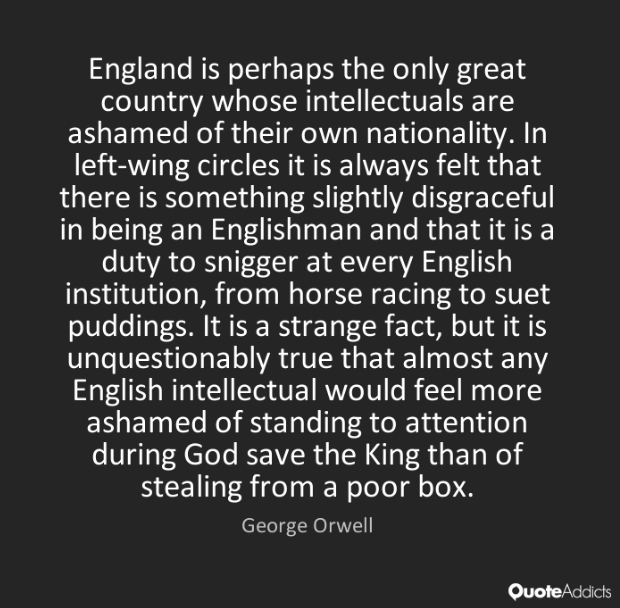
in liberalism, Marxist economics Tags: British politics, George Orwell, Leftover Left, New Left, Old Left, political correctness
.
24 Jul 2016 Leave a comment
in defence economics, politics - New Zealand, war and peace Tags: Cold War, game theory, George Orwell, nuclear free New Zealand, peace movements, war against terror
If the dilettantes at the end of the known world accomplished anything at all by declaring New Zealand nuclear free after 1984, anything at all, it was to prolong the Cold War, embolden Communist Russia and increase the chance of a nuclear exchange. As George Orwell said in 1941
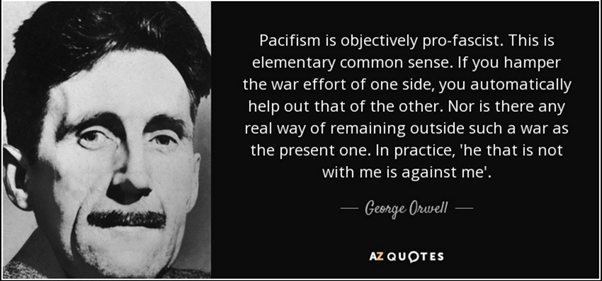
Pacifism is objectively pro-Fascist. This is elementary common sense. If you hamper the war effort of one side you automatically help that of the other. Nor is there any real way of remaining outside such a war as the present one. In practice, ‘he that is not with me is against me’.
The idea that you can somehow remain aloof from and superior to the struggle, while living on food which British sailors have to risk their lives to bring you, is a bourgeois illusion bred of money and security.
Mr Savage remarks that ‘according to this type of reasoning, a German or Japanese pacifist would be “objectively pro-British”.’ But of course he would be! That is why pacifist activities are not permitted in those countries (in both of them the penalty is, or can be, beheading) while both the Germans and the Japanese do all they can to encourage the spread of pacifism in British and American territories. The Germans even run a spurious ‘freedom’ station which serves out pacifist propaganda indistinguishable from that of the P.P.U. They would stimulate pacifism in Russia as well if they could, but in that case they have tougher babies to deal with.
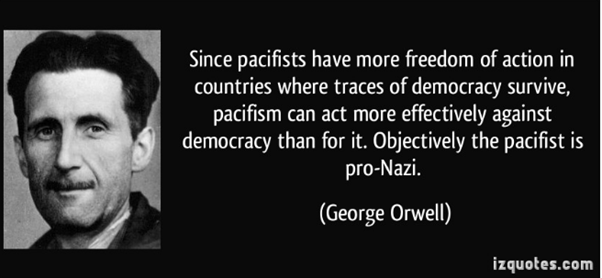
In so far as it takes effect at all, pacifist propaganda can only be effective against those countries where a certain amount of freedom of speech is still permitted; in other words it is helpful to totalitarianism.
There is a strong peace movement in the 1930s that undermined rearmament at every point. Indeed, the then leader of the British Labour Party met with Hitler one afternoon with the aim of persuading him to become a Christian pacifist. He failed.
The slaughterhouse of World War I would certainly rest on the memory but Hitler gave them no choice but to rearm yet some on the Left would not accept this reality. The purpose of British foreign policy in the 1930s was to buy time to rearmament before the inevitable clash.
The pro-fascism of the peace movement continues to this day. To quote Michael Walzer
so many leftists rushed to the defense of civil liberties while refusing to acknowledge that the country faced real dangers–as if there was no need at all to balance security and freedom.
Maybe the right balance will emerge spontaneously from the clash of right-wing authoritarianism and left-wing absolutism, but it would be better practice for the left to figure out the right balance for itself, on its own; the effort would suggest a responsible politics and a real desire to exercise power, some day.
But what really marks the left, or a large part of it, is the bitterness that comes with abandoning any such desire. The alienation is radical.
How else can one understand the unwillingness of people who, after all, live here, and whose children and grandchildren live here, to join in a serious debate about how to protect the country against future terrorist attacks? There is a pathology in this unwillingness, and it has already done us great damage.
With one exception, democracies do not go to war with other democracies. There are plenty of undemocratic countries out there with dictators willing to have it go if they see weakness.
That is before you consider the suspicion that the Communist dictatorships had of other countries. In Tom Schelling’s view, many wars including World War 1 were the products of mutual alarm and unpredictable tests of will.
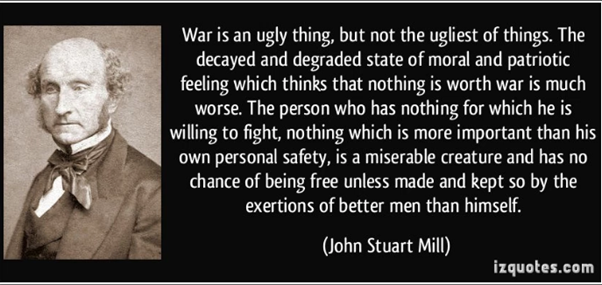
Robert Aumann argued well that the way to peace is like bargaining in a medieval bazaar. Never look too keen, and bargain long and hard. Aumann argues that:
If you are ready for war, you will not need to fight. If you cry ‘peace, peace,’ you will end up fighting… What brings war is that you signal weakness and concessions.
A nuclear free New Zealand signalled weakness and a willingness to make concessions. The peace movements across all democracies had the same effect.
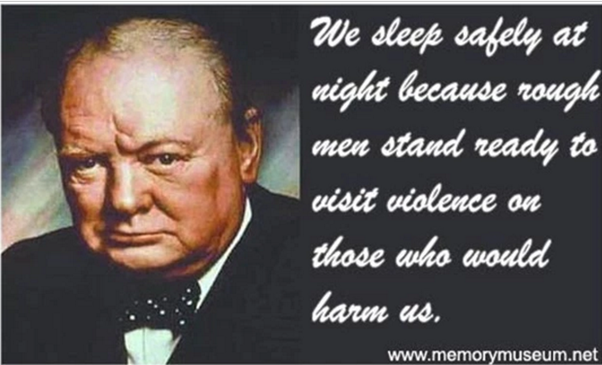
Disarmament increases the chances of war. Aumann gave the example of the Cold War of how their stockpiles of nuclear weapons and fleets of bombers prevented a hot war from starting:
In the long years of the cold war between the US and the Soviet Union, what prevented “hot” war was that bombers carrying nuclear weapons were in the air 24 hours a day, 365 days a year? Disarming would have led to war.
Peace activists are utterly clueless about what is discussed at peace talks. The ability to negotiate a credible peaceful settlement between sovereign states depends on:
Central to any peace talks is that any peace agreement is credible – it will hold and not will not be quickly broken:
A state would think that another state’s promise not to start a war is credible only if the other state would be better off by keeping its promise not to start a war than by breaking its promise.
Peace talks occur only when there something to bargain about. As James Fearon explained, there must be
a set of negotiated settlements that both sides prefer to fighting
That need for a bargaining range is the fundamental flaw of peace activists. When they call for peace talks, peace activists never explain what will be discussed in a world where everybody is not like them terms of good intentions.
What are the possible negotiated settlements that each both side will prefer to continue fighting? Diplomacy is about one side having some control over something the other side wants and this other side have something you want to exchange. In a war, the attacker thinks he can get what it wants to fighting for it.
If peace activists truly want peace, rather than victory for the other side, they must prepare for war including fortified borders so that the other side doesn’t dare cross them and start a war. A peace settlement depends upon the ability to divide the contested territory with or without fortified borders to make a settlement credible:
…despite the costs and risks of war, if a dispute is existential, or, more generally, if the whole of a contested territory is sufficiently more valuable than the sum of its parts, then a peaceful settlement is not possible.
A peaceful settlement of a territorial dispute, and especially a settlement that includes an agreement not to fortify the resulting border, also can be impossible if a state thinks, even if over optimistically, that by starting a war it would be able at a small cost to settle the dispute completely in its favour permanently.
03 Jun 2016 Leave a comment
in defence economics, liberalism, war and peace Tags: George Orwell, pacifism, World War II


19 Apr 2016 Leave a comment
in applied welfare economics, behavioural economics, constitutional political economy, development economics, economic history, growth disasters, growth miracles, P.T. Bauer, politics - USA, Public Choice Tags: 2016 presidential election, antiforeign buyers, George Orwell, living wage, rational irrationality, The fatal conceit, The pretense to knowledge
India tried that in the 1950s as part of its five-year plans. It did not work that well. Bauer said that in development economics there is a “need to restate the obvious.”
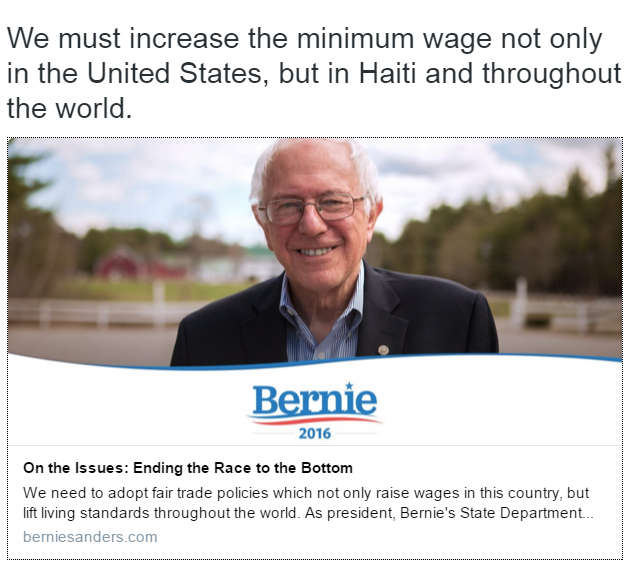
Source: Ending the Race to the Bottom – Bernie Sanders.
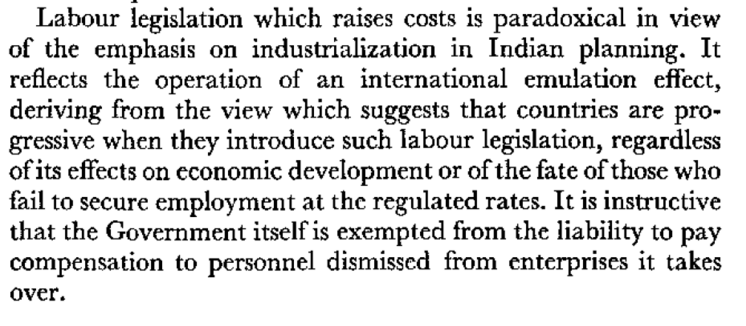
Source: Indian Economic Policy and Development – P. T. Bauer (1959) – Google Books
<p><img src="http://quotes.lifehack.org/media/quotes/quote-George-Orwell-we-have-now-sunk-to-a-depth-39424.png" /></p> <p>
21 Mar 2016 Leave a comment
in health economics, liberalism Tags: George Orwell, meddlesome preferences, nanny state, sugar tax, The fatal conceit
14 Nov 2015 Leave a comment
in defence economics, politics - Australia, politics - New Zealand, politics - USA, war and peace Tags: British politics, France, game theory, George Orwell, pacifism, Paris, war on terror
23 Jan 2015 2 Comments
08 Jan 2015 Leave a comment
#truth http://t.co/9Oe6dqFXOP—
Learn Liberty (@LearnLiberty) December 05, 2014
20 Mar 2014 2 Comments
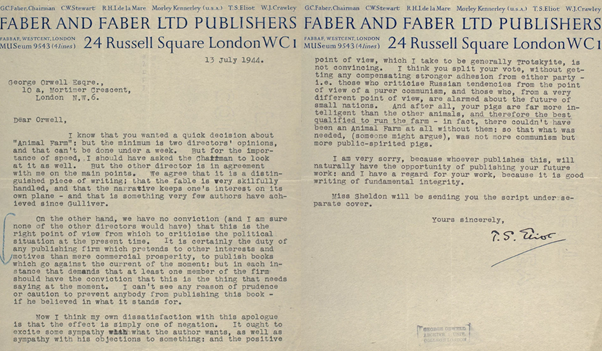
in development economics, economic growth, growth miracles, liberalism, P.T. Bauer Tags: Animal Farm, colonialism, development disasters, George Orwell, immiseration of the proletariat, inconvenient truths, Renegade liberals
George Orwell, in his proposed preface of Animal Farm, wrote of the “renegade liberal”. Renegade liberals glorify socialist experiments and disdain middle-class life despite their own pleasant circumstances.
Renegade liberals search the globe for outlaw states and revolutionary movements to support, who, of course, would ship their local versions of these renegade liberals straight to the camps as soon as they won power. Iran, Castro and Hugo Chávez are their latest rebels without a clue.
The revolutionary excesses of the new socialist or Anti-American regimes are excused as the misadventures of ‘liberals in a hurry’, who understandably lost patience with the slow pace of democratic reform. It is all in the name of liberating the proletariat from their misery or throwing off the dead hand of colonial rule.
How is the immiseration of the proletariat going these days?
I agree with G.A. Cohen when he argues that there is no group in advanced industrial societies united by:
To avoid the inconvenient truth of modern affluence and the move of so many of the proletariat into the middle class, renegade liberals search endlessly for under-developed countries so they can blame their poverty on capitalism.

When they visit them in solidarity, these renegade liberals should read the visa stamp: ‘people’s republic’ or ‘socialist republic’ is so frequently on it. It is still mandatory for all political parties in India to be committed to socialism.

Nearly all of Asia (where much of the world’s population lives) has undergone rapid and sustained economic and social progress because they became market economies, starting with the Asian Tigers and recently in previously socialist India and communist China. Latin America adopted the inward economic polices of the mid-20th century that renegade liberals praise so much and they became development disasters.
As the world embraced free market policies in the late 20th century, living standards rose sharply; life expectancy, education and democracy improved and absolute poverty declined. Xavier Sala-I-Martin and Maxim Pinkovskiy (2010) found that between 1970 and 2006, poverty fell by 86% in South Asia, 73% in Latin America, 39% in the Middle East and 20% in Africa. The percentage of people living on less than $1 a day (in PPP-adjusted 2000 dollars) fell from 26.8% in 1970 to 5.4% in 2006.
To go further, P.T. Bauer disputed the lack of development in British colonies. Bauer argued that much of British colonial Africa was transformed in the colonial period.

Before British rule, there were no rubber trees in Malaya, no cocoa trees in West Africa, no tea in India:
“…Much of British colonial Africa was transformed during the colonial period. In the Gold Coast there were about 3000 children at school in the early 1900s, whereas in the mid-1950s there were over half a million. In the early 1890s there were in the Gold Coast no railways or roads, but only a few jungle paths…
Before colonialism, Sub-Saharan Africa was a subsistence economy, because of colonialism it became a monetized economy.
Before colonialism, the absence of public security made investment impossible.
After it, investment flowed. So too was scientific agriculture introduced by colonial administrations, or by “foreign private organizations and persons under the comparative security of colonial rule, and usually in the face of formidable obstacles…
In British West Africa public security and health improved out of all recognition… peaceful travel became possible; slavery and slave trading and famine were practically eliminated, and the incidence of the worst diseases reduced..” (P.T. Bauer)
Some colonial powers were better than others. After 500 years of Portuguese rule in East Timor, in 1975, there was one road – to the governor’s house – and the phone number of the Australian consulate was 7! Portugal itself may have not been much better at that time too. Colonial masters are like parents. You must choose them well.
Celebrating humanity's flourishing through the spread of capitalism and the rule of law
Scholarly commentary on law, economics, and more
Beatrice Cherrier's blog
Celebrating humanity's flourishing through the spread of capitalism and the rule of law
Celebrating humanity's flourishing through the spread of capitalism and the rule of law
Celebrating humanity's flourishing through the spread of capitalism and the rule of law
Why Evolution is True is a blog written by Jerry Coyne, centered on evolution and biology but also dealing with diverse topics like politics, culture, and cats.
Celebrating humanity's flourishing through the spread of capitalism and the rule of law
Celebrating humanity's flourishing through the spread of capitalism and the rule of law
A rural perspective with a blue tint by Ele Ludemann
DPF's Kiwiblog - Fomenting Happy Mischief since 2003
Celebrating humanity's flourishing through the spread of capitalism and the rule of law
The world's most viewed site on global warming and climate change
Tim Harding's writings on rationality, informal logic and skepticism
A window into Doc Freiberger's library
Let's examine hard decisions!
Commentary on monetary policy in the spirit of R. G. Hawtrey
Thoughts on public policy and the media
Celebrating humanity's flourishing through the spread of capitalism and the rule of law
Politics and the economy
A blog (primarily) on Canadian and Commonwealth political history and institutions
Reading between the lines, and underneath the hype.
Economics, and such stuff as dreams are made on
"The British constitution has always been puzzling, and always will be." --Queen Elizabeth II
Celebrating humanity's flourishing through the spread of capitalism and the rule of law
Celebrating humanity's flourishing through the spread of capitalism and the rule of law
WORLD WAR II, MUSIC, HISTORY, HOLOCAUST
Undisciplined scholar, recovering academic
Celebrating humanity's flourishing through the spread of capitalism and the rule of law
Res ipsa loquitur - The thing itself speaks
Celebrating humanity's flourishing through the spread of capitalism and the rule of law
Researching the House of Commons, 1832-1868
Articles and research from the History of Parliament Trust
Reflections on books and art
Posts on the History of Law, Crime, and Justice
Celebrating humanity's flourishing through the spread of capitalism and the rule of law
Exploring the Monarchs of Europe
Cutting edge science you can dice with
Small Steps Toward A Much Better World
“We do not believe any group of men adequate enough or wise enough to operate without scrutiny or without criticism. We know that the only way to avoid error is to detect it, that the only way to detect it is to be free to inquire. We know that in secrecy error undetected will flourish and subvert”. - J Robert Oppenheimer.
The truth about the great wind power fraud - we're not here to debate the wind industry, we're here to destroy it.
Celebrating humanity's flourishing through the spread of capitalism and the rule of law
Celebrating humanity's flourishing through the spread of capitalism and the rule of law
Economics, public policy, monetary policy, financial regulation, with a New Zealand perspective
Celebrating humanity's flourishing through the spread of capitalism and the rule of law
Restraining Government in America and Around the World


 Utopia, you are standing in it!
Recent Comments