
HT: aei-ideas.org
Celebrating humanity's flourishing through the spread of capitalism and the rule of law
15 Jul 2014 Leave a comment
in economics of climate change, environmental economics, environmentalism, global warming Tags: an inconvenient truth, global warming
HT: aei-ideas.org
08 Jul 2014 Leave a comment
in environmentalism, global warming Tags: global cooling, global warming, Little ice age, Medieval warming period

The second IPCC report, in 1996, showed a 1,000-year graph demonstrating that temperature in the Middle Ages was warmer than today.
The 2001 report contained a new graph showing no medieval warm period. The technique they overweighed was one which the UN’s 1996 report had said was unsafe: measurement of tree-rings from bristlecone pines.
Scores of scientific papers show that the medieval warm period was real, global and up to 3C warmer than now.
29 Jun 2014 Leave a comment
in environmental economics, global warming Tags: cap and trade, carbon tax, emissions trading, global warming, rent seeking

25 Jun 2014 Leave a comment
in environmental economics, environmentalism, global warming Tags: global warming, Little ice age, Medieval warm period, River Thames frost fairs


This painting, dated 1684, by Abraham Hondius depicts one of many frost fairs on the River Thames during the Little Ice Age. River Thames frost fairs were held on its tideway in some winters between the 17th century and early 19th century.
20 Jun 2014 Leave a comment
in applied welfare economics, economics of climate change, Public Choice Tags: Gary Libecap, global commons, global environmental externalities, global warming, property rights, transaction costs
Gary D. Libecap, “Addressing Global Environmental Externalities: Transaction Costs Considerations.” Journal of Economic Literature (2014).

Abstract
Is there a way to understand why some global environmental externalities are addressed effectively, whereas others are not?
The transaction costs of defining the property rights to mitigation benefits and costs is a useful framework for such analysis. This approach views international cooperation as a contractual process among country leaders to assign those property rights.
Leaders cooperate when it serves domestic interests to do so. The demand for property rights comes from those who value and stand to gain from multilateral action.
Property rights are supplied by international agreements that specify resource access and use, assign costs and benefits including outlining the size and duration of compensating transfer payments, and determining who will pay and who will receive them.
Four factors raise the transaction costs of assigning property rights:
(i) scientific uncertainty regarding mitigation benefits and costs;
(ii) varying preferences and perceptions across heterogeneous populations;
(iii) asymmetric information; and
(iv) the extent of compliance and new entry.
These factors are used to examine the role of transaction costs in the establishment and allocation of property rights to provide globally valued national parks, implement the Convention on the International Trade in Endangered Species of Wild Fauna and Flora, execute the Montreal Protocol to manage emissions that damage the stratospheric ozone layer, set limits on harvest of highly-migratory ocean fish stocks, and control greenhouse gas emissions.
16 Jun 2014 Leave a comment
in economics of climate change, energy economics, environmental economics, global warming Tags: global warming, peak oil
 |
 |
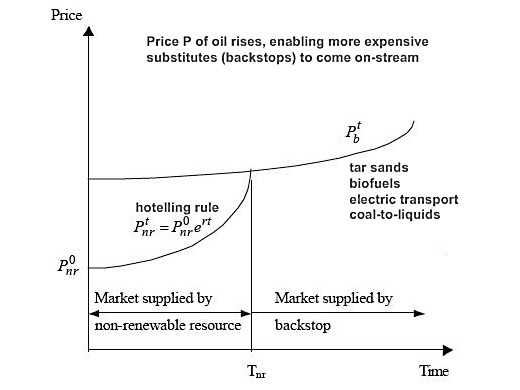
The environmental movement manages to believe in both peak oil – oil will run out in the next two decades or so – and global warming based on runaway carbon emissions for the rest of the century burning the increasingly expensive and increasingly scarce crude oil that had ran out a long time ago previously.
Global warming will solve itself as long as we are willing to accept that the environmental movement is genuine in its predictions about peak oil.
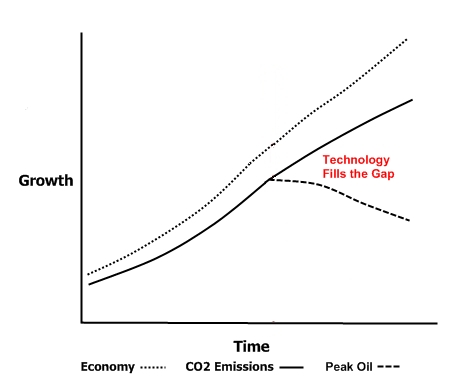
The ideal green share market portfolio would be made up of shares in green energy companies and futures contracts in the natural resources sector to take advantage of peak oil.
16 Jun 2014 Leave a comment
in environmental economics, global warming Tags: Bjørn Lomborg, global warming
HT: Cool It
16 Jun 2014 Leave a comment
in environmental economics, global warming Tags: global warming
American voters are more likely to fear global warming and take part in a campaign to stop it than they are climate change but the term is falling out of favour. Climate change is less frightening to voters than global warming:
climate change “sounds like you’re going from Pittsburgh to Fort Lauderdale.” While global warming has catastrophic connotations attached to it, climate change suggests a more controllable and less emotional challenge.


14 Jun 2014 Leave a comment
in economics of media and culture, environmental economics, environmentalism, global warming Tags: Fox News, global warming

HT: Cool It
11 Jun 2014 Leave a comment
in environmental economics, global warming Tags: Bjørn Lomborg, global warming, Richard Tol, Yes Prime Minister
Figure 1. The 14 estimates of the global economic impact of climate change, expressed as the welfare-equivalent income loss, as a functions of the increase in global mean temperature relative to today

Source: Richard Tol
The recent IPCC report found that the temperature rise that we are expected to see sometime around 2055-2080 will create a net cost of 0.2-2% of GDP. The UK, Japan, and the US wanted this rewritten or stricken.
The IPCC report showed that strong climate policies would be more expensive than claimed as well – costing upwards of 4% of GDP in 2030, 6% in 2050, and 11% by 2100.
Politicians tried to delete or change references to these high costs. British officials said they wanted such cost estimates cut because they “would give a boost to those who doubt action is needed.”
Sir Humphrey: No, no… Blurring issues is one of the basic Ministerial skills.
Jim: Oh, what are the others?
Sir Humphrey: Delaying decisions, dodging questions, juggling figures, bending facts and concealing errors.
and more from Yes Minister:
Seven ways of explaining away the fact that North-West region has saved £32 million while your department overspent:
a. They have changed their accounting system in the North-West.
b. Redrawn the boundaries, so that this year’s figures are not comparable.
c. The money was compensation for special extra expenditure of £16 million a year over the last two years, which has now stopped.
d. It is only a paper bag saving, so it will have to be spent next year.
e. A major expenditure is late in completion and therefore the region will be correspondingly over budget next year. (Known technically as phasing – Ed)
f. There has been an unforeseen but important shift in personnel and industries to other regions whose expenditure rose accordingly.
g. Some large projects were cancelled for reasons of economy early in the accounting period with the result that the expenditure was not incurred but the budget had already been allocated.
HT: Bjørn Lomborg and wattsupwiththat
Addendum

http://www.reddit.com/user/pnewell was good enough on the climate sceptics subreddit to point out that there is an updated version of the graph I posted at the top that includes corrections for gremlins in Richard Tol’s original paper.
His response reminds me of another passage from Yes Minister where prime ministerial candidate Jim Hacker is arguing with a European commission official about butter mountains.
Hacker said in one room a European commission official was subsidising people to produce milk, while in the next room another official is subsidising people to destroy it.
The response of this European union official was to say that was not true. Hacker asked how it was not true. He was told that the two officials were not on the same floor, the other official paying people to take the milk away is on the next floor.
The main body of my post is:
09 Jun 2014 2 Comments
in applied welfare economics, environmental economics, global warming, international economics, Thomas Schelling Tags: game theory, global warming
Tom Schelling has been involved with the global warming debate since chairing a commission on the subject for President Carter in 1980.
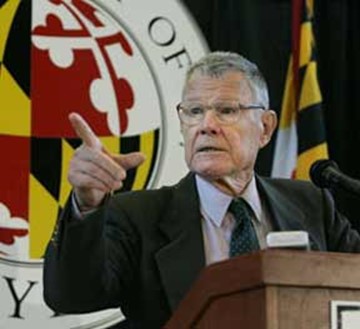
Schelling is an economist who specialises in strategy so he focuses on climate change as a bargaining problem. Schelling drew in his experiences with the negotiation of the Marshall Plan and NATO.
International agreements rarely work if they talk in terms of results. They work better if signatories promise to supply specific inputs – to perform specific actions now.
Individual NATO members did not, for example, promise to slow the Soviet invasion by 90 minutes if it happened after 1962.
NATO members promised to raise and train troops, procure equipment and supplies, and deploy these assets geographically.
All of these actions can be observed, estimated and compared quickly. The NATO treaty was a few pages long.
The Kyoto Protocol commitments were made not about actions but to results that were to be measured after more than a decade and several elections.
Climate treaties should promise to do certain actions now such as invest in R&D and develop carbon taxes that return the revenue as tax cuts. If the carbon tax revenue is fully refunded as tax cuts, less reliable countries, in particular, have an additional incentive to collect the carbon tax properly to keep their budget deficits under control.
Schelling is a genius at problem definition when he asked this
Suppose the kind of climate change expected between now and, say, 2080 had already taken place, since 1900.
Ask a seventy-five-year-old farm couple living on the same farm where they were born: would the change in the climate be among the most dramatic changes in either their farming or their lifestyle?
The answer most likely would be no. Changes from horses to tractors and from kerosene to electricity would be much more important.
Climate change would have made a vastly greater difference to the way people lived and earned their living in 1900 than today.
Today, little of our gross domestic product is produced outdoors, and therefore, little is susceptible to climate. Agriculture and forestry are less than 3 per cent of total output, and little else is much affected.
Even if agricultural productivity declined by a third over the next half-century, the per capita GNP we might have achieved by 2050 we would still achieve in 2051.
Considering that agricultural productivity in most parts of the world continues to improve (and that many crops may benefit directly from enhanced photosynthesis due to increased carbon dioxide), it is not at all certain that the net impact on agriculture will be negative or much noticed in the developed world.
As for the chances of a global treaty, Schelling has said:
The Chinese, Indonesians, or Bangladeshis are not going to divert resources from their own development to reduce the greenhouse effect, which is caused by the presence of carbon-based gases in the earth’s atmosphere.
This is a prediction, but it is also sound advice.
Their best defence against climate change and vulnerability to weather in general is their own development, reducing their reliance on agriculture and other such outdoor livelihoods.
Furthermore, they have immediate environmental problems — air and water pollution, poor sanitation, disease — that demand earlier attention.
Celebrating humanity's flourishing through the spread of capitalism and the rule of law
Scholarly commentary on law, economics, and more
Beatrice Cherrier's blog
Celebrating humanity's flourishing through the spread of capitalism and the rule of law
Celebrating humanity's flourishing through the spread of capitalism and the rule of law
Celebrating humanity's flourishing through the spread of capitalism and the rule of law
Why Evolution is True is a blog written by Jerry Coyne, centered on evolution and biology but also dealing with diverse topics like politics, culture, and cats.
Celebrating humanity's flourishing through the spread of capitalism and the rule of law
Celebrating humanity's flourishing through the spread of capitalism and the rule of law
A rural perspective with a blue tint by Ele Ludemann
DPF's Kiwiblog - Fomenting Happy Mischief since 2003
Celebrating humanity's flourishing through the spread of capitalism and the rule of law
The world's most viewed site on global warming and climate change
Tim Harding's writings on rationality, informal logic and skepticism
A window into Doc Freiberger's library
Let's examine hard decisions!
Commentary on monetary policy in the spirit of R. G. Hawtrey
Thoughts on public policy and the media
Celebrating humanity's flourishing through the spread of capitalism and the rule of law
Politics and the economy
A blog (primarily) on Canadian and Commonwealth political history and institutions
Reading between the lines, and underneath the hype.
Economics, and such stuff as dreams are made on
"The British constitution has always been puzzling, and always will be." --Queen Elizabeth II
Celebrating humanity's flourishing through the spread of capitalism and the rule of law
Celebrating humanity's flourishing through the spread of capitalism and the rule of law
WORLD WAR II, MUSIC, HISTORY, HOLOCAUST
Undisciplined scholar, recovering academic
Celebrating humanity's flourishing through the spread of capitalism and the rule of law
Res ipsa loquitur - The thing itself speaks
Celebrating humanity's flourishing through the spread of capitalism and the rule of law
Researching the House of Commons, 1832-1868
Articles and research from the History of Parliament Trust
Reflections on books and art
Posts on the History of Law, Crime, and Justice
Celebrating humanity's flourishing through the spread of capitalism and the rule of law
Exploring the Monarchs of Europe
Cutting edge science you can dice with
Small Steps Toward A Much Better World
“We do not believe any group of men adequate enough or wise enough to operate without scrutiny or without criticism. We know that the only way to avoid error is to detect it, that the only way to detect it is to be free to inquire. We know that in secrecy error undetected will flourish and subvert”. - J Robert Oppenheimer.
The truth about the great wind power fraud - we're not here to debate the wind industry, we're here to destroy it.
Celebrating humanity's flourishing through the spread of capitalism and the rule of law
Celebrating humanity's flourishing through the spread of capitalism and the rule of law
Economics, public policy, monetary policy, financial regulation, with a New Zealand perspective
Celebrating humanity's flourishing through the spread of capitalism and the rule of law
Restraining Government in America and Around the World


 Utopia, you are standing in it!
Recent Comments