@BernieSanders @HillaryClinton an average American works 11% less than in 1950, but earns 246% more
05 Nov 2015 Leave a comment
in economic history, politics - USA Tags: 2016 presidential elections, antimarket bias, good old days, Leftover Left, living standards, pessimism bias, rational ignorance, rational rationality, The Great Enrichment, Twitter left
Everything is on sale compared to 1979 @BernieSanders @jeremycorbyn
29 Oct 2015 Leave a comment
in applied welfare economics, economic history, politics - USA Tags: 2016 presidential election, good old days, Leftover Left, living standards, Twitter left
HT: Stephen Berry.
Creative destruction in car prices
09 Oct 2015 Leave a comment
in applied welfare economics, economic history, industrial organisation Tags: car prices, creative destruction, good old days
A century of progress: cars in 1913 vs. 2013. buff.ly/1OVS1iB #tech #wealth http://t.co/nzmW84la9R—
HumanProgress.org (@humanprogress) October 06, 2015
@RobinHoodTax @helenkellyCTU does the average worker earn less than 40 years ago?
30 Sep 2015 Leave a comment
in applied welfare economics, economic history, Marxist economics, politics - New Zealand, politics - USA Tags: good old days, living standards, measurement error, middle class stagnation, productivity measurement, The Great Enrichment, wage stagnation
https://twitter.com/RobinHoodTax/status/648963471690698752/photo/1
For Economic Justice, America Badly Needs Some Raises goo.gl/iA3Ecp #RobinHoodTaxUSA robinhoodtax.org/why http://t.co/0wx4kCpb4Q—
Robin Hood Tax (@RobinHoodTax) September 23, 2015
Innovation is letting us accomplish more with less. Learn more: buff.ly/1LmtAZD #tech #progress http://t.co/e2kQlGu3NA—
HumanProgress.org (@humanprogress) June 22, 2015
The key difference between what poor people and everyone else eat
18 Sep 2015 Leave a comment
in economic history, economics of education, health economics Tags: economics of obesity, good old days
When I was a lad, the poor were thin. Indeed, I can remember the names of my two classmates from high school who were just a little bit chubby. I will not mention names.
The key difference between what poor people & everyone else eat: urbn.is/1guocq8 (via @robferdman) #sdoh http://t.co/JXu3TKJdvo—
Urban Institute (@urbaninstitute) September 17, 2015
Gone are these days, thanks to helicopter parenting, but maybe for the better
12 Sep 2015 Leave a comment
in population economics, transport economics Tags: good old days, helicopter parenting, road accidents, road safety, seat belts
These good old days were not that long ago
14 Jul 2015 Leave a comment
in health economics Tags: anti-vaccination movement, cognitive biases, cognitive psychology, good old days, polio, political psychology, The Great Fact, vaccines
Creative destruction in 1990s memories
11 Jul 2015 Leave a comment
in economic history, economics of media and culture, entrepreneurship Tags: creative destruction, entrepreneurial alertness, good old days


Moving Brad DeLong’s Time Machine behind John Rawls’ veil of ignorance
06 Jul 2015 Leave a comment
in applied welfare economics, constitutional political economy, economic history, Rawls and Nozick Tags: Brad Delong, Elizabeth Warren, good old days, John Rawls, The Great Enrichment, The Great Escape, The Great Fact, time machine, Twitter left
Brad DeLong set up a thought experiment to work out if we were better off than in the good old days. He asked how much money would you want to take with you if you had to step into a time machine to go back to some specific point in time and not be worse off for the trip in living standards and life expectancy. He was writing in 1995, talking about going back to 1895.

John Rawls asks a similar question by saying what type of society would you to agree to in a social contract if you’re behind a veil of ignorance. You didn’t know where you were going to be in society behind the veil of ignorance.

All you know you is you will be some random member of that society, at the top, bottom or somewhere in between.
…no one knows his place in society, his class position or social status; nor does he know his fortune in the distribution of natural assets and abilities, his intelligence and strength, and the like.
What social institutions would you agree in that society given you don’t know where you will be in it?
John Rawls also said that the society was fair if you didn’t mind showing up somewhere in it as a random member.

Let’s suppose a thought experiment which combines a time machine with a veil of ignorance:
- Alien proctologists from outer space take time off from kidnapping rednecks at closing time at pubs to kidnap you instead;
- After probing your nether regions, but before flying off to light years away where they came from without any further earthly contact they offer you the option of beaming back to where you came from but with a twist in time;
- You can beam back to be a random member of your current society or a random member of a society in the past of your choice; but
- Random reassignment to either the present or a past of your choosing are your only options as the alien kidnap victim.
Behind that inter-temporal veil of ignorance, would you choose to be a random member of your own society or prefer to beam back in time to before the ravages of neoliberalism destroyed the good old days?
Apparently, we not a cent better off compared to the 70s because all the income gains, every single cent, went into the pockets of the top 10%, if Senator Warren is to be believed in her recent Washington post op-ed:
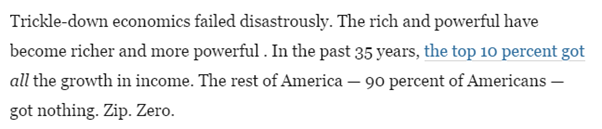
When you line up by Senator Warren to go into the time machine, remember to leave your iPhones and air points at the door.
Innovation is letting us accomplish more with less. Learn more: buff.ly/1LmtAZD #tech #progress http://t.co/e2kQlGu3NA—
HumanProgress.org (@humanprogress) June 22, 2015
Would you rather make $50,000 in today’s New Zealand or $100,000 in the 1980s before neo-liberalism?
21 Jun 2015 1 Comment
in applied welfare economics, economic history, politics - New Zealand, population economics, technological progress Tags: good old days, left-wing fantasies, Leftover Left, life expectancies, neoliberalism, The Great Enrichment, time machine, welfare state
Ezra Klein and Matt O’Brien posed an interesting variation of Brad De Long’s Time Machine question. O’Brien asked:
Try this thought experiment. Adjusted for inflation, would you rather make $50,000 in today’s world or $100,000 in 1980’s? In other words, is an extra $50,000 enough to get you to give up the internet and TV and computer that you have now? The answer isn’t obvious.
And if $100,000 isn’t enough, what would be? $200,000? More? This might be the best way to get a sense of how much better technology has made our lives—not to mention the fact that people are living longer—the past 35 years, but the problem is it’s particular to you and your tastes. It’s not easy to generalize.
This doesn’t mean, though, that the middle class is doing well or even as well as it should be. Just that it’s doing better than the official numbers say it is.
Let them have iPhones is the new let them eat cake.
The same questions are asked in New Zealand in a different way when people go on about how much more unequal New Zealand is compared to the 1980s and how bad things have got because of that rise in inequality.
Would it better to be on the welfare benefit in the 1980s than on a benefit today in a less equal New Zealand than in the 1980s? It is certainly the case that the Gini coefficient is worse than it was in the 1980s – see figure 1.
Figure 1: Gini coefficient New Zealand 1980-2015
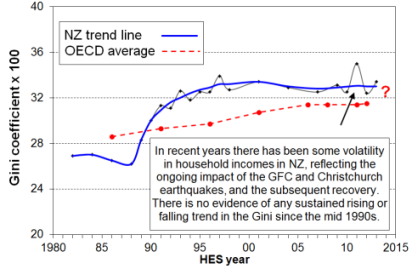
Source: Bryan Perry, Household incomes in New Zealand: Trends in indicators of inequality and hardship 1982 to 2013. Ministry of Social Development (July 2014).
But household incomes on a real basis increased across the border in New Zealand – see figure 2 – including for Maori and Pasifika. As shown in figure 2 below, between 1994 and 2010, real equivalised median New Zealand household income rose by 47%; for Māori, this rise was 68%; for Pasifika, the rise in real equivalised median household income was 77%.
Figure 2: Real equivalised median household income (before housing costs) by ethnicity, 1988 to 2013 ($2013)
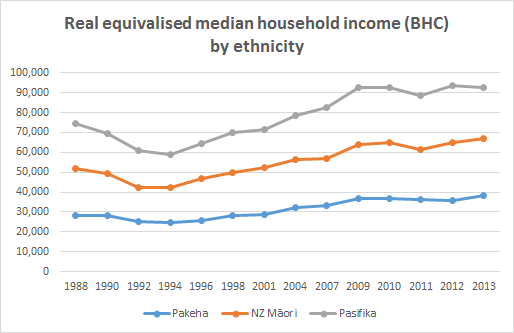
Source: Bryan Perry, Household incomes in New Zealand: Trends in indicators of inequality and hardship 1982 to 2013. Ministry of Social Development (July 2014).
The biggest worry for anyone longing to be on a welfare benefit or to be otherwise working back in the good old days in the 1980s on the more equal incomes of back then is instant death.

Stepping into that Time Machine to go back to the more equal, more egalitarian 1980s shaves about five years off your life expectancy, if not more! Death certainly is the great leveller when it comes to Left over Left fantasies about the good old days before the economic reforms of the 1980s. Indeed, the 1980s was a period where life expectancies started to increase again after a hiatus in the 1960s and 1970s.

Time travel back to the good old days in the 1980s before neoliberalism would be particularly grim from Maori because of their much lower life expectancies of Maori back in the 1980s – see figure 3.
Figure 3: Life expectancy at birth, Maori and non-Maori by sex
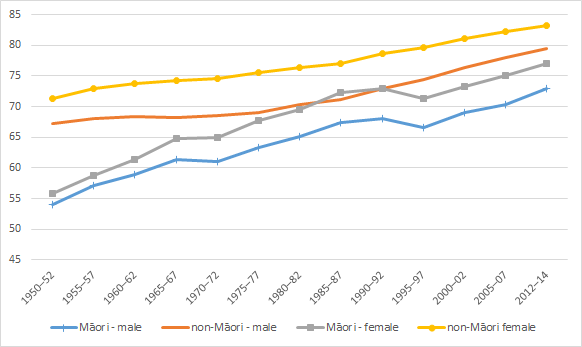
Source: Statistics New Zealand.
The most apt summary of how bad it was in the 1980s compared to today is by veteran left-wing grumbler Max Rashbrooke. To paint pre-1984 New Zealand, pre-neoliberal New Zealand as an egalitarian paradise, he had to ignore the economic progress of two thirds of the population and the inequalities they suffered:
New Zealand up until the 1980s was fairly egalitarian, apart from Maori and women, our increasing income gap started in the late 1980s and early 1990s.
Middle class stagnation versus food poverty
15 Jun 2015 Leave a comment
in politics - USA, population economics, poverty and inequality, technological progress Tags: good old days, middle class stagnation, The Great Enrichment, wage stagnation
CHART: As a share of income, spending on food has gone from 25% in 1930s to < 10% in 2013. http://t.co/pxRgf6tNOZ—
Mark J. Perry (@Mark_J_Perry) May 14, 2015
@phattonez Note that almost 50% of food expenditures are for now food away from home. http://t.co/zWAu0Zlw82—
Mark J. Perry (@Mark_J_Perry) May 18, 2015
On the day I first started to feel old
13 Jun 2015 1 Comment
in economics of media and culture Tags: good old days, grumpy old man
About 10 years ago, I was minding my own business at a car museum in Launceston, Tasmania. We were having a fine time looking through all the various developments of cars and motorbikes from the very early days. It was an excellent museum. I enjoy the occasional visit to a car museum.
The horror, the horror. With no warning it was upon me. One of the exhibits of a vintage car was one of the sports cars of my youth: a Holden Monaro GTS.

With no warning, no phase-in period, I instantly started to feel old. Courtesy of Facebook, I can relive and share those moments at my leisure.
How can I pretend to be still young when surrounded by a range of sports cars of my high school days at a museum. If the sports cars in my youth are vintage cars I must be a bit of a vintage myself. All my previous experiences with vintage cars was with old cars, usually from before World War II, that had been restored after years of neglect and disuse.
Creative destruction in television prices in New Zealand
01 Jun 2015 1 Comment
in economics of media and culture, entrepreneurship, politics - New Zealand, technological progress Tags: creative destruction, good old days


Good old days alert: 1950s Britain
12 May 2015 Leave a comment
in economic history Tags: British economy, good old days

In the early 1950s, two million British households had no electricity or gas, which meant cooking in ranges or on open fires and lighting by candles or oil lamps. As late as 1961, 15 percent of the households in the industrial city of Birmingham didn’t have exclusive use of a toilet, and 32 percent didn’t have their own fixed baths; nearly 20 percent of Manchester’s households lacked a hot-water tap—the percentage of working-class households living in these conditions was naturally higher.
Would you step into a time machine to go back to the 70s glory days?
11 May 2015 2 Comments
in applied welfare economics, economic history, population economics, technological progress Tags: good old days, middle class stagnation, The Great Enrichment, time machine, wage stagnation
Apparently, we are not a cent better off compared to the 70s because all the income gains, every single cent, went into the pockets of the top 10%, if Senator Warren is to be believed in her recent Washington post op-ed.


If you’re willing to put your money where your grumpy socialist mouth is, you would step into a time machine to go back to the 70s because that would make you wealthier.
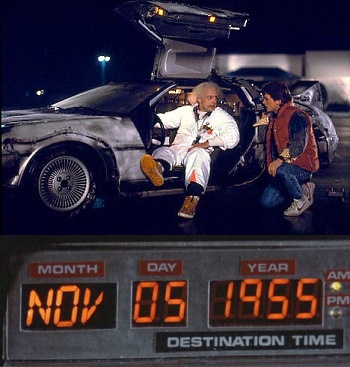
A way to grasp the conceptual difficulties of measuring changes in living standards and life expectancies across the decades is to step into Brad De Long’s time machine.
In this thought experiment, De Long asks how much you would want in additional income to agree to go back in time to a specific year. De Long was an economic historian examining the differences in American living standards since 1900.
Of course, to work how much you would want be paid (or were willing to pay to go back to the Senator Warren’s better times in the 1970), if you used a less biased estimate of price inflation, the answer is steady increases in incomes for the last 25 years so you would want to be paid.

Senator Warren’s linked article actually confirms the same results. For after-tax incomes, everybody is noticeably richer than 30 years ago, especially if you’re a woman.
Senior citizen socialists should take care and think deeply about entering that time machine. It might mean instant death for them because of higher life expectancy is now as compared to the 1970s.
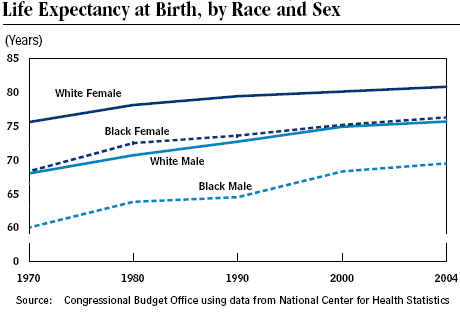
When you do step into that time machine be very picky about what part of the USA you go to if you like air conditioning. There wasn’t as much air conditioning in homes in the 1970s as compared to day, especially if you were poor.

Another thing is, don’t expect to take that many trips. Air travel was not as common in the 70s. Airline deregulation was at the very end of the 1970s.

To add to your boredom in your spare time, your chances of owning a car was a lot less back then than now despite Senator Warren’s assurance that there has been no income growth for the bottom 90% in the last 30 to 40 years. She said that, not me.

As for lifting yourself up in life, and living the American dream, which was the title of Senator Warren’s op-ed? You were much more likely to not go to college back in the glory days of the 70s than now, especially if you were poor.

The most curious anomaly in Senator Warren’s arguments is that many consumer goods are fallen rapidly in price over the last 40 years, but people are somehow unable to buy them from the same fixed income.
via America’s Growing Income Gap, by the Numbers – ProPublica and U.S. Wages Are Historically Great, Or They’re Awful. It Depends on Your Preferred Inflation Measure – Real Time Economics – WSJ.
 Utopia, you are standing in it!
Recent Comments