https://twitter.com/WorldBank/status/664161394955304961
Night-light maps shows huge need 4 #infrastructure investment in African #cities. Video: https://t.co/21z0sT1fXk pic.twitter.com/BJXzwAZPyE
— World Bank (@WorldBank) November 10, 2015
Celebrating humanity's flourishing through the spread of capitalism and the rule of law
14 Nov 2015 1 Comment
in development economics, energy economics, environmental economics, growth disasters, growth miracles Tags: Africa, child poverty, energy poverty, extreme hunger, extreme poverty, global hunger, Greenpeace, Oxfam, The Great Escape
07 Oct 2015 Leave a comment
5 Ways People Power Helped Defeat Shell >> bit.ly/1L4KgAP #savethearctic http://t.co/e3Bn319yOe—
Greenpeace Canada (@GreenpeaceCA) October 06, 2015
Today in Energy: Sustained low oil prices could reduce exploration and production investment go.usa.gov/3twad http://t.co/zH8EpFc4Xx—
EIA (@EIAgov) September 24, 2015
CHART: Thanks to #fracking, US produced >89% of energy consumed this year (through June) for 1st time since 1984 http://t.co/8yEUac1pBA—
Mark J. Perry (@Mark_J_Perry) September 29, 2015
CHART: Thanks to #fracking, US petroleum imports this year through August (25.3%) are lowest in 44 years, since 1971 http://t.co/ThSbPTVDkH—
Mark J. Perry (@Mark_J_Perry) September 29, 2015
New EIA Data: US oil output fell to 9.1 bpd last week, down by 508,000 bpd from July peak ir.eia.gov/wpsr/overview.… http://t.co/VwAjeQ2dEN—
Mark J. Perry (@Mark_J_Perry) September 30, 2015
Energy Milestone: Thanks #fracking US Nat Gas Production Increased in July to New Record High eia.gov/dnav/ng/ng_pro… http://t.co/8KECE6ftxm—
Mark J. Perry (@Mark_J_Perry) September 30, 2015
Humanity keeps finding new reserves of energy: buff.ly/1LbOCcW #progress http://t.co/QhzgYkjWEi—
HumanProgress.org (@humanprogress) October 04, 2015
25 Sep 2015 Leave a comment
in development economics, economics of regulation, environmental economics, growth disasters, growth miracles, health economics Tags: child mortality, child poverty, economics of agriculture, extreme poverty, global hunger, global poverty, GMOs, golden rice, Greenpeace, infant mortality, Luddites, malnutrition, New Zealand Greens, unintended consequences
Good as Gold: Can Golden Rice and Other Biofortified Crops Prevent Malnutrition? ow.ly/QQ1VT #Harvard http://t.co/O3SwpGhsXD—
Golden Rice (@Golden_Rice) August 13, 2015
25 Sep 2015 Leave a comment
in environmental economics, global warming, politics - Australia, politics - New Zealand, politics - USA, Public Choice Tags: China, climate alarmism, climate treaties, global warming, green tariffs, Greenpeace, international environmental law, Paris Summit 2015, Twitter left
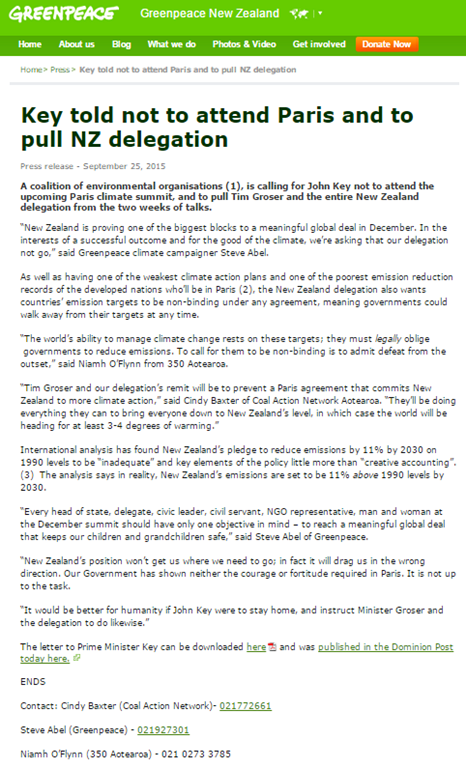
Greenpeace is right in saying in their open letter with others that New Zealand should not send a minister to the climate talks in Paris later this year. I agree for different reasons.
An open letter from @GreenpeaceNZ, @350nz & @coalaction to @johnkeypm not to send anyone to #climate talks in Paris. http://t.co/C1hBJ1teNU—
ActionStation (@actionstation) September 25, 2015
In common with many previous climate summits, the Paris talks will be a futile gesture that will have no significant effect on the pace of global warming and holding the summit is a waste of taxpayers money.
Nothing will come of them because the developing countries have no interest in postponing their development because of a minor inconvenience from global warming.
Do us all a favour @JohnKeyPM, don't send Tim to Paris >> stuff.co.nz/environment/cl… #GroserDontGo #COP21 http://t.co/DaqvPGZ4Ls—
Greenpeace NZ (@GreenpeaceNZ) September 25, 2015
The easy way to tell if there is anything going to happen at a climate summit is the seniority of the delegation.

The Chinese made it clear at the Copenhagen summit in 2009 that they were not interested in an agreement by sending a Vice Minister of Foreign Affairs to a key side meeting of the American and French presidents, the British Prime Minister and the German Chancellor. All subsequent policy manoeuvrings by the Chinese on global warming are an attempt to head off green tariffs on their exports.
22 Sep 2015 Leave a comment
in Economics of international refugee law, environmental economics, global warming, international economics, law and economics, politics - New Zealand Tags: climate refugees, global warming, Greenpeace, Kiribati, nuisance suits, political refugees, vexatious litigation, war refugees
Political support is tenuous enough for admitting more political refugees and war refugees to New Zealand without visa overstayers trying it on with claims for asylum on the basis of climate change – that they are a climate refugee.
Currently New Zealand small refugee quota of 750 is under review. Chances of that been increased to 1000 are reasonable. If people are trying to open the floodgates to millions of people as potential refugees of climate change, if Greenpeace’s own alarmist rhetoric about global warming is to be believed, Greenpeace only strengthens the hand of the anti-immigration and xenophobic parties such as New Zealand First and within the National Party caucus.
Not everyone is a worthy cause, particularly those who make vexatious legal claims that were always going to fail in court. The High Court, the Court of Appeal and the Supreme Court all ruled that it is not their place to expand the scope of the international refugee convention to cover those displaced by climate change. As the Court of Appeal ruled
No-one should read this judgment as downplaying the importance of climate change. It is a major and growing concern for the international community. The point this judgment makes is that climate change and its effect on countries like Kiribati is not appropriately addressed under the Refugee Convention.
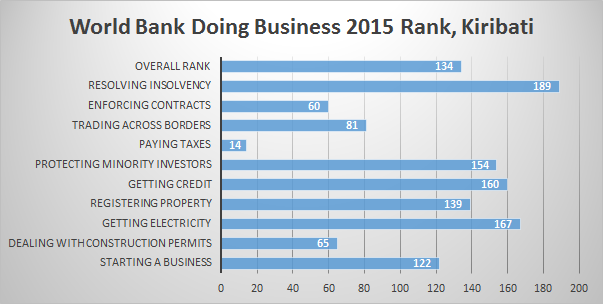
Source: Doing Business in Kiribati – World Bank Group
Kirabati can do a lot more to help itself rather than looking to others to solve its problems. It is ranked 133rd in the World Bank’s Doing Business database. This means it can do a lot to help its own development, which strengthens its resilience against climate change and rising sea levels. In the High Court, Priestley J observed:
The economic environment of Kiribati might certainly not be as attractive to the applicant and his fellow nationals as the economic environment and prospects of Australia and New Zealand. But he would not, if he returns, be subjected to individual persecution…
The appellant raised an argument that the international community itself was tantamount to the “persecutor” for the purposes of the Refugee Convention. This completely reverses the traditional refugee paradigm. Traditionally a refugee is fleeing his own government or a non-state actor from whom the government is unwilling or unable to protect him. Thus the claimant is seeking refuge within the very countries that are allegedly “persecuting” him.
Kiribati’s Human Development Index value for 2012 is 0.629—in the medium human development category—positioning the country at 121 out of 187 countries and territories. The rank is shared with Indonesia and South Africa. Kiribati is not unusually poor if it is similar in human development index ranking is to Indonesia and South Africa. Since 1980, Kiribati life expectancy at birth has increased from 55 years to 68 years. Average years of schooling is nearly 8 years and expected years of schooling for their children is now 12 years.
12 Sep 2015 Leave a comment
in economics of regulation, environmental economics, environmentalism, global warming, health economics, politics - New Zealand Tags: anti-science left eye global warming, climate alarmism, GMOs, Greenpeace, Leftover Left, New Zealand Greens, Russell Norman, The Great Escape, The Great Fact, Twitter left
Like McDonalds, Greenpeace globally is a brand. I read the papers every day in detail but are utterly clueless as to who its leaders are. That is a deliberate branding decision so people cannot conflate the inevitably dodgy and far left backgrounds of its leaders and activist support base with self appointed environmental do-gooders brand.

That is no longer so in New Zealand where a middle-age political junkie retiring as co-leader of the New Zealand Greens will now be their CEO in New Zealand.
.@RusselNorman to lead @GreenpeaceNZ bit.ly/1K08JJj http://t.co/M4QNmeGQjr—
Greenpeace NZ (@GreenpeaceNZ) September 10, 2015
If Russell Norman wants to do his job properly, you should never give an interview, never appear in public.
Incoming @GreenpeaceNZ leader @RusselNorman says Greenpeace critical for humanity's future stuff.co.nz/national/polit… http://t.co/XqpxYjYmf4—
Greenpeace NZ (@GreenpeaceNZ) September 12, 2015
What is worse is the carrying on by the Greens about the retirement of Russell Norman to lead the Greenpeace in New Zealand.
If they wanted to maintain the political effectiveness of Greenpeace, they should have made a short press release congratulating him on his retirement and wishing him well in his new job and saying little more. The Greens should stop carrying on as though you have taken over Greenpeace New Zealand.
I do not wish Greenpeace well with its anti-growth, anti-science, anti-human agenda, so I hope this was a mistake and I hope I am not interrupting them in making that mistake.
30 Aug 2015 Leave a comment
in economics of regulation, environmental economics, global warming, health economics Tags: Anti-Science left, climate alarmism, economics of agriculture, global warming, GMOs, Greenpeace, New Zealand Greens, precautionary principle
21 Aug 2015 Leave a comment
in applied welfare economics, economics of regulation, energy economics, environmental economics, health economics, international economics, labour economics, law and economics, politics - New Zealand, Public Choice Tags: antiforeign bias, antimarket bias, expressive voting, Greenpeace, Leftover Left, make-work bias, methodology of economics, New Zealand Greens, New Zealand Labour Party, rational ignorance, rational irrationality
Quotation of the Day from French Economist Frederic Bastiat in the 1850s http://t.co/2ECWtb6m9u—
Mark J. Perry (@Mark_J_Perry) August 14, 2015
19 Aug 2015 Leave a comment
in applied price theory, development economics, economic history, economics of information, economics of media and culture, economics of regulation, environmental economics, environmentalism, growth disasters, growth miracles, health economics, liberalism Tags: Anti-Science left, expressive voting, GMOs, golden rice, Greenpeace, Luddites, New Zealand Greens, precautionary principle, rational ignorance, rational irrationality, The Great Escape
Good as Gold: Can Golden Rice and Other Biofortified Crops Prevent Malnutrition? ow.ly/QQ1VT #Harvard http://t.co/O3SwpGhsXD—
Golden Rice (@Golden_Rice) August 13, 2015
INFOGRAPHICS: The Impacts of #Biotechnology: A Close Look at the Latest Study ow.ly/GUi4U @FoodInsight http://t.co/JQsmrm2Lv1—
Golden Rice (@Golden_Rice) January 07, 2015
Anti-Golden Rice keyboard
Used by opponent to debate against supporters of #goldenrice
@EcoSenseNow @Golden_Rice http://t.co/q6xt5j7hb1—
Golden Rice Now (@paulevans18) August 21, 2015
.@gpph If this girl could have eaten #goldenrice for lunch, she would not be blind today. ALLOW GOLDEN RICE NOW http://t.co/3UlwHAdWdZ—
Golden Rice Now (@paulevans18) July 29, 2015
15 Aug 2015 2 Comments
in constitutional political economy, economics of crime, environmental economics, global warming, law and economics, liberalism, politics - New Zealand, Public Choice, Rawls and Nozick, rentseeking Tags: civil disobedience, climate alarmism, expressive voting, Greenpeace, John Rawls, Justice Scalia, Leftover Left, rule of law
PRESS RELEASE: Greenpeace Parliament Climbers Convicted of Trespass bit.ly/1DRfKMG #realclimateaction http://t.co/sxRokpwRNk—
Greenpeace NZ (@GreenpeaceNZ) August 13, 2015
The Greenpeace vandals who trespassed at Parliament, climbing up to put signs down the front in flagrant disregard of the most ample possible options for peaceful protest right outside at least had the integrity to plead guilty. That shows some sort of fidelity to law and an acknowledgement that what they did was a criminal offence.
John Rawls makes the point that the purpose of civil disobedience is not to impose your will upon others but through your protest to implore them to reconsider their position and change the law or policy you are disputing.
Rawls argues that civil disobedience is never covert or secretive; it is only ever committed in public, openly, and with fair notice to legal authorities. Openness and publicity, even at the cost of having one’s protest frustrated, offers ways for the protesters to show their willingness to deal fairly with authorities. Rawls argues:
Rawls argues, and too many forget, that civil disobedience and dissent more generally contribute to the democratic exchange of ideas by forcing the champions of dominant opinion to defend their views.
Legitimate non-violent direct action are publicity stunts to gain attention and provoke debate within the democratic framework, where we resolve our differences by trying to persuade each other and convince the electorate.
Too many acts of non-violent direct action aim to impose their will on others rather than peaceful protests designed to bring about democratic change in the laws or policies of the incumbent government. That ‘might does not make right’ is fundamental to the rule of law. As United States Supreme Court Justice Antonin Scalia said
The virtue of a democratic system [with a constitutionally guaranteed right to free speech] is that it readily enables the people, over time, to be persuaded that what they took for granted is not so and to change their laws accordingly..
Both sides passionately but respectfully attempt to persuade their fellow citizens to accept their views. Win or lose, advocates for today’s losing causes can continued pressing their cases, secure in the knowledge that an electoral loss today can be negated by a later electoral win, which is democracy in action as Justice Kennedy explains:
…a democracy has the capacity—and the duty—to learn from its past mistakes; to discover and confront persisting biases; and by respectful, rationale deliberation to rise above those flaws and injustices…
It is demeaning to the democratic process to presume that the voters are not capable of deciding an issue of this sensitivity on decent and rational grounds.
The process of public discourse and political debate should not be foreclosed even if there is a risk that during a public campaign there will be those, on both sides, who seek to use racial division and discord to their own political advantage. An informed public can, and must, rise above this. The idea of democracy is that it can, and must, mature.
Freedom embraces the right, indeed the duty, to engage in a rational, civic discourse in order to determine how best to form a consensus to shape the destiny of the Nation and its people. These First Amendment dynamics would be disserved if this Court were to say that the question here at issue is beyond the capacity of the voters to debate and then to determine.
John Rawls’ view that fidelity to law and democratic change through trying to persuade each other is at the heart of civil disobedience reflects the difference between the liberal and the left-wing on democracy and social change as Jonathan Chait observed this week:
Liberals treat political rights as sacrosanct. The left treats social and economic justice as sacrosanct. The liberal vision of political rights requires being neutral about substance.
To the left, this neutrality is a mere guise for maintaining existing privilege; debates about “rights” can only be resolved by defining which side represents the privileged class and which side represents the oppressed…
Liberals believe that social justice can be advanced without giving up democratic rights and norms. The ends of social justice do not justify any and all means.
How the left-wing and liberal visions of democracy are different nymag.com/daily/intellig… http://t.co/Qk5vS9SaV4—
Jonathan Chait (@jonathanchait) August 13, 2015
09 Aug 2015 Leave a comment
in economics of regulation, environmental economics, environmentalism, health economics, Public Choice, rentseeking Tags: antiscience left, expressive voting, GMOs, green rent seeking, Greenpeace, Left-wing hypocrisy, precautionary principle, rational ignorance, rational irrationality
US researchers: the idea that global warming has slowed is "no longer valid" grnpc.org/IgDMn via @BBCWorld http://t.co/bIDhaWPV3r—
(@Greenpeace) June 05, 2015
Brace yourself. Global warming is 'set to speed up to rates not seen for 1,000 years.' bit.ly/1x8TnKd http://t.co/pLTprLEiIm—
Greenpeace USA (@greenpeaceusa) March 09, 2015
Are we doomed? Global temperatures hit critical point, scientists warn. bit.ly/1DWkJq7 via @EcoWatch http://t.co/VRT7DH3stN—
Greenpeace USA (@greenpeaceusa) August 01, 2015
01 Aug 2015 Leave a comment
in economics of crime, environmental economics, environmentalism, law and economics, politics - Australia, politics - New Zealand, politics - USA, property rights, Rawls and Nozick, transport economics Tags: Greenpeace, John Rawls, peaceful protest
Were the Greenpeace runabouts observing maritime safety rules such as avoiding collisions and giving way? Any protester that behaved like that in a car would be immediately arrested and charged.
Why it is tolerated in the high seas is beyond me when it would never be tolerated on the road. No one would pretend reckless driving was peaceful protest. Is it okay to behave recklessly in a boat? No one would accept that in a car on land.
Central to the notion of peaceful protest is fidelity to democracy and the rule of law. The idea is not to impose your will upon others, but to persuade the majority to reconsider their position by showing the passionate extent to which you disagree with them and honestly believe they are mistaken.
The civil disobedient is attempting to appeal to the “sense of justice” of the majority and a willingness to accept arrest is proof of the integrity of the act says Rawls:
…any interference with the civil liberties of others tends to obscure the civilly disobedient quality of one’s act.
Rawls argues that the use or threat of violence is incompatible with a reasoned appeal to fellow citizens to move them to change a law. The actions are not a means of coercing or frightening others into conforming to one’s wishes. That is a breach of the principles of a just society.
26 Jun 2015 Leave a comment
in environmental economics, environmentalism, global warming, politics - New Zealand Tags: climate alarmism, expressive politics, expressive voting, global warming, Greenpeace, Leftover Left, nonviolent direct action, peaceful protests
30 Mar 2015 Leave a comment
Save the kids, stop supporting @Greenpeace!
#GoldenRice goldenrice.org/Content3-Why/w… http://t.co/5gBWNFJswA—
Urs Bolt (@UrsBolt) December 08, 2014
Celebrating humanity's flourishing through the spread of capitalism and the rule of law
Scholarly commentary on law, economics, and more
Beatrice Cherrier's blog
Celebrating humanity's flourishing through the spread of capitalism and the rule of law
Celebrating humanity's flourishing through the spread of capitalism and the rule of law
Celebrating humanity's flourishing through the spread of capitalism and the rule of law
Why Evolution is True is a blog written by Jerry Coyne, centered on evolution and biology but also dealing with diverse topics like politics, culture, and cats.
Celebrating humanity's flourishing through the spread of capitalism and the rule of law
Celebrating humanity's flourishing through the spread of capitalism and the rule of law
A rural perspective with a blue tint by Ele Ludemann
DPF's Kiwiblog - Fomenting Happy Mischief since 2003
Celebrating humanity's flourishing through the spread of capitalism and the rule of law
The world's most viewed site on global warming and climate change
Tim Harding's writings on rationality, informal logic and skepticism
A window into Doc Freiberger's library
Let's examine hard decisions!
Commentary on monetary policy in the spirit of R. G. Hawtrey
Thoughts on public policy and the media
Celebrating humanity's flourishing through the spread of capitalism and the rule of law
Politics and the economy
A blog (primarily) on Canadian and Commonwealth political history and institutions
Reading between the lines, and underneath the hype.
Economics, and such stuff as dreams are made on
"The British constitution has always been puzzling, and always will be." --Queen Elizabeth II
Celebrating humanity's flourishing through the spread of capitalism and the rule of law
Celebrating humanity's flourishing through the spread of capitalism and the rule of law
WORLD WAR II, MUSIC, HISTORY, HOLOCAUST
Undisciplined scholar, recovering academic
Celebrating humanity's flourishing through the spread of capitalism and the rule of law
Res ipsa loquitur - The thing itself speaks
Celebrating humanity's flourishing through the spread of capitalism and the rule of law
Researching the House of Commons, 1832-1868
Articles and research from the History of Parliament Trust
Reflections on books and art
Posts on the History of Law, Crime, and Justice
Celebrating humanity's flourishing through the spread of capitalism and the rule of law
Exploring the Monarchs of Europe
Cutting edge science you can dice with
Small Steps Toward A Much Better World
“We do not believe any group of men adequate enough or wise enough to operate without scrutiny or without criticism. We know that the only way to avoid error is to detect it, that the only way to detect it is to be free to inquire. We know that in secrecy error undetected will flourish and subvert”. - J Robert Oppenheimer.
The truth about the great wind power fraud - we're not here to debate the wind industry, we're here to destroy it.
Celebrating humanity's flourishing through the spread of capitalism and the rule of law
Celebrating humanity's flourishing through the spread of capitalism and the rule of law
Economics, public policy, monetary policy, financial regulation, with a New Zealand perspective
Celebrating humanity's flourishing through the spread of capitalism and the rule of law
Restraining Government in America and Around the World
 Utopia, you are standing in it!
Recent Comments