Tweet… is from page 152 of Thomas Sowell’s Compassion Versus Guilt, a 1987 collection of some of his popular essays; specifically, it’s from Sowell’s June 14th, 1985, column titled “Chances versus Guarantees”: People who bought homes in a quiet little town often become resentful when other people begin moving in, expanding and changing the community.…
The following is written in Don’s capacity as trustee for Hobson’s Pledge: It is almost the end of 2025 and, as you may know, the Government has recently introduced to Parliament the two Bills it seeks to replace the Resource Management Act (RMA) with. The Bills were pushed through first reading under urgency and have…
Inside the reform that will change how New Zealand is built Ani O’Brien writes – If you’ve ever tried to build a deck, subdivide a section, or watched a major infrastructure project slowly suffocate in a decade of “consenting hell,” you already know the RMA is New Zealand’s great productivity killer. For over 30 years, […]
Wayne Jackson writes – The 50th anniversary of New Zealand’s Household Economic Survey (HES) provides a unique vantage point to assess how far households have come in terms of income, expenditure, and wealth accumulation. Comparing 1974 with 2024 reveals a story of rising prosperity, shifting household structures, and widening disparities. From dual‑income households to skyrocketing […]
Libertarians don’t like local government much, generally. While some aspire for maximum devolution, similar to Switzerland, so that most government power (outside defence, foreign affairs and border control) is at the more local level, that would require a transformational constitutional change. Switzerland works because its best and brightest get concentrated at the canton level, and…
It seems natural enough, at least based on US experience, to believe that building and permitting are in a natural opposition: that is, stronger permitting means less building. Zachary Liscow has been looking for a way out of this opposition. He spells out some of his thoughts in “Reforming Permitting to Build Infrastructure” (Hutchins Center…
Don Brash writes – In recent years, when addressing Rotary and other audiences, I often talk about the five big challenges facing New Zealand – persistently slow growth in productivity, and therefore in income levels; ridiculously unaffordable house prices; the increasing division of our society into those with a Maori ancestor and those without; the […]
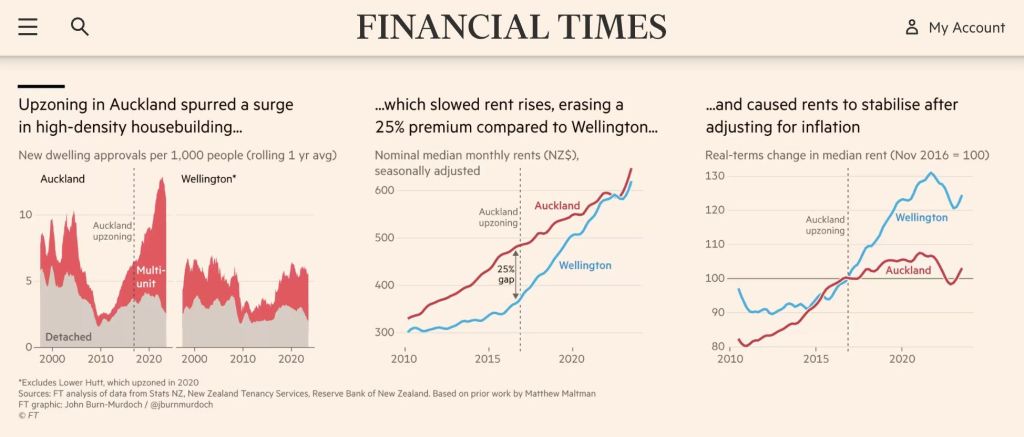
Yes: In December 2018, Minneapolis became the first U.S. city to eliminate single-family zoning through the Minneapolis 2040 Plan, a landmark reform with a central focus on improving housing affordability. This paper estimates the effect of the Minneapolis 2040 Plan on home values and rental prices. Using a synthetic control approach we find that the […]
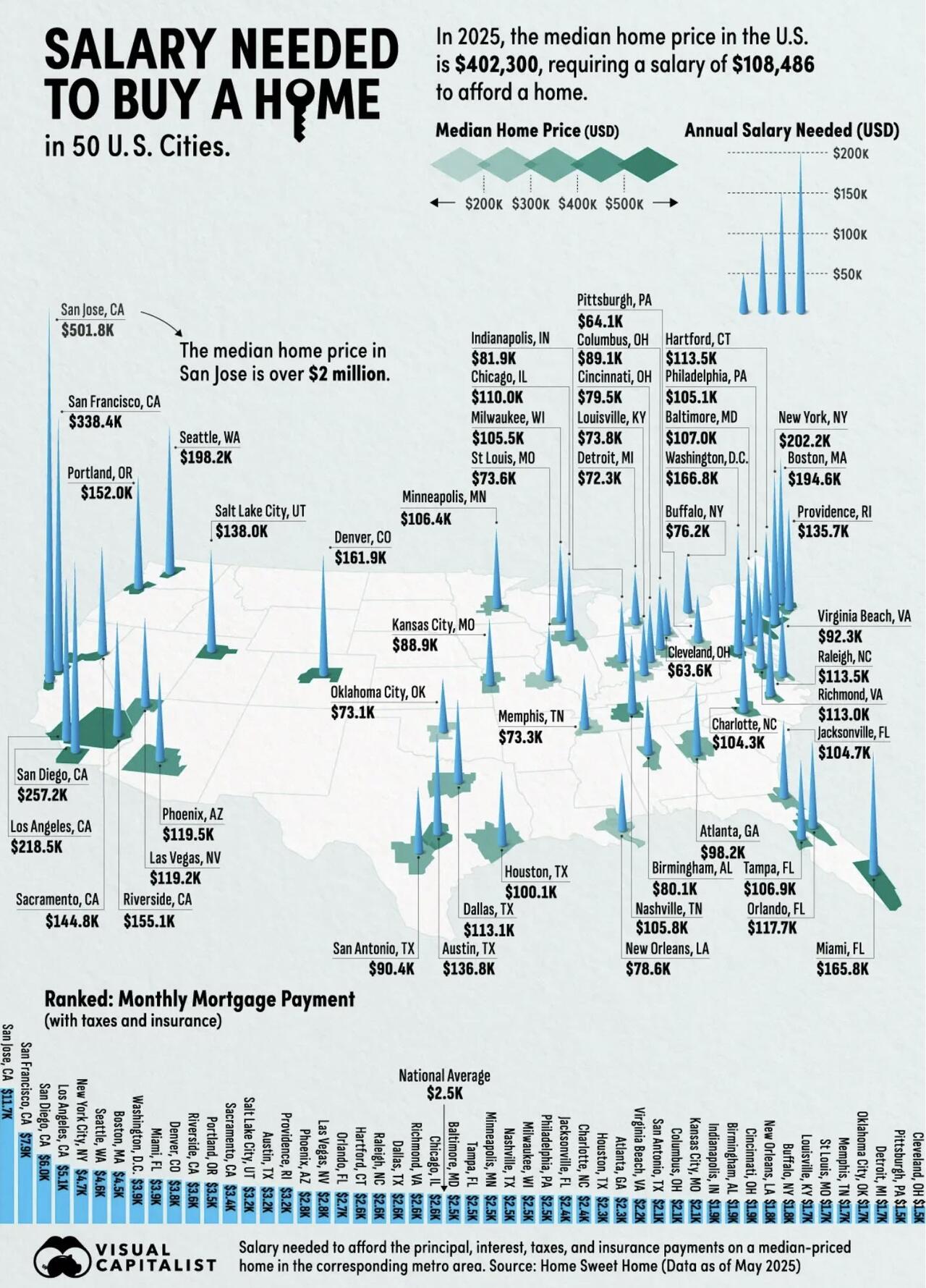
In my post Affordable Housing is Almost Pointless, I highlighted how point systems for awarding tax credits prioritize DEI, environmental features, energy efficiency, and other secondary goals far more than low cost. A near-comic example comes from D.C., where so-called affordable housing units now cost between $800,000 and $1.3 million dollars each! One such unit […]
Housing prices across much of America have hit historic highs, while less housing is being built. If the U.S. housing stock had expanded at the same rate from 2000-2020 as it did from 1980-2000, there would be 15 million more housing units. This paper analyzes the decline of America’s new housing supply, focusing on large […]
Housing in Canada, Hong Kong, New Zealand, and Singapore was slightly more affordable in 2024 than it had been in 2023. Wendell Cox’s latest assessment of housing affordability, when compared with last year’s assessment, shows that housing became slightly less affordable in Ireland and the United Kingdom, while affordability remained … Continue reading →
Brian Easton writes – While there have been decades of complaints – from all sides – about the workings of the Resource Management Act (RMA), replacing is proving difficult. The Coalition Government is making another attempt. To help answer the question, I am going to use the economic lens of the Coase Theorem, set out […]
Why Evolution is True is a blog written by Jerry Coyne, centered on evolution and biology but also dealing with diverse topics like politics, culture, and cats.
“We do not believe any group of men adequate enough or wise enough to operate without scrutiny or without criticism. We know that the only way to avoid error is to detect it, that the only way to detect it is to be free to inquire. We know that in secrecy error undetected will flourish and subvert”. - J Robert Oppenheimer.



 Utopia, you are standing in it!
Recent Comments