Daron Acemoglu discusses “Why Nations Fail: The Origins of Power, Prosperity, and Poverty”
06 Aug 2019 Leave a comment
in development economics, economic history, economics of bureaucracy, growth disasters, growth miracles, income redistribution, labour economics, labour supply, law and economics, property rights, Public Choice, rentseeking Tags: age of empires, Age of exploration, economics of colonialism, imperialism
Is America an imperialist, white-supremacist, capitalist patriarchy? | FACTUAL FEMINIST
21 Jan 2017 2 Comments
in defence economics, development economics, discrimination, gender, labour economics Tags: feminism, foreign policy, gender wage gap, imperialism, racial discrimination, racism
Iran is the only Middle Eastern country never conquered by a European power—but it came close
17 Oct 2015 Leave a comment
in economic history Tags: age of empires, British imperialism, imperialism, Iran, Middle-East politics
Iran is the only Middle Eastern country never conquered by a European power—but it came close bit.ly/VoxMidEastMaps http://t.co/nmMYnJet3m—
Vox Maps (@VoxMaps) September 28, 2015
The depth and breadth of European colonization 1500-1900
19 Aug 2015 Leave a comment
in constitutional political economy, economic history, Public Choice, rentseeking Tags: age of empires, British empire, British imperialism, colonialism, imperialism
A map showing the depth and breadth of European colonization 1500-1900: thesocietypages.org/socimages/2015… http://t.co/37234ZzDfj—
(@SocImages) March 21, 2015
Colonial Africa on the eve of World War I
10 Aug 2015 Leave a comment
in economic history, war and peace Tags: Africa, British empire, British imperialism, colonialism, imperialism, World War I
Colonial Africa On The Eve of World War I. Learn more here: brilliantmaps.com/africa-1914/ http://t.co/RAm2HXA3X6—
Brilliant Maps (@BrilliantMaps) April 30, 2015
Flags of the British Empire
13 Jul 2015 Leave a comment
in constitutional political economy, economic history, Public Choice Tags: age of empires, British empire, British imperialism, British justice, capitalism and freedom, imperialism, rule of law, the common law
Flags of the British Empire. http://t.co/feiKPR3BnK—
History Facts 247 (@historyfacts247) July 04, 2015
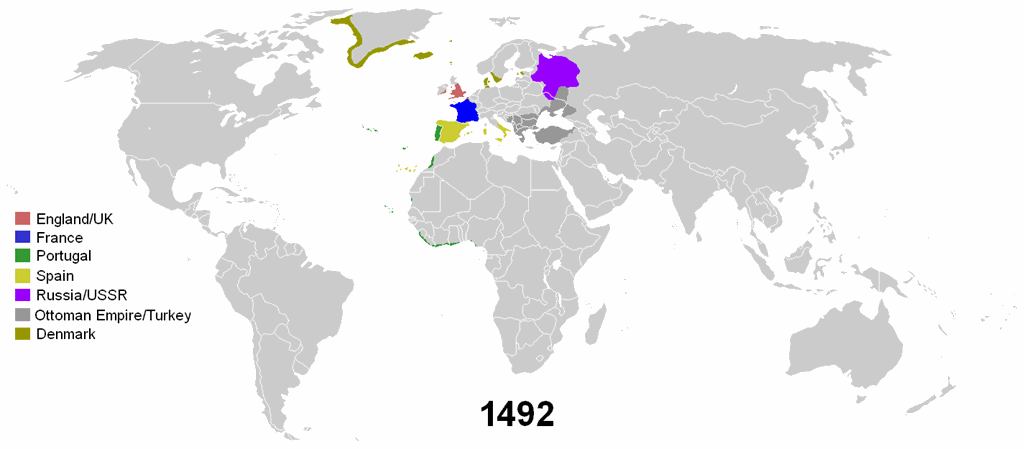
Expansion of global empires, 1492-2008
10 Jul 2015 Leave a comment
in economic history Tags: age of empires, colonialism, imperialism
European imperialism in 1922
06 Jul 2015 Leave a comment
in economic history Tags: age of empires, British imperialism, colonisation, imperialism, maps
European imperialism in 1922 http://t.co/dxWEeXUcfr—
Charts and Maps (@ChartsandMaps) June 05, 2015
The Empire of Japan in 1939
03 Jul 2015 Leave a comment
in defence economics, economic history, war and peace Tags: China, colonisation, imperialism, Japan, World War II
The Empire of Japan in 1939, read how it got there brilliantmaps.com/russo-japanese… http://t.co/wop0insgnD—
Brilliant Maps (@BrilliantMaps) January 21, 2015
Colonizability of Africa (1899)
25 Jun 2015 Leave a comment
in economic history Tags: Africa, age of empires, British empire, colonisation, imperialism
Colonizability of Africa (1899) by Harry Johnston, a British explorer bit.ly/1uQjAPX http://t.co/2jiqQdCgeT—
Brilliant Maps (@BrilliantMaps) November 23, 2014
The British empire was one of the last colonialists out of the block
08 Jun 2015 Leave a comment
in economic history, economics of media and culture, Public Choice, rentseeking Tags: age of empires, British empire, colonialism, imperialism

Who colonised Africa?
22 Apr 2015 Leave a comment
in economic history Tags: Africa, British empire, British imperialism, colonisation, imperialism
if colonizing Africa was the quiz Blockbusters, Britain would have been very good at it http://t.co/qeD1P0GgHU—
Laurence Chandy (@laurencechandy) February 03, 2014
Who gains from anti-imperialism and opposition to foreign investment?
21 May 2014 Leave a comment
in applied price theory, David Friedman, development economics, Public Choice Tags: bootleggers and baptists, expressive voting, foreign investment, imperialism, marxist fallacies
Much more commonly, [economic imperialism] is used by Marxists to describe–and attack–foreign investment in “developing” (i.e., poor) nations.
The implication of the term is that such investment is only a subtler equivalent of military imperialism–a way by which capitalists in rich and powerful countries control and exploit the inhabitants of poor and weak countries.
There is one interesting feature of such “economic imperialism” that seems to have escaped the notice of most of those who use the term.
Developing countries are generally labour rich and capital poor; developed countries are, relatively, capital rich and labour poor. One result is that in developing countries, the return on labour is low and the return on capital is high–wages are low and profits high. That is why they are attractive to foreign investors.
To the extent that foreign investment occurs, it raises the amount of capital in the country, driving wages up and profits down.
The effect is exactly analogous to the effect of free migration. If people move from labour-rich countries to labour-poor ones, they drive wages down and rents and profits up in the countries they go to, while having the opposite effect in the countries they come from.
If capital moves from capital-rich countries to capital-poor ones, it drives profits down and wages up in the countries it goes to and has the opposite effect in the countries it comes from.
The people who attack “economic imperialism” generally regard themselves as champions of the poor and oppressed.
To the extent that they succeed in preventing foreign investment in poor countries, they are benefiting the capitalists of those countries by holding up profits and injuring the workers by holding down wages.
It would be interesting to know how much of the clamour against foreign investment in such countries is due to Marxist ideologues who do not understand this and how much is financed by local capitalists who do.
David D. Friedman
Opposition to immigration might protect the wages of local workers. Opposition to foreign investment might increase the profits of local capitalists.
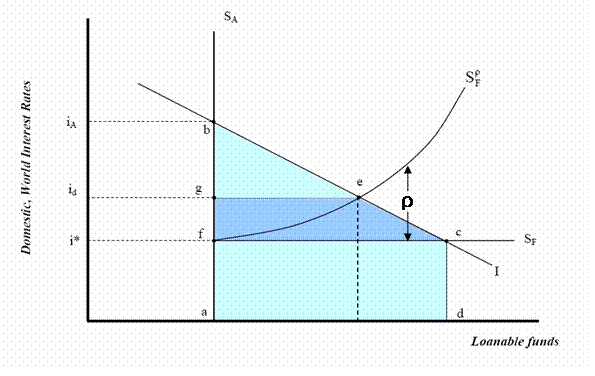
How does more competition help the local capitalists? The foreign investment is in response to the high returns in the local market and that inflow of foreign capital will continue until local rates of return match those in other countries.
Equalisation of risk-adjusted rate of returns is central to the operation of capital markets.
Stopping this process of equalisation through regulation only benefits the capitalists inside the country. It reduces the wages of workers because they have less capital and fewer modern technologies to work with.
 Utopia, you are standing in it!
Recent Comments