In #India poverty is falling very, very rapidly – while inequality is rising.
More at: bit.ly/1KLT8Lh http://t.co/xTxlW1i06o—
Max Roser (@MaxCRoser) June 29, 2015
The Great Fact in India
02 Aug 2015 Leave a comment
in applied welfare economics, development economics, economic history, growth disasters, growth miracles Tags: India, The Great Fact
I’m in hog heaven! Found a blog devoted to anomalies on maps!!
02 Aug 2015 Leave a comment
in economic history, economics of bureaucracy, Public Choice Tags: Bangladesh, economics of borders, enclaves, exclaves, geography, India, maps


via Say goodbye to the weirdest border dispute in the world – The Washington Post.


via An Apology of Enclaves – The New York Times.
The great new blog is http://bigthink.com/articles?blog=strange-maps
The Great Escape in China, India and Indonesia
12 Jul 2015 Leave a comment
in applied welfare economics, development economics, economic history, growth disasters, growth miracles, health economics Tags: China, India, Indonesia, life expectancies, The Great Escape, The Great Fact
These 4 nations are 50% of mankind. That's 3.5 billion people who are living longer. buff.ly/1Kle6mU #health http://t.co/949oqisMsL—
HumanProgress.org (@humanprogress) June 30, 2015
@MaxCRoser only one line in this chart about India matters
05 Jul 2015 Leave a comment
in comparative institutional analysis, constitutional political economy, development economics, economic history, growth disasters, growth miracles, poverty and inequality, Public Choice Tags: capitalism and freedom, extreme poverty, global poverty, India, Leftover Left, The Great Escape, The Great Fact, top 1%
In #India poverty is falling very, very rapidly – while inequality is rising.
More at: bit.ly/1KLT8Lh http://t.co/xTxlW1i06o—
Max Roser (@MaxCRoser) June 29, 2015
The rise of the South
03 Jul 2015 Leave a comment
in development economics, growth disasters, growth miracles Tags: China, India, The Great Fact, undeveloped countries
The GDP of the South doubled to 40% by 2012, w/ China —12% of global GDP: wrld.bg/N9CYe #RisingoftheSouth http://t.co/Yt2LiF9srr—
World Bank Pubs (@WBPubs) May 20, 2015
India at night in 1994 and 2010 – Estimating Poverty Using Nightlights
27 Jun 2015 Leave a comment
in development economics, econometerics, economic history, growth disasters, growth miracles Tags: India, measurement error, national accounts

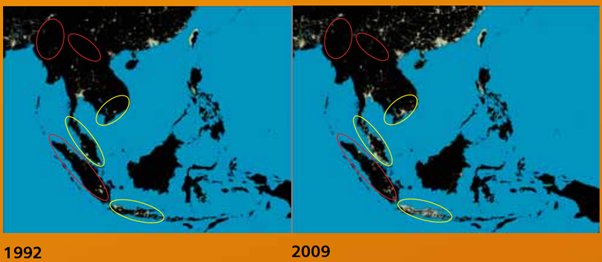
Maxim Pinkovskiy and Xavier Sala-i-Martin last year suggested that national accounting estimates of poverty should be adjusted for the evolution of satellite-recorded night-time lights. I agree from personal experience.
In India between 1994 and 2010, its survey income grew by 29% but its GDP per capita more than doubled during this time. We see that lights in India increase dramatically both in their intensity over the major cities as well as in their extent over previously dark areas of the country. This suggests that the GDP estimate is a more accurate assessment of economic development of India and the faster reduction of poverty than income surveys suggest.
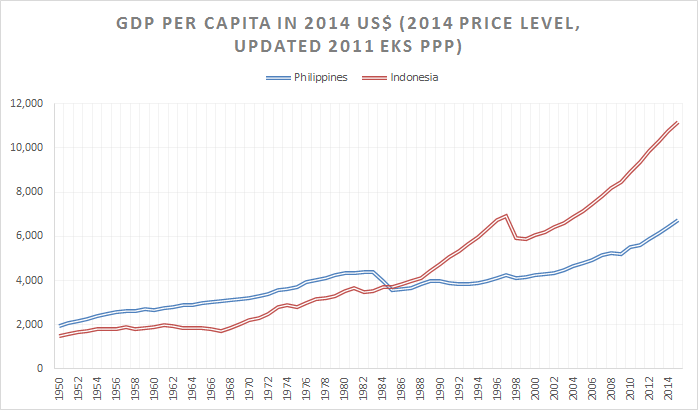
Source: The Conference Board. 2015. The Conference Board Total Economy Database™, May 2015, http://www.conference-board.org/data/economydatabase/
National accounting data on real GDP, PPP would suggest that Indonesia is a much wealthier country than the Philippines. The Philippines from about the late 1998, has had rapid economic growth, but so has Indonesia. I first visited the Philippines in 1997. I have never visited Indonesia.
When I first visited my parents-in-law in the Philippines in 1998, that part of Leyte had no sealed roads and no phones.
The next time I visited, the road was being sealed and mobile reception was better if you had an aerial on the roof.
After a five year gap in visiting, not only was mobile reception good, there was cable TV if you wanted it. When I visited in 2012, there was wireless internet if you had outside aerial.
Christmas before last, we hot spotted off my sister-in-law’s mobile. Neighbours have Skype if we want to say hello. I don’t know how that rapid change in economic fortunes is captured accurately in national accounting figures.
The success of Indian migrants
27 Jun 2015 Leave a comment
Indians have become an extraordinarily successful minority in America. A burgeoning new elite econ.st/1cgD0GN http://t.co/XxwcclHpDJ—
The Economist (@EconEconomics) May 26, 2015
Who will be the 20 largest economies in 2030?
10 Jun 2015 Leave a comment
in development economics, economic growth, growth miracles, macroeconomics Tags: China, convergence, India, Japan
These will be the world’s 20 largest economies in 2030 bloom.bg/1IzgMhl http://t.co/KADxgakbEj—
Bloomberg VisualData (@BBGVisualData) May 20, 2015
The rapid rise of the middle-class in developing countries
08 Jun 2015 Leave a comment
in development economics, growth miracles Tags: China, India, The Great Enrichment, The Great Fact
Google maps of India differ in India and China
07 Jun 2015 Leave a comment
in defence economics, economics of media and culture, war and peace Tags: border disputes, China, Google, India, maps
Did vaccines work in India?
05 May 2015 Leave a comment
in development economics, health economics Tags: anti-vaccination movement, India, The Great Escape, vaccinations, vaccines
Only one line in this chart about India matters, ever
27 Apr 2015 Leave a comment
in applied welfare economics, development economics, economic history, growth disasters, growth miracles Tags: extreme poverty, global poverty, India, Leftover Left, poverty and inequality
In #India poverty is falling very, very rapidly – while inequality is rising.
More at: bit.ly/1KLT8Lh http://t.co/t5d1LQR4l0—
Max Roser (@MaxCRoser) April 27, 2015
The marriage squeeze in India and China
27 Apr 2015 Leave a comment
The marriage squeeze in India and China is taking a third of humanity into uncharted territory econ.st/1IN2wyw http://t.co/GbjVDDqJ5h—
The Economist (@EconBizFin) April 26, 2015
 Utopia, you are standing in it!
Recent Comments