.
Celebrating humanity's flourishing through the spread of capitalism and the rule of law
20 Mar 2015 Leave a comment
in George Stigler, history of economic thought, Public Choice, rentseeking Tags: evidence-based policy, expressive politics, expressive voting, intellectuals, politics of reform, rational ignorance, rational irrationality
.
06 Oct 2014 1 Comment
in liberalism Tags: conspiracy theories, Eric Crampton, intellectuals, Leftover Left, Mont Pelerin Society, neoliberalism, progressive left, Thomas Sowell, Twitter left

When I feud with strangers on other blogs about neoliberalism, I often asked them is to nominate which parties are neoliberal. Obviously the right-wing parties are neoliberal.
What is routine, however, is for this remnant of the Left over Left to nominate the Labour Party as a cauldron of neoliberalism as well. Tony Blair, Bob Hawke, and Paul Keating are hate figures as is Roger Douglas in New Zealand.

Neoliberalism is more about smearing labour parties than the right-wing parties, and, in particular, factional enemies further to the right with you on the old Left. Looks like to be a neoliberal is what it was like to be a capitalist running dog in the days of the cultural revolution.
These days it’s quite common to nominate the Mont Pelerin Society as the global ringmaster of neoliberalism.


As global ringmasters go, they have a crap website. The super profits of supreme power should at least extend to a decent website.

Eric Crampton was tweeting live from his first meeting of the Mont Pelerin Society a few weeks ago. I asked him how did it feel to be in the inner circles of supreme power. His tweet was they must hold all the conspiratorial meetings in side rooms because he did not feel any more powerful than the previous day at his desk at his University
 No one had ever heard of the Mont Pelerin society until the Twitter Left put it at the centre of a global conspiracy.

It is much easier to do to explain your defeat at elections on a conspiracy, rather than on your ideas having been tried and failed time and again.

These allegations of a secret conspiracy led by the Mont Pelerin society is a rarity in the stock and fair of conspiracy theories. The leader of the conspiracy is actually unknown. Most conspiracy theories allege that the secret machinations are by relatively well-known people you are trying to smear or don’t like.

These allegations of a global conspiracy led by academics is the ultimate ego trip by proxy. Academics dream of supreme power. When they do not have this power themselves, they fantasise that the right-wingers at the other end of the corridor at their university have it instead.

29 Jul 2014 Leave a comment
in applied price theory, economics, economics of education, personnel economics Tags: intellectuals, Richard Posner, Thomas Sowell


19 Mar 2014 1 Comment
in F.A. Hayek, market efficiency, occupational choice, organisational economics, personnel economics Tags: academic bias, compensating differences, Hayek, intellectuals, Richard Posner, Robert Nozick, Schumpeter
The expansion of jobs for graduates from the 1960s onwards increased the choices for well-educated people more disposed to the market of working outside the teaching profession. Those left behind in academia were even more of the Leftist persuasion than earlier in the 20th century.
Dan Klein showed that in the hard sciences, there were 159 Democrats and 16 Republicans at UC-Berkley. Similar at Stanford. No registered Republicans in the sociology department and one each in the history and music departments. For UC-Berkeley, an overall Democrat:Republican ratio of 9.9:1. For Stanford, an overall D:R ratio of 7.6:1. Registered Democrats easily outnumber registered Republicans in most economics departments in the USA. The registered Democrat to Republican ratio in sociology departments is 44:1! For the humanities overall, only 10 to 1.
The left-wing bias of universities is no surprise, given Hayek’s 1948 analysis of intellectuals in light of opportunities available to people of varying talents:
People are guided into different occupations based on their net agreeableness and disagreeableness including any personal distaste that they might have for different jobs and careers. There is growing evidence of the role of personality traits in occupational choice and career success.
The theories of occupational choice, compensating differentials and the division of labour suggest plenty of market opportunities both for caring people and for the more selfish rest of us:
Schumpeter explained in Capitalism, Socialism, and Democracy that it is “the absence of direct responsibility for practical affairs” that distinguishes the academic intellectual from others “who wield the power of the spoken and the written word.”
Schumpeter and Robert Nozick argued that intellectuals were bitter that the skills so well-rewarded at school and at university with top grades were less well-rewarded in the market.
Richard Posner also had little time for academics who say they speak truth to power:
13 Mar 2014 3 Comments
in economics, George Stigler Tags: george stigler, intellectuals
Some regard economists as rather too influential over public policy – politicians seem to fall under their (two-handed) spell. I found this out when strangers would walk up to me at parties and blame me for the latest economic reforms they did not like. They go into offensive mode without even introducing themselves or knowing my name.
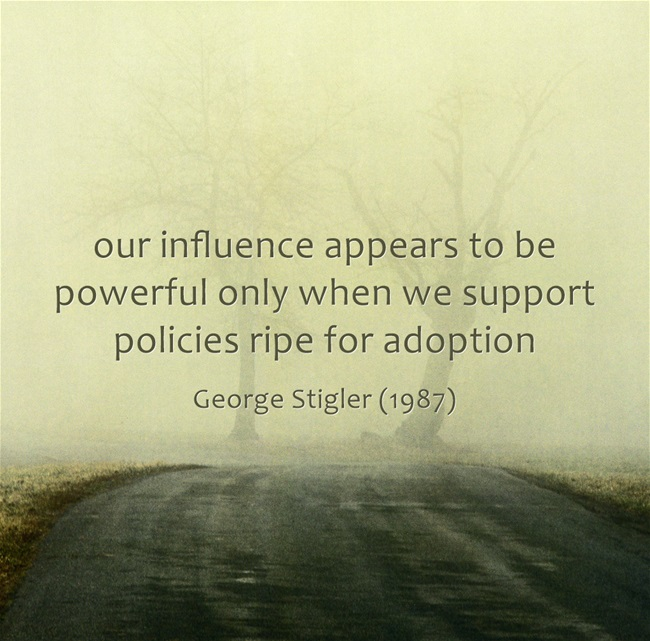
George Stigler argued that ideas about economic reform needed to wait for a market.
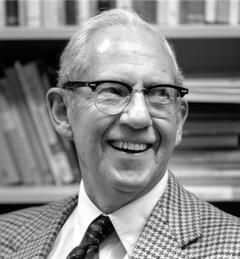
Stigler contended that economists exert a minor and scarcely detectable independent influence on the societies in which they live. As is well known, Stigler in the 1970s toasted Milton Friedman at a dinner in his honour by saying: “Milton, if you hadn’t been born, it wouldn’t have made any difference.”
Stigler said that if Richard Cobden had spoken only Yiddish, and with a stammer, and Robert Peel had been a narrow, stupid man, England would have still have repealed the corn laws. It would still have moved towards free trade in grain as its agricultural classes declined and its manufacturing and commercial classes grew in the 1840s onwards because of the industrial revolution.
As Stigler noted, when their day comes, economists seem to be the leaders of public opinion. But when the views of economists are not so congenial to the current requirements of special interest groups, these economists are left to be the writers of letters to the editor in provincial newspapers.
These days, they would post an angry blog.
Celebrating humanity's flourishing through the spread of capitalism and the rule of law
Scholarly commentary on law, economics, and more
Beatrice Cherrier's blog
Celebrating humanity's flourishing through the spread of capitalism and the rule of law
Celebrating humanity's flourishing through the spread of capitalism and the rule of law
Celebrating humanity's flourishing through the spread of capitalism and the rule of law
Why Evolution is True is a blog written by Jerry Coyne, centered on evolution and biology but also dealing with diverse topics like politics, culture, and cats.
Celebrating humanity's flourishing through the spread of capitalism and the rule of law
Celebrating humanity's flourishing through the spread of capitalism and the rule of law
A rural perspective with a blue tint by Ele Ludemann
DPF's Kiwiblog - Fomenting Happy Mischief since 2003
Celebrating humanity's flourishing through the spread of capitalism and the rule of law
The world's most viewed site on global warming and climate change
Tim Harding's writings on rationality, informal logic and skepticism
A window into Doc Freiberger's library
Let's examine hard decisions!
Commentary on monetary policy in the spirit of R. G. Hawtrey
Thoughts on public policy and the media
Celebrating humanity's flourishing through the spread of capitalism and the rule of law
Politics and the economy
A blog (primarily) on Canadian and Commonwealth political history and institutions
Reading between the lines, and underneath the hype.
Economics, and such stuff as dreams are made on
"The British constitution has always been puzzling, and always will be." --Queen Elizabeth II
Celebrating humanity's flourishing through the spread of capitalism and the rule of law
Celebrating humanity's flourishing through the spread of capitalism and the rule of law
WORLD WAR II, MUSIC, HISTORY, HOLOCAUST
Undisciplined scholar, recovering academic
Celebrating humanity's flourishing through the spread of capitalism and the rule of law
Res ipsa loquitur - The thing itself speaks
Celebrating humanity's flourishing through the spread of capitalism and the rule of law
Researching the House of Commons, 1832-1868
Articles and research from the History of Parliament Trust
Reflections on books and art
Posts on the History of Law, Crime, and Justice
Celebrating humanity's flourishing through the spread of capitalism and the rule of law
Exploring the Monarchs of Europe
Cutting edge science you can dice with
Small Steps Toward A Much Better World
“We do not believe any group of men adequate enough or wise enough to operate without scrutiny or without criticism. We know that the only way to avoid error is to detect it, that the only way to detect it is to be free to inquire. We know that in secrecy error undetected will flourish and subvert”. - J Robert Oppenheimer.
The truth about the great wind power fraud - we're not here to debate the wind industry, we're here to destroy it.
Celebrating humanity's flourishing through the spread of capitalism and the rule of law
Celebrating humanity's flourishing through the spread of capitalism and the rule of law
Economics, public policy, monetary policy, financial regulation, with a New Zealand perspective
Celebrating humanity's flourishing through the spread of capitalism and the rule of law
Restraining Government in America and Around the World




 Utopia, you are standing in it!
Recent Comments