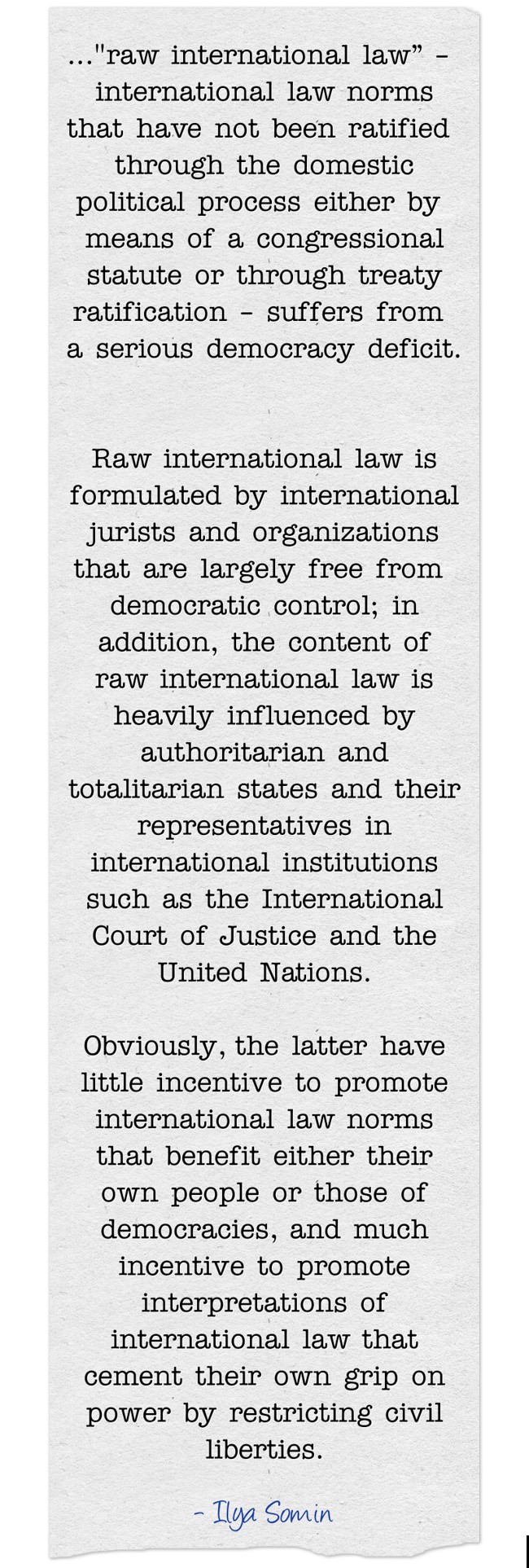
The Democracy Deficit of International Law
12 Dec 2014 Leave a comment
in environmental economics, environmentalism, international economics, law and economics Tags: Democracy deficit, international economic law, international human rights law, international humanitarian law, international investment law, international law, international trade law

The deliberate intermingling of civilians and combatants is a breach of the Law of International Armed Conflict
12 Jul 2014 Leave a comment


The Anti-War Left and the purpose of the International Humanitarian Laws of War
25 May 2014 Leave a comment
in economics, laws of war, war and peace Tags: international humanitarian law
When it comes to the raison d’être of international humanitarian law, a stout ignorance infects the Renegade Left.
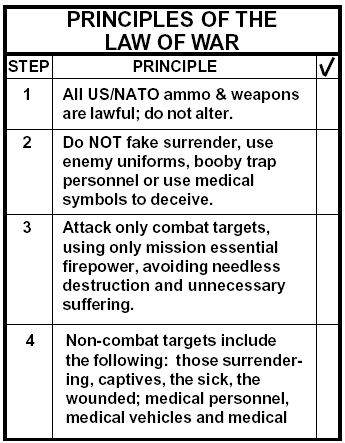

The purpose of international humanitarian law is to ensure a strict differentiation between civilians and combatants and provide for the detention and treatment of captured combatants.
The prospect of humane detention until the end of the conflict increases both the incentive to give quarter and to surrender when a military position is hopeless.
The purpose of this wartime detention of combatants is not to punish them, but to prevent return to the battlefield. Some of the detainees who have been released from Gitmo have returned to the battlefield.
The strict requirement under the Geneva conventions for combatants to carry their weapons openly and to dress in a uniform recognisable at a distance is to ensure that combatants are easy to distinguish from afar so that troops do not get trigger happy around civilians and refugee columns.
This is the fundamental purpose of international humanitarian law: saving civilians from the fighting.
In return for many legal protections from being harmed by the hostilities, civilians are strictly forbidden from engaging in hostilities.
If civilians directly engage in hostilities, they are considered unlawful or unprivileged combatants or belligerents. They may be prosecuted under the law of the detaining state. Both lawful and unlawful combatants may be interned for the duration in wartime, and they may be interrogated and also prosecuted for war crimes.
The severest of punishments are allowed for spies, saboteurs, infiltrators, francs-tireurs and guerrillas. Not carrying weapons openly and not dressing in a military uniform that is recognisable from a distance is a self-inflicted death sentence.
In the Battle of the Bulge, the English-speaking Nazi infiltrators dressed in American uniforms lost all interest in their missions once the first few who were captured were court-martialled in the field and immediately shot. This was the standard practice of every army at the time.
The Hostages Trial at Nuremburg dismissed some murder charges against some German commanders because partisan fighters in Europe could not be considered lawful belligerents under Article 1 of the 1907 Hague convention. The Tribunal stated:
We are obliged to hold that such guerrillas were francs tireurs who, upon capture, could be subjected to the death penalty. Consequently, no criminal responsibility attaches to the defendant List because of the execution of captured partisans…
The term combatant denotes the right to participate directly in hostilities. Lawful combatants cannot be prosecuted for lawful acts of war in the course of military operations even if their behaviour would constitute a serious crime in peacetime.
The term unlawful combatant was first used in US law in a 1942 United States Supreme Court decision in the case Ex parte Quirin.
The Supreme Court upheld the jurisdiction of a U.S. military tribunal over the trial of several German saboteurs in the US. This judgment states:
By universal agreement and practice, the law of war draws a distinction between the armed forces and the peaceful populations of belligerent nations and also between those who are lawful and unlawful combatants.
Lawful combatants are subject to capture and detention as prisoners of war by opposing military forces. Unlawful combatants are likewise subject to capture and detention, but in addition they are subject to trial and punishment by military tribunals for acts which render their belligerency unlawful.
The criteria from a just war include "serious prospects of success" and "the use of arms must not produce evils and disorders graver than the evil to be eliminated.
Neither applies to the firing of missiles from the Gaza into Israel after the 2005 disengagement.
When was the last time the Progressive Left denounced Hamas as war criminals for targeting civilians in Israel and intermingling with their own civilians for cover. Both are war crimes
This Google map shows much of the Gaza Strip is rural. There is plenty of rural land that is ideal for Hamas military bases this away from civilian centres as required by the laws of war.
The laws of war do not make it safer to be a combatant.
The laws of war are designed to reduce the chances that civilians are attacked because they are near military targets and of soldiers unlawfully intermingle among them for cover.
 Utopia, you are standing in it!
Recent Comments