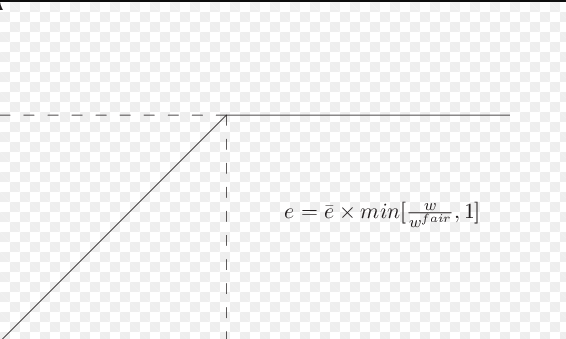
The fair-wage effort hypothesis is a theory of mass low-skilled unemployment

image

Living wage advocates make much of the demoralising effects of pay inequality on workplace productivity. In common with the efficiency wage hypothesis, this is another example of what Nozick (1974) called normative sociology; the study of what the causes of social problems ought to be. Again, living wage activists misconstrue what the fair-wage effort hypothesis was seeking to explain.

The fair-wage effort hypothesis aimed to fill gaps in the efficiency wage hypothesis by explaining why unemployment is so much higher among the lower skilled (Akerlof and Yellen 1988, 1990). Under the fair-wage effort hypothesis, workers slack off if paid less than they think they deserve:

The motivation for the fair wage-effort hypothesis is a simple observation concerning human behavior: when people do not get what they deserve, they try to get even (Akerlof and Yellen 1990, p. 256).

Lazear (1989, 1991) contends that employers too may want greater pay equity to temper over-competitiveness in teams. If pay and promotions in a team are linked to the relative performance of its members, large pay differentials may undermine co-operation and might encourage sabotage:

Very large pay spreads induce high effort, but they also create a work environment in the firm that is not very pleasant… individuals who are competing with one another can either seek to outperform others, or they can contribute to the failure of others. Such incentives can result in collusion (Dye, 1984) or in sabotage (Lazear, 1989). Thus, pay structure must strike a balance between providing incentives for effort and reducing the adverse consequences associated with this kind of industrial politics (Lazear and Shaw 2007, p. 95).

Lazear’s (1989, 1991) theory about the industrial politics arising from pay inequality stressed how sizable rewards to individual members of a team could lead to a lack of team play and lower team output. If the prizes were smaller for superior relative performance, the pay rise after a promotion or the annual performance bonus, there may be more teamwork (Lazear 1989, 1991). Akerlof and Yellen (1990) were correct in their insight that their hypothesis about fair-wage effort applies more to workers on lower wages with fewer chances of moving up promotion ladders and pay scales.

The fair-wage effort hypothesis is but another Keynesian macroeconomic theory of unemployment:

The hypothesis explains the existence of unemployment. Unemployment occurs when the fair wage w* exceeds the market-clearing wage. With natural specifications of the determination of w*, this hypothesis may explain why skill and unemployment are negatively correlated. In addition, it potentially explains wage differentials and labor market segmentation (Akerlof and Yellen 1990, p. 256).

The fair-wage effort hypothesis was developed as a descendant of the efficiency wage hypothesis because the latter cannot explain why wages are high for everyone working in high-paid industries:

All workers in better-paid industries tend to receive positive wage premia. That is, the wages of secretaries and engineers are highly correlated across industries. Ease of supervision and the magnitude of turnover costs might well be correlated across industries for a given occupation explaining, for example, why, say, skilled machinery operators receive positive wage premia in most industries. But there is no obvious reason why, say, secretaries, should be harder to supervise in the chemical industry where pay is high, than in the apparel industry where pay is low (Akerlof and Yellen 1988, p. 44).

The efficiency wage hypothesis also offered “no natural explanation” for why unemployment rates [JC1] are much higher among the lower-skilled (Akerlof and Yellen 1990). Skilled workers are probably more difficult to monitor than the unskilled so their unemployment rates should be higher than for the low-skilled as a worker discipline device but the contrary is the case (Akerlof and Yellen 1990).

The fair-wage effort hypothesis aimed to fill gaps in the efficiency wage theory of unemployment by explaining why low skilled unemployment is much higher both in recessions and in better times. Living wage activists must accept that their demands for workplace pay equity increase low-skilled unemployment under a Keynesian theory which they embrace with considerable enthusiasm.

If high wages are paid to the more skilled to attract the best applicants, demands for pay equity by their less skilled co-workers could price some of them out of the market leading to unemployment (Akerlof and Yellen 1988, 1990). In addition, pay equity norms are unlikely to respond quickly enough to fluctuations in aggregate demand so wages can be too high in recessions causing mass unemployment of the low skilled (Akerlof and Yellen 1988, 1990; Summers 1988). The unemployed cannot successfully offer to work for less than existing workers do in a recession because they cannot make a credible commitment to eschew fairness considerations once hired (Akerlof 2002).

An important premise of New Keynesian macroeconomics is demands for pay equity come at a price. At a price that is high enough for the efficiency wage and fair-wage effort hypotheses to be put as a comprehensive New Keynesian explanations of involuntary mass unemployment (Gordon 1990).

Both the efficiency wage hypothesis and the fair-wage effort hypothesis are attempts to flesh out a theory of extensive labour market dysfunction leading to mass unemployment. Living wage activists are using Keynesian theories of why wages are too high to argue for even higher wages.
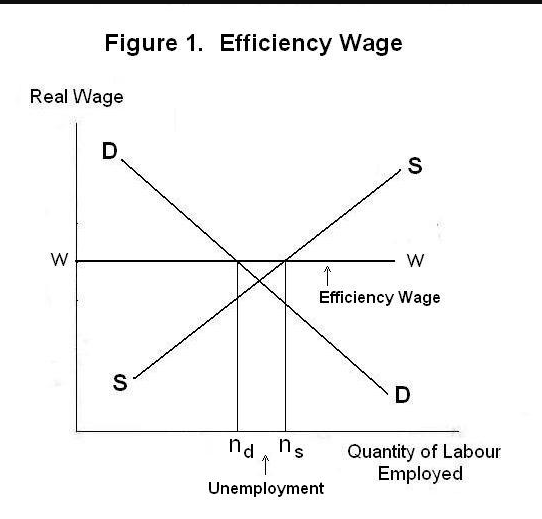
An efficiency wage is a theory of persistent mass unemployment

image

Shapiro and Stiglitz (1984) first put forward their theory of an efficiency wage to explain large-scale involuntary unemployment. It was the very real threat of a prolonged spell of unemployment (rather than a morale boosting pay rise) that motivated employees to put in more effort to keep their jobs:

To induce the worker not too shirk, the firm attempts to pay more the “going rate”; then, if the worker is caught shirking and is fired, he will pay a penalty. If it pays one firm to raise its wage, it pays all firms to raise their wages. When they all raise their wages, the incentive to shirk again disappears. But as all firms raise their wages, the demand for labour decreases, and unemployment results. With unemployment, even if all firms pay the same wage, a worker has an incentive not to shirk. For, if he is fired, an individual will not immediately obtain another job. The equilibrium unemployment rate must be sufficiently large that it pays the workers to work rather than take the risk of being caught shirking (Shapiro and Stiglitz 1984, p. 435).

The unemployed offer to work for less pay than existing employees but they are not hired because their labour productivity is not assured at this lower pay (Akerlof 1982, 1984; Katz 1986, 1988; Yellen 1984). There is involuntary mass unemployment because of the prevalence of efficiency wages:

If there is involuntary unemployment in an equilibrium situation, it must be that firms, for some reason or other, wish to pay more than the market-clearing wage. And that is the heart of any efficiency-wage theory (Akerlof 1984, p. 79).

Direct parallels were quickly drawn between the efficiency wage hypothesis as a worker discipline device eliciting greater effort and the old Marxist concept of the reserve army of the unemployed:

… it pays each firm to increase its wage to eliminate shirking. When all firms do this, the average wage rises and employment is reduced. In equilibrium, all firms pay a wage above the market clearing level, creating unemployment. Since jobs are scarce and rationed, the loss of a job can involve a lengthy spell of unemployment. The reserve army of the unemployed acts as a discipline device making shirking costly (Katz 1986, pp. 240-41).

It is misconceived for living wage activists to use a theory of lengthy unemployment to justify a large living wage rise but argue that there will be little unemployment because of the efficiency wage effects. This is the exact opposite of what the efficiency wage hypothesis is about. The leading Keynesian macroeconomists of their generation were striving to explain mass unemployment:

… the economists who developed the theory of efficiency wages (including Shapiro and Stiglitz, Akerlof and Yellen and Yellen) had no illusions that they were helping business firms to discover a new way to increase profits. The economists who developed efficiency wage theory were trying to explain persistent unemployment. Hence the title of Janet Yellen’s famous survey, Efficiency Wage Models of Unemployment.

The question that motivated efficiency wage theory was not why firms should raise wages but why firms don’t cut wages when they should. The answer they gave was that firms don’t cut wages despite unemployment because they fear that workers will respond to lower wages with reduced productivity …

In the original efficiency wage literature, there is no wishful thinking–no idea that we can have more of everything that we want without trade-offs. Instead of being desirable, the efficiency wage is a problem because lower wages would reduce unemployment and be better for the economy … the efficiency wage theorists took it for granted that to the extent that firms can increase profits by raising wages they have already done so (hence the persistent unemployment) (Tabarrok 2015).

Gordon was blunt about why efficiency wage arguments were popular and with whom

If any development in the microeconomics of labor markets could be called the “rage of the 80s,” it is efficiency wage theory, based on the hypothesis that worker productivity depends on the level of the real wage. When there is such a link between the wage rate and worker efficiency, firms may rationally pay a real wage rate that exceeds the market-clearing level. Firms may refuse to reduce the wage to hire members of a pool of unemployed workers who may be available at a lower wage, fearful that a reduction in real wages for existing workers may reduce productivity by more than the gain in lower wages (Gordon 1990, p. 1157).

Living wage activists have it the wrong way around about the social benefits of paying an efficiency wage. The efficiency wage hypothesis is a theory of why wages are too high and employment is too low (Akerlof 1982, 1984, 2002; Yellen 1984; Katz 1986, 1988; Stiglitz 2002). Living wage activists are using a well-respected theory of why wages are too high to argue that wages are too low.

Robert Lucas on the voluntary and involuntary unemployment distinction

Robert Lucas in a famous 1978 paper argued that all unemployment was voluntary because involuntary unemployment was a meaningless concept:

“The worker who loses a good job in prosperous time does not volunteer to be in this situation: he has suffered a capital loss. Similarly, the firm which loses an experienced employee in depressed times suffers an undesirable capital loss.

Nevertheless the unemployed worker at any time can always find some job at once, and a firm can always fill a vacancy instantaneously. That neither typically does so by choice is not difficult to understand given the quality of the jobs and the employees which are easiest to find.

Thus there is an involuntary element in all unemployment, in the sense that no one chooses bad luck over good; there is also a voluntary element in all unemployment, in the sense that however miserable one’s current work options, one can always choose to accept them.”

I agree that we all make choices subject to constraints. To say that a choice is involuntary because it is constrained by a scarcity of job-opportunities information is to say that choices are involuntary because there is scarcity. Alchian said there are always plenty of jobs because to suppose the contrary suggests that scarcity has been abolished.

Lucas elaborated further in 1987 in Models of Business Cycles:

A theory that does deal successfully with unemployment needs to address two quite distinct problems. One is the fact that job separations tend to take the form of unilateral decisions – a worker quits, or is laid off or fired – in which negotiations over wage rates play no explicit role.

The second is that workers who lose jobs, for whatever reason, typically pass through a period of unemployment instead of taking temporary work on the ‘spot’ labour market jobs that are readily available in any economy.

Of these, the second seems to me much the more important: it does not ‘explain’ why someone is unemployed to explain why he does not have a job with company X. After all, most employed people do not have jobs with company X either. To explain why people allocate time to a particular activity – like unemployment – we need to know why they prefer it to all other available activities: to say that I am allergic to strawberries does not ‘explain’ why I drink coffee.

Neither of these puzzles is easy to understand within a Walrasian framework, and it would be good to understand both of them better, but I suggest we begin by focusing on the second of the two.

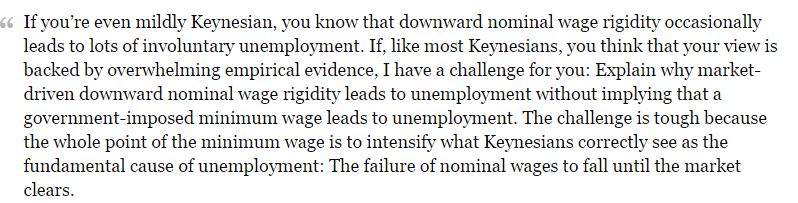
If You’re A Keynesian Then You Must Believe The Minimum Wage Increases Unemployment

image

Via If You’re A Keynesian Then You Must Believe The Minimum Wage Increases Unemployment and The Myopic Empiricism of the Minimum Wage, Bryan Caplan | EconLog | Library of Economics and Liberty.

Bassett, Brash & Hide

Celebrating humanity's flourishing through the spread of capitalism and the rule of law

Truth on the Market

Scholarly commentary on law, economics, and more

The Undercover Historian

Beatrice Cherrier's blog

Matua Kahurangi

Celebrating humanity's flourishing through the spread of capitalism and the rule of law

Temple of Sociology

Celebrating humanity's flourishing through the spread of capitalism and the rule of law

Velvet Glove, Iron Fist

Celebrating humanity's flourishing through the spread of capitalism and the rule of law

Why Evolution Is True

Why Evolution is True is a blog written by Jerry Coyne, centered on evolution and biology but also dealing with diverse topics like politics, culture, and cats.

Down to Earth Kiwi

Celebrating humanity's flourishing through the spread of capitalism and the rule of law

NoTricksZone

Celebrating humanity's flourishing through the spread of capitalism and the rule of law

Homepaddock

A rural perspective with a blue tint by Ele Ludemann

Kiwiblog

DPF's Kiwiblog - Fomenting Happy Mischief since 2003

The Dangerous Economist

Celebrating humanity's flourishing through the spread of capitalism and the rule of law

Watts Up With That?

The world's most viewed site on global warming and climate change

The Logical Place

Tim Harding's writings on rationality, informal logic and skepticism

Doc's Books

A window into Doc Freiberger's library

The Risk-Monger

Let's examine hard decisions!

Uneasy Money

Commentary on monetary policy in the spirit of R. G. Hawtrey

Barrie Saunders

Thoughts on public policy and the media

Liberty Scott

Celebrating humanity's flourishing through the spread of capitalism and the rule of law

Point of Order

Politics and the economy

James Bowden's Blog

A blog (primarily) on Canadian and Commonwealth political history and institutions

Science Matters

Reading between the lines, and underneath the hype.

Peter Winsley

Economics, and such stuff as dreams are made on

A Venerable Puzzle

"The British constitution has always been puzzling, and always will be." --Queen Elizabeth II

The Antiplanner

Celebrating humanity's flourishing through the spread of capitalism and the rule of law

Bet On It

Celebrating humanity's flourishing through the spread of capitalism and the rule of law

History of Sorts

WORLD WAR II, MUSIC, HISTORY, HOLOCAUST

Roger Pielke Jr.

Undisciplined scholar, recovering academic

Offsetting Behaviour

Celebrating humanity's flourishing through the spread of capitalism and the rule of law

JONATHAN TURLEY

Res ipsa loquitur - The thing itself speaks

Conversable Economist

Celebrating humanity's flourishing through the spread of capitalism and the rule of law

The Victorian Commons

Researching the House of Commons, 1832-1868

The History of Parliament

Articles and research from the History of Parliament Trust

Books & Boots

Reflections on books and art

Legal History Miscellany

Posts on the History of Law, Crime, and Justice

Sex, Drugs and Economics

Celebrating humanity's flourishing through the spread of capitalism and the rule of law

European Royal History

Exploring the Monarchs of Europe

Tallbloke's Talkshop

Cutting edge science you can dice with

Marginal REVOLUTION

Small Steps Toward A Much Better World

NOT A LOT OF PEOPLE KNOW THAT

“We do not believe any group of men adequate enough or wise enough to operate without scrutiny or without criticism. We know that the only way to avoid error is to detect it, that the only way to detect it is to be free to inquire. We know that in secrecy error undetected will flourish and subvert”. - J Robert Oppenheimer.

STOP THESE THINGS

The truth about the great wind power fraud - we're not here to debate the wind industry, we're here to destroy it.

Lindsay Mitchell

Celebrating humanity's flourishing through the spread of capitalism and the rule of law

Alt-M

Celebrating humanity's flourishing through the spread of capitalism and the rule of law

croaking cassandra

Economics, public policy, monetary policy, financial regulation, with a New Zealand perspective

The Grumpy Economist

Celebrating humanity's flourishing through the spread of capitalism and the rule of law

International Liberty

Restraining Government in America and Around the World