Anti-science Left alert: climate alarmists routinely reject the IPCC consensus
10 Dec 2014 Leave a comment
in environmental economics, global warming Tags: Anti-Science left, climate alarmists, conjecture and refutation, global warming, IPCC
Bjørn Lomborg says that the UN climate panel’s latest report tells a story that politicians prefer to ignore
09 Nov 2014 Leave a comment
in climate change, energy economics, environmental economics, global warming Tags: Bjørn Lomborg, climate alarmism, global warming, green rent seeking, IPCC
The second IPCC installment showed that the temperature rise that we are expected to see sometime around 2055-2080 will create a net cost of 0.2-2% of GDP – the equivalent of less than one year of recession…
Again, not surprisingly, politicians tried to have this finding deleted. British officials found the peer-reviewed estimate “completely meaningless,” and, along with Belgium, Norway, Japan, and the US, wanted it rewritten or stricken. One academic speculated that governments possibly felt “a little embarrassed” that their previous exaggerated claims would be undercut by the UN.
The third installment of the IPCC report showed that strong climate policies would be more expensive than claimed as well – costing upwards of 4% of GDP in 2030, 6% in 2050, and 11% by 2100.
And the real cost will likely be much higher, because these numbers assume smart policies, instantly enacted, with key technologies magically available.
IPCC report: six graphs that show how we’re changing the world’s climate
01 Nov 2014 Leave a comment
in environmental economics, global warming Tags: IPCC

Global Temperature Trends and the IPCC
08 Oct 2014 Leave a comment
in environmental economics, global warming Tags: forecasting errors, global warming, IPCC
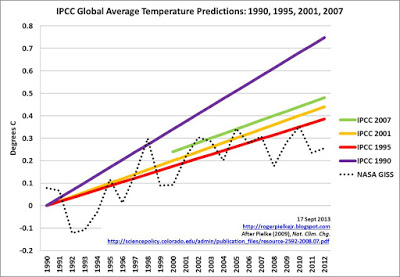
Via rogerpielkejr
The global warming hiatus? Climate models all wrongly predicted warming, so let’s call it a discrepancy
22 Jun 2014 Leave a comment
in economics of climate change, environmental economics, global warming Tags: climate change, hiatus in global warming, IPCC

Ross McKitrick noted this week that the IPCC still uses the word unequivocal to describe the evidence, but has let a new word slip into its lexicon : hiatus – the global warming hiatus since 1998.

How times have changed. Up until now, to mention this hiatus was to be a climate denier – pure wickedness: to be anti-science and a paid lackey or wannabe paid lackey of Big Oil.

Has the IPCC become a climate denier? Trends change. Differentiating a break in trend from fluctuations around a trend is never easy.

I have not seen a statement of when this hiatus becomes a break in trend. Nor have I seen an estimate of when a return of warming, in what year in the 2020s or 2030s or whenever, will a return in warming make recent trends in global temperatures statistically significant evidence of global warming.
Richard Tol: IPCC again
27 Apr 2014 Leave a comment
in economics, environmental economics, global warming, politics Tags: global warming, IPCC, Richard Tol
Richard Tol reports that landlocked countries vigorously protested at IPCC meetings that they too would suffer from sea level rise!

This was because the international climate negotiations of 2013 in Warsaw concluded that poor countries might be entitled to compensation for the impacts of climate change.
The assessment of the size of those impacts and hence any compensation led to an undignified bidding war among delegations – my country is more vulnerable than yours. Landlocked countries had no intention of missing out.
The IPCC is a typical multilateral meeting process from Tol’s description:
- Many countries send a single person delegation.
- Some countries can afford to send many delegates.
- They work in shifts, exhausting the other delegations with endless discussions about trivia, so that all important decisions are made in the final night with only a few delegations left standing.
Naturally, all inconvenient truths are vetoed, as Tol explains, listing the following omissions and redrafts of the Summary for Policy Makers:
- it omits to say that better cultivars and improved irrigation increase crop yields;
- it shows the impact of sea level rise on the most vulnerable country, but does not mention the average;
- it emphasizes the impacts of increased heat stress but downplays reduced cold stress; and
- it warns about poverty traps, violent conflict and mass migration without much support in the literature.
Tol then aptly states his position on it all:
Alarmism feeds polarization.
Climate zealots want to burn heretics of global warming on a stick.
Others only see incompetence and conspiracy in climate research, and nepotism in climate policy.
A polarized debate is not conducive to enlightened policy in an area as complex as climate change – although we only need a carbon tax, and a carbon tax only, that applies to all emissions and gradually and predictably rises over time.
HT: Catallaxyfiles
Is the IPCC Government Approval Process Broken? | Robert Stavins
27 Apr 2014 Leave a comment
in environmental economics, global warming, politics, Public Choice Tags: global warming, IPCC
Robert Stavins, the Co-Coordinating Lead Author of Chapter 13, “International Cooperation: Agreements and Instruments,” of Working Group III (Mitigation) of the Fifth Assessment Report of the Intergovernmental Panel on Climate Change (IPCC) has written a letter arguing the following:
- If the IPCC is to continue to survey scholarship on international cooperation in future assessment reports, it should not put country representatives in the uncomfortable and fundamentally untenable position of reviewing text in order to give it their unanimous approval.
- In my view, with the current structure and norms, it will be exceptionally difficult, if not impossible, to produce a scientifically sound and complete version of text for the SPM on international cooperation that can survive the country approval process.
- The general motivations for government revisions – from most (but not all) participating delegations – appeared to be quite clear in the plenary sessions.
- These motivations were made explicit in the “contact groups,” which met behind closed doors in small groups with the lead authors on particularly challenging sections of the SPM.
- In these contact groups, government representatives worked to suppress text that might jeopardize their negotiating stances in international negotiations under the United Nations Framework Convention on Climate Change (UNFCCC).
- Nearly all delegates in the meeting demonstrated the same perspective and approach, namely that any text that was considered inconsistent with their interests and positions in multilateral negotiations was treated as unacceptable.
HT: Catallaxyfiles
The incentives to research the economics of global warming – the minimum wage edition
02 Apr 2014 Leave a comment
in applied welfare economics, economics of natural disasters, environmental economics, personnel economics, Public Choice Tags: David Card, global warming, IPCC, Richard Tol
David Card’s research suggested that small rises in the minimum wage do not reduce employment by much.
He said that he did not do much further research in the area because people were so personally unpleasant for him:
I haven’t really done much since the mid-’90s on this topic. There are a number of reasons for that that we can go into.
I think my research is mischaracterized both by people who propose raising the minimum wage and by people who are opposed to it.
… it cost me a lot of friends. People that I had known for many years, for instance, some of the ones I met at my first job at the University of Chicago, became very angry or disappointed.
They thought that in publishing our work we were being traitors to the cause of economics as a whole.
I also thought it was a good idea to move on and let others pursue the work in this area. You don’t want to get stuck in a position where you’re essentially defending your old research.
You need a thick hide and academic tenure to do research into the minimum wage these days. There are plenty of research topics that do not cost you friends.
Richard Tol has pointed out that maybe 20 or so academic economists work on climate change on a regular basis. Many of the key survey papers are written by the same few people, including him.

The reasons were that inter-disciplinary works is looked down on in the economics profession and government agencies do not like what economic research says about the costs and benefits of global warming so they pre-emptively do not fund it.
Richard Tol quit as the lead author of an economics chapter of the most recent of the IPCC report after a dispute about research techniques. Tol had been invited to help in the drafting in a team of 70 and was also the coordinating lead author of a sub-chapter about economics.
When he dissented about the quality and alarmist nature of the economics of the IPCC reports, they smeared him so badly as a fringe figure that you wonder why they hired him in the first place.
The co-chair of the IPCC working group that produced the report, said Richard Tol was outside the mainstream scientific community and was upset because his research had not been better represented in the summary:
“When the IPCC does a report, what you get is the community’s position. Richard Tol is a wonderful scientist but he’s not at the centre of the thinking. He’s kind of out on the fringe,” Professor Field said before the report’s release.
You cannot, on the one hand, say that you have hired the best and the brightest to work on “the greatest moral, economic and social challenge of our time” and then say that a dissenting member is a fringe figure. If that was true, rather than a smear, he would never have been hired in the first instance.
Nor would Richard Tol have been asked to write a 2009 survey of the economics of climate change for the leading surveys journal in all of economics – The Journal of Economic Perspectives. This fringe figure said in that survey in 2009 that:
Only 14 estimates of the total damage cost of climate change have been published, a research effort that is in sharp contrast to the urgency of the public debate and the proposed expenditure on greenhouse gas emission reduction.
These estimates show that climate change initially improves economic welfare. However, these benefits are sunk.
Impacts would be predominantly negative later in the century.
Global average impacts would be comparable to the welfare loss of a few percent of income, but substantially higher in poor countries.
Still, the impact of climate change over a century is comparable to economic growth over a few years.
The IPCC hired Tol because their economics of global warming chapters would have lacked credibility if he had not been on the team. LBJ said that it is better to have someone inside the tent pissing out than outside pissing in.
Richard Tol even has an academic stalker:
Bob Ward, has reached a new level of trolling. He seems to have taking it on himself to write to every editor of every journal I have ever published in, complaining about imaginary errors even if I had previously explained to him that these alleged mistakes in fact reflect his misunderstanding and lack of education. Unfortunately, academic duty implies that every accusation is followed by an audit. Sometimes an error is found, although rarely by Mr Ward.
Richard Tol blogs at http://richardtol.blogspot.co.nz/
 Utopia, you are standing in it!
Recent Comments