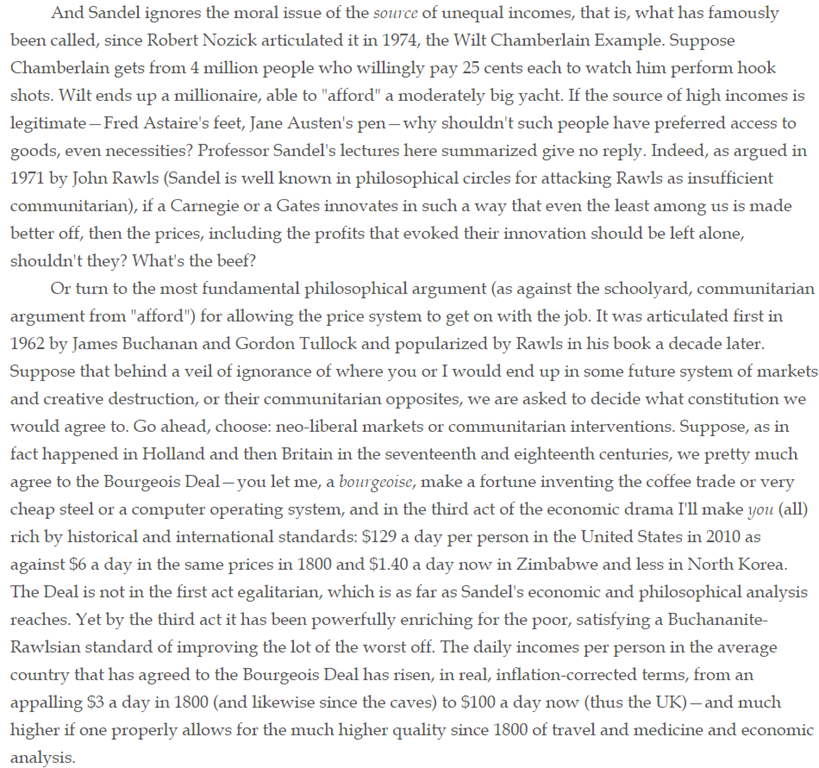
Source: Review of Michael J. Sandel’s What Money Can’t Buy: The Moral Limit of Markets by Deirdre McCloskey August 1, 2012. Shorter version published in the Claremont Review of Books XII(4), Fall 2012 via Deirdre McCloskey: editorials.
Celebrating humanity's flourishing through the spread of capitalism and the rule of law
02 Jan 2017 Leave a comment
in applied price theory, applied welfare economics, comparative institutional analysis, constitutional political economy, development economics, economic history, Gordon Tullock, growth miracles, history of economic thought, James Buchanan, James Buchanan, labour economics, law and economics, poverty and inequality, property rights, Public Choice, Rawls and Nozick Tags: creative destruction, Deirdre McCloskey, industrial revolution, John Rawls, Robert Nozick, The Great Enrichment, The Great Escape, The Great Fact, top 1%, veil of ignorance, veil of uncertainty
Source: Review of Michael J. Sandel’s What Money Can’t Buy: The Moral Limit of Markets by Deirdre McCloskey August 1, 2012. Shorter version published in the Claremont Review of Books XII(4), Fall 2012 via Deirdre McCloskey: editorials.
18 Aug 2015 Leave a comment
in liberalism, Rawls and Nozick Tags: individual rights, John Rawls, liberalism, political philosophy, Robert Nozick


15 Aug 2015 2 Comments
in constitutional political economy, economics of crime, environmental economics, global warming, law and economics, liberalism, politics - New Zealand, Public Choice, Rawls and Nozick, rentseeking Tags: civil disobedience, climate alarmism, expressive voting, Greenpeace, John Rawls, Justice Scalia, Leftover Left, rule of law
PRESS RELEASE: Greenpeace Parliament Climbers Convicted of Trespass bit.ly/1DRfKMG #realclimateaction http://t.co/sxRokpwRNk—
Greenpeace NZ (@GreenpeaceNZ) August 13, 2015
The Greenpeace vandals who trespassed at Parliament, climbing up to put signs down the front in flagrant disregard of the most ample possible options for peaceful protest right outside at least had the integrity to plead guilty. That shows some sort of fidelity to law and an acknowledgement that what they did was a criminal offence.
John Rawls makes the point that the purpose of civil disobedience is not to impose your will upon others but through your protest to implore them to reconsider their position and change the law or policy you are disputing.
Rawls argues that civil disobedience is never covert or secretive; it is only ever committed in public, openly, and with fair notice to legal authorities. Openness and publicity, even at the cost of having one’s protest frustrated, offers ways for the protesters to show their willingness to deal fairly with authorities. Rawls argues:
Rawls argues, and too many forget, that civil disobedience and dissent more generally contribute to the democratic exchange of ideas by forcing the champions of dominant opinion to defend their views.
Legitimate non-violent direct action are publicity stunts to gain attention and provoke debate within the democratic framework, where we resolve our differences by trying to persuade each other and convince the electorate.
Too many acts of non-violent direct action aim to impose their will on others rather than peaceful protests designed to bring about democratic change in the laws or policies of the incumbent government. That ‘might does not make right’ is fundamental to the rule of law. As United States Supreme Court Justice Antonin Scalia said
The virtue of a democratic system [with a constitutionally guaranteed right to free speech] is that it readily enables the people, over time, to be persuaded that what they took for granted is not so and to change their laws accordingly..
Both sides passionately but respectfully attempt to persuade their fellow citizens to accept their views. Win or lose, advocates for today’s losing causes can continued pressing their cases, secure in the knowledge that an electoral loss today can be negated by a later electoral win, which is democracy in action as Justice Kennedy explains:
…a democracy has the capacity—and the duty—to learn from its past mistakes; to discover and confront persisting biases; and by respectful, rationale deliberation to rise above those flaws and injustices…
It is demeaning to the democratic process to presume that the voters are not capable of deciding an issue of this sensitivity on decent and rational grounds.
The process of public discourse and political debate should not be foreclosed even if there is a risk that during a public campaign there will be those, on both sides, who seek to use racial division and discord to their own political advantage. An informed public can, and must, rise above this. The idea of democracy is that it can, and must, mature.
Freedom embraces the right, indeed the duty, to engage in a rational, civic discourse in order to determine how best to form a consensus to shape the destiny of the Nation and its people. These First Amendment dynamics would be disserved if this Court were to say that the question here at issue is beyond the capacity of the voters to debate and then to determine.
John Rawls’ view that fidelity to law and democratic change through trying to persuade each other is at the heart of civil disobedience reflects the difference between the liberal and the left-wing on democracy and social change as Jonathan Chait observed this week:
Liberals treat political rights as sacrosanct. The left treats social and economic justice as sacrosanct. The liberal vision of political rights requires being neutral about substance.
To the left, this neutrality is a mere guise for maintaining existing privilege; debates about “rights” can only be resolved by defining which side represents the privileged class and which side represents the oppressed…
Liberals believe that social justice can be advanced without giving up democratic rights and norms. The ends of social justice do not justify any and all means.
How the left-wing and liberal visions of democracy are different nymag.com/daily/intellig… http://t.co/Qk5vS9SaV4—
Jonathan Chait (@jonathanchait) August 13, 2015
01 Aug 2015 Leave a comment
in economics of crime, environmental economics, environmentalism, law and economics, politics - Australia, politics - New Zealand, politics - USA, property rights, Rawls and Nozick, transport economics Tags: Greenpeace, John Rawls, peaceful protest
Were the Greenpeace runabouts observing maritime safety rules such as avoiding collisions and giving way? Any protester that behaved like that in a car would be immediately arrested and charged.
Why it is tolerated in the high seas is beyond me when it would never be tolerated on the road. No one would pretend reckless driving was peaceful protest. Is it okay to behave recklessly in a boat? No one would accept that in a car on land.
Central to the notion of peaceful protest is fidelity to democracy and the rule of law. The idea is not to impose your will upon others, but to persuade the majority to reconsider their position by showing the passionate extent to which you disagree with them and honestly believe they are mistaken.
The civil disobedient is attempting to appeal to the “sense of justice” of the majority and a willingness to accept arrest is proof of the integrity of the act says Rawls:
…any interference with the civil liberties of others tends to obscure the civilly disobedient quality of one’s act.
Rawls argues that the use or threat of violence is incompatible with a reasoned appeal to fellow citizens to move them to change a law. The actions are not a means of coercing or frightening others into conforming to one’s wishes. That is a breach of the principles of a just society.
06 Jul 2015 Leave a comment
in applied welfare economics, constitutional political economy, economic history, Rawls and Nozick Tags: Brad Delong, Elizabeth Warren, good old days, John Rawls, The Great Enrichment, The Great Escape, The Great Fact, time machine, Twitter left
Brad DeLong set up a thought experiment to work out if we were better off than in the good old days. He asked how much money would you want to take with you if you had to step into a time machine to go back to some specific point in time and not be worse off for the trip in living standards and life expectancy. He was writing in 1995, talking about going back to 1895.

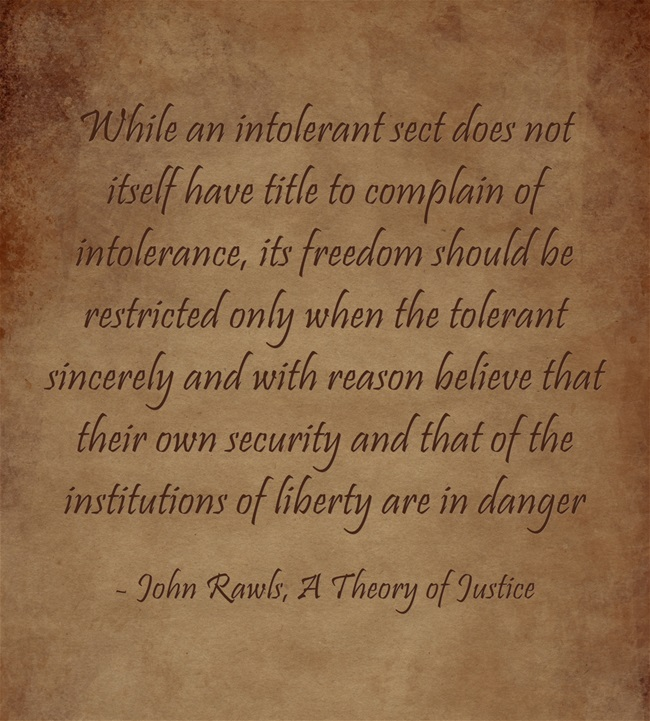
John Rawls asks a similar question by saying what type of society would you to agree to in a social contract if you’re behind a veil of ignorance. You didn’t know where you were going to be in society behind the veil of ignorance.

All you know you is you will be some random member of that society, at the top, bottom or somewhere in between.
…no one knows his place in society, his class position or social status; nor does he know his fortune in the distribution of natural assets and abilities, his intelligence and strength, and the like.
What social institutions would you agree in that society given you don’t know where you will be in it?
John Rawls also said that the society was fair if you didn’t mind showing up somewhere in it as a random member.

Let’s suppose a thought experiment which combines a time machine with a veil of ignorance:
Behind that inter-temporal veil of ignorance, would you choose to be a random member of your own society or prefer to beam back in time to before the ravages of neoliberalism destroyed the good old days?
Apparently, we not a cent better off compared to the 70s because all the income gains, every single cent, went into the pockets of the top 10%, if Senator Warren is to be believed in her recent Washington post op-ed:
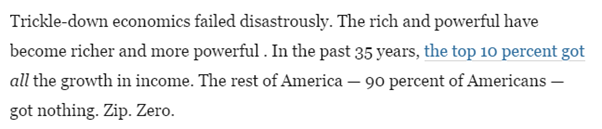
When you line up by Senator Warren to go into the time machine, remember to leave your iPhones and air points at the door.
Innovation is letting us accomplish more with less. Learn more: buff.ly/1LmtAZD #tech #progress http://t.co/e2kQlGu3NA—
HumanProgress.org (@humanprogress) June 22, 2015
22 Jan 2015 Leave a comment
in economic growth, macroeconomics Tags: Edmund Phelps, Golden rule of savings, intergenerational equity, John Rawls, just savings

Why is the Left so keen to tax the rich of today, which reduces investment, but through this concerns about sustainable development, not tax the rich of the next generation by leaving them a smaller capital stock?
Rawls proposes a principle of just savings. Rawls suggests that each generation puts itself in the place of the next, and asks what it could reasonably expect to receive.
Currently living people have a justice-based reason to save for future people only if such saving is necessary for allowing future people to reach the sufficientarian threshold as specified. This is known as the accumulation stage.
Once just institutions are securely established — this is known as the steady-state stage — justice does not require people to save for future people. Rawls also holds that, in that second stage, people ought to leave their descendants at least the equivalent of what they received from the previous generation.
Edmund Phelps developed a Golden Rule in the 1960s that suggests that it is possible to save and invest too much. Phelps also generated the result that the savings rate can be too high:
The basic significance of the golden rule is as a warning against national policies of over-saving or counterproductive austerity.
Celebrating humanity's flourishing through the spread of capitalism and the rule of law
Scholarly commentary on law, economics, and more
Beatrice Cherrier's blog
Celebrating humanity's flourishing through the spread of capitalism and the rule of law
Celebrating humanity's flourishing through the spread of capitalism and the rule of law
Celebrating humanity's flourishing through the spread of capitalism and the rule of law
Why Evolution is True is a blog written by Jerry Coyne, centered on evolution and biology but also dealing with diverse topics like politics, culture, and cats.
Celebrating humanity's flourishing through the spread of capitalism and the rule of law
Celebrating humanity's flourishing through the spread of capitalism and the rule of law
A rural perspective with a blue tint by Ele Ludemann
DPF's Kiwiblog - Fomenting Happy Mischief since 2003
Celebrating humanity's flourishing through the spread of capitalism and the rule of law
The world's most viewed site on global warming and climate change
Tim Harding's writings on rationality, informal logic and skepticism
A window into Doc Freiberger's library
Let's examine hard decisions!
Commentary on monetary policy in the spirit of R. G. Hawtrey
Thoughts on public policy and the media
Celebrating humanity's flourishing through the spread of capitalism and the rule of law
Politics and the economy
A blog (primarily) on Canadian and Commonwealth political history and institutions
Reading between the lines, and underneath the hype.
Economics, and such stuff as dreams are made on
"The British constitution has always been puzzling, and always will be." --Queen Elizabeth II
Celebrating humanity's flourishing through the spread of capitalism and the rule of law
Celebrating humanity's flourishing through the spread of capitalism and the rule of law
WORLD WAR II, MUSIC, HISTORY, HOLOCAUST
Undisciplined scholar, recovering academic
Celebrating humanity's flourishing through the spread of capitalism and the rule of law
Res ipsa loquitur - The thing itself speaks
Celebrating humanity's flourishing through the spread of capitalism and the rule of law
Researching the House of Commons, 1832-1868
Articles and research from the History of Parliament Trust
Reflections on books and art
Posts on the History of Law, Crime, and Justice
Celebrating humanity's flourishing through the spread of capitalism and the rule of law
Exploring the Monarchs of Europe
Cutting edge science you can dice with
Small Steps Toward A Much Better World
“We do not believe any group of men adequate enough or wise enough to operate without scrutiny or without criticism. We know that the only way to avoid error is to detect it, that the only way to detect it is to be free to inquire. We know that in secrecy error undetected will flourish and subvert”. - J Robert Oppenheimer.
The truth about the great wind power fraud - we're not here to debate the wind industry, we're here to destroy it.
Celebrating humanity's flourishing through the spread of capitalism and the rule of law
Celebrating humanity's flourishing through the spread of capitalism and the rule of law
Economics, public policy, monetary policy, financial regulation, with a New Zealand perspective
Celebrating humanity's flourishing through the spread of capitalism and the rule of law
Restraining Government in America and Around the World




 Utopia, you are standing in it!
Recent Comments