

Celebrating humanity's flourishing through the spread of capitalism and the rule of law
26 Dec 2014 Leave a comment
in F.A. Hayek, liberalism, Rawls and Nozick Tags: FA Hayek, John Rawls
08 Jul 2014 Leave a comment
in labour economics, minimum wage Tags: difference principle, John Rawls, minimum wage, Pareto improvement, utilitarianism
 Auckland University of Technology Associate Professor Gail Pacheco is not quoted as often she should be in the politics of the minimum wage in New Zealand. Her research repeatedly finds that the increases in the minimum wage over the last 10 to 15 years in New Zealand reduced employment, increased unemployment, and reduced skill acquisition among teenagers:
In summary, increases in the youth minimum wage in New Zealand reduced employment, increased unemployment but did not reduce the profits of employers.

If the minimum wage is operating off the monopsony power of employers, investors should have anticipated that the profits of these employers will fall, but they did not. Investors anticipated that most of the consequences of the minimum wage increases would fall upon low paid workers themselves in terms of loss of employment, greater intensity of work effort and reduce training opportunities.

The minimum wage is an inefficient way of tackling poverty because many minimum-wage earners are actually teenagers or second earners in wealthy households in New Zealand and in all other countries that have a minimum wage. As soon as one person is unemployed as a result of the minimum wage increase or otherwise disadvantaged, applied welfare economics comes into play with concepts like Pareto improvement. How do you trade-off the losses for one with another’s gains.


Most are those who support the minimum wage shift gears their applied welfare economics in all other social context to emphasise how the losers should be given priority and greater weight when adding up the social gains and social losses of economic change.

The social cost of the minimum wage is not discussed in this way: how many jobs are lost and that these job losses are much more important than any gains to society. All that is done is the number of jobs lost is compared with some other social metrics such as how much the wages go up for those that still have a job and that is enough to conclude that there is a socially beneficial change from a minimum wage increase.
Any low paid workers affected by the minimum wage increase are just reduced to numbers and added and subtracted with great ease and few moral compunctions about interpersonal comparisons of utility


A minimum wage increase is not free if one worker loses their job. The Paretian Criterion states that welfare is said to increase or decrease if at least one person is made better off or worse off with no change in the positions of others.
As Rawls pointed out, a general problem that throws utilitarianism into question is some people’s interests, or even lives, can be sacrificed if doing so will maximize total satisfaction. As Rawls says:
[ utilitarianism] adopt[s] for society as a whole the principle of choice for one man… there is a sense in which classical utilitarianism fails to take seriously the distinction between persons.
Minimum wage advocates fail to take seriously that low paid workers who lose their jobs because of minimum wage increases are real living people who suffer when their interests are traded off for the greater good of their fellow low paid workers, some of whom come from much wealthier households.

If the Left want to improve the lot of the poor, they would be doing better by either promoting an institutional framework that promotes general wage growth and by simply increasing the earned income tax credit.
07 Jul 2014 Leave a comment
in applied price theory, income redistribution, politics - New Zealand, Rawls and Nozick Tags: difference principle, income distribution, John Rawls, Maori economic development, Pasifika economic development
An urban legend in New Zealand is that income inequality is going from bad to worse.
Since the mid 1990s to around 2011 there was a small net fall in New Zealand’s income inequality trend line in the graph for the Gini coefficient for the income distribution for New Zealand shows. inequality in New Zealand is similar to that in Australia, Ireland, Canada and Japan.

Source: Ministry of Social Development (2014)
Taxes and transfers have reduced inequality in New Zealand when measured by Gini coefficients, but the trend is been relatively stable for many years.
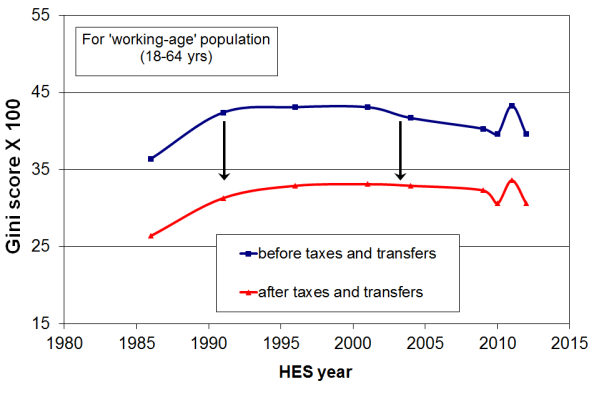
Source: Ministry of Social Development (2014)
Rawls pointed out that behind the veil of ignorance, people will agree to inequality as long as it is to everyone’s advantage. Rawls was attuned to the importance of incentives in a just and prosperous society. If unequal incomes are allowed, this might turn out to be to the advantage of everyone. Robert Nozick said that:
Political philosophers must now either work within Rawls’s theory or explain why not.
The groups that have been doing best in New Zealand have been Maori and Pasifika. In real terms, overall median household income rose 47% from 1994 to 2010; for Maori, this rise was 68%; for Pacific, 77%!

Source: Ministry of Social Development (2014)
The large improvements in Māori incomes since 1992 were based on rising Māori employment rates, fewer Māori on benefits or zero incomes, more Māori moving into higher paying jobs, and greater Māori educational attainment (Dixon and Maré 2007).
Maori unemployment reached a 20-year low of 8 per cent from 2005 to 2008. Labour force participation by Maori increased from 45% in the late 1980s to about 62% in the last few years.
Most of the remaining income disparities between Māori and non-Māori flow from differences in educational attainment and demographic and socio-economic characteristics including household composition (Chapple 2000; Maani 2004; Dixon and Maré 2007).
How much of the massive increases in incomes over the last 20 years spread throughout the entire community are you willing to give up for a little more equality? How much of your income will you donate to charity to lead the way?
.
25 Jun 2014 2 Comments
in Rawls and Nozick Tags: difference principle, distributive justice, envy, Gore Vidal, John Rawls, Richard Epstein, Robert Nozick

Nozick argues that one of the unchallenged assumptions made by egalitarians is that the have-nots resent the haves only to the extent that the haves possess power and wealth that were unearned. The envious man, if he cannot also possess a talent and success that someone else has prefers that the other not have it either. The envious man prefers neither have it if he does not have it.
An old Russian joke tells of a poor peasant whose better-off neighbour has just bought a cow. In his anguish, the peasant cries out to God for relief from his distress. When God replies and asks him what he wants him to do, the peasant replies “shoot the cow.”
Nozick said that what really rankles the have-nots is the haves who clearly earned their status and possessions:
It may injure one’s self-esteem and make one feel less worthy as a person to know of someone else who has accomplished more or risen higher.
Nozick said that proximity is a bigger factor in the creation of envy than just desert. Envy is local rather than global in its scope with your neighbour as the target of your envy is rather than far-off figures you don’t really know who may be far more wealthy and successful than the people you actually envy in your day to day lives:
Workers in a factory recently started by someone who was previously a worker will be constantly confronted with the following thoughts: ‘Why not me? Why am I only here?”
Whereas one can manage to ignore much more easily the knowledge that someone else has done more if one is not confronted daily with him.
The point, though sharper then, does not depend upon another’s deserving his superior ranking along some dimension. That there is someone else who is a good dancer will affect your estimate of how good you yourself are at dancing, even if you think that a large part of grace in dancing depends upon unearned natural assets.
These considerations make one somewhat sceptical of the chances of equalizing self-esteem and reducing envy by equalizing positions along that particular dimension upon which self-esteem is importantly based.
Knowing that another’s superior ranking along some dimension depends in part upon unearned natural assets does not soften this loss of self-esteem. These considerations made Nozick sceptical of the chances of equalizing self-esteem and reducing envy by equalizing positions along that particular dimension upon which self-esteem is importantly based.
Nozick said that a contraction of options through regulation, redistribution and other government mandates will only increase envy because it will inevitably result in fewer socially acceptable ways of demonstrating personal worth. With fewer options (i.e. less freedom), the perception of inequality and emotion of envy are likely to be more, not less pronounced. Nozick has point here: primitive societies were racked with envy and any good fortune good fortune has tainted by genuine luck from escaping harvest failures and disease.
Nozick said we should expand a person’s options through capitalism thereby making it more likely that he will find something that he does well and on which he can base his self-esteem. Nozick said we should expand a person’s options thereby making it more likely that he will find something that he does well and on which he can base his self-esteem.
Adam Smith wrote that matters of justice can only be resolved if people distance themselves from the grubby particulars their own positions in particular disputes. This view evolved into Rawls arguing that the justice of social institutions should be tested from behind a veil of ignorance where people are ignorant of their particular role in society and individual talents.

Rawls had no place for envy behind his veil of ignorance:
Rawls was nonetheless alive to the possibility is that:
The inequalities sanctioned by the difference principle may be so great as to arouse envy to a socially dangerous extent.
Rawls’ project was to outline a realistic utopia — a society that could really exist given actual human nature. Political philosophy must describe workable political arrangements that can gain support of real people as they are.

On envy, Rawls’ main fall-back was the background institutions (including a competitive economy) making it likely that excessive inequalities will not be the rule. He recognised that the income of the poorest, along with the whole of society, benefit from competition in a market economy. Richard Epstein explained how the market is important to distributive justice and social peace despite envy:
Strong competitive markets do not favour one individual over another. They work well to harness individual self-interest to generate massive amounts of wealth, widely distributed in society, through voluntary transactions. Behind the veil, rational people should the support of strong and transparent markets as their first order of business.

15 Jun 2014 Leave a comment
in economics, laws of war, Rawls and Nozick, war and peace Tags: international law, John Rawls
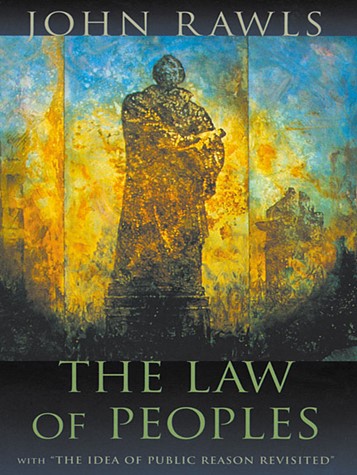
John Rawls’ Law of Peoples had as its key point that the fundamental division is not between democratic and non-democratic peoples or liberal and non-liberal, but decent and non-decent or outlaw peoples. Decent peoples allow toleration and subscribe to eight principles:
Peoples are to observe treaties and undertakings.
Peoples are equal and are parties to the agreements that bind them.
Peoples are to observe a duty of non-intervention.
Peoples have the right of self-defence but no right to instigate war for reasons other than self-defence.
Peoples are to honour human rights.
Peoples are to observe certain specified restrictions in the conduct of war.
Peoples have a duty to assist other peoples living under unfavourable conditions that prevent their having a just or decent political and social regime.
Libertarians such as Murray Rothbard define a just war thus:
· A just war exists when a people tries to ward off the threat of coercive domination by another people, or to overthrow an already-existing domination; and
· A war is unjust, when a people try to impose domination on another people, or try to retain an already existing coercive rule over them.
A condition for a just war is force may be used only after all peaceful and viable alternatives have been seriously tried and exhausted or are clearly not practical.

Most of all, save me from self-styled anti-war activists what Matt Welch called temporary doves. Temporary doves spit bile at those that support the wars they oppose – denouncing them as moral pigmies. The temporary doves then make exceptions for the wars they support and spite bile once again at those that question the whimsical nature and application of their values about just and unjust wars and the just conduct of wars.
The wars championed by the temporary doves can be equally or more bloody in civilian casualties as the wars they oppose either because of the reasons they were started or because of how these wars are conducted – civilian casualties In Iraq and Afghanistan.
Civilian casualties are put forward by the temporary doves as a moral trump card against the Iraq and Afghan wars and the atomic bombings. Many of the architects and champions of the NATO bombings in the Kosovo war opposed Gulf War II. Slobodan Milosevic, like Saddam Hussein, was described as a modern-day Hitler, eager to practice genocide against minorities and menace peaceful neighbours.
Is Bill Clinton a war criminal because he bombed Iraq and Sudan, but a human rights hero because he bombed Serbia? All of these bombings resulted in civilian deaths.
The supporters of both wars frequently invoked the Munich Agreement of 1938 and sought regime change. Perhaps less bloody but certainly slower social and political emancipation from oppression and mass murder is OK for the temporary doves for Iraq and Afghanistan but not for Kosovo. Temporary doves are just as prepared to wade up to their armpits in civilian casualties as the next warmonger, but they then put themselves forward as free of sin when they call for war crimes trials and citizen’s arrests of those that supported and conducted equally bloody wars.
Edward Luttwick argued that the Kosovo war proved that precision modern air bombardments can be effective as humanitarian interventions only in unique circumstances:
• An enemy sufficiently economically developed to offer targets worth bombing, and
• sufficiently democratic to respond to the inconvenience thereby inflicted on civilians at large; and
• yet sufficiently primitive and authoritarian to become the target of a humanitarian bombing campaign in the first place.
In most cases, from the Taliban’s Afghanistan to Zaire and from Rwanda to Sierra Leone, there were no identifiable, high-value, and relevant targets. In Bosnia, the post-heroic behaviour of almost all peacekeeping troops in UN service ranged from doing little or nothing to protect civilians while engaging in every possible form of misconduct, from black-market trafficking to cowardly passivity in the face of mass murder.
04 May 2014 Leave a comment
in applied welfare economics, economic growth, entrepreneurship, industrial organisation, market efficiency, Rawls and Nozick, technological progress Tags: envy, John Rawls, super-rich, SuperEntrepreneurs, top 1%, top talent
The report SuperEntrepreneurs shows that:
SuperEntrepreneurs examined about 1,000 self-made men and women who have earned at least $1 billion dollars and who appeared in Forbes magazine list of the world’s richest people between 1996 and 2010.

Hong Kong has the most, with around three SuperEntrepreneurs per million inhabitants, followed by Israel, the US, Switzerland and Singapore.
The US is roughly four times more super-entrepreneurial than Western Europe and three times more super-entrepreneurial than Japan.
Super-entrepreneurs tend to be well-educated – 84% have a university degree.
Many started their own company but there is no clear relationship between self-employment and successful entrepreneurship
Steven Kaplan and Joshua Rauh’s “It’s the Market: The Broad-Based Rise in the Return to Top Talent” Journal of Economic Perspectives 2013 found that those in the Forbes 400 richest are less likely to have inherited their wealth or grown-up wealthy.
Today’s super-rich are self-made rich because they produce new and better products and services that people wanted and are willing to pay for.
John Rawls was alive to the importance of incentives in a just and prosperous society.
With his emphasis on fair distributions of income, Rawls’ initial appeal was to the Left. Left-wing thinkers then started to dislike his acceptance of capitalism and his tolerance of large discrepancies in income and wealth.
Rawls excluded envy when we are behind his veil of ignorance designed the social contract about how the society will be organised. He believed that principles of justice should not be affected by individual inclinations, which are mere accidents.
Rawls also argued that the liberties and political status of equal citizens encourage self-respect even when one is less well off than others; and background institutions (including a competitive economy) make it likely that excessive inequalities will not be the rule. He supposes that
the main psychological root of our liability to envy is a lack of self-confidence in our own worth combined with a sense of impotence
Then there is the old Russian joke that tells the story of a peasant with one cow who hates his neighbour because he has two. A sorcerer offers to grant the envious farmer a single wish any thing he wants: “Shoot my neighbour’s cow!” he demands.
24 Mar 2014 Leave a comment
in politics - Australia, Rawls and Nozick Tags: Australian political parties, civil disobedience, John Rawls, non-violent direct action, political activism
Most activists take to the streets because if they ran openly for office, they would struggle to get 1% of the vote. Their best options are entryism and branch stacking.
The strength of democracy lies in the ability of small groups of concerned and thoughtful citizens to band together and change things by running for office and winning elections.
That is how new Australian parties such as the ALP, the country party, DLP, Australian democrats and Greens changed Australia. One Nation even had its 15 minutes of fame. Australian state upper houses even have Christian and shooters parties and many independents. Many started in someone’s living room.
Some find democracy frustrating because they cannot win openly at the ballot box even under proportional representation in federal and state upper houses.
When the “shooters” party and “no aircraft noise” party can win ahead of you, it is time to accept that your message of struggle and direct action simply does not resonate with the electorate.
John Rawls, discussing non-violent direct action, argues that in a nearly just society, those who resort to civil disobedience present themselves to the majority to show that, in their considered opinion, the principles of justice governing cooperation amongst free and equal persons have not been respected.

Rawls argues that civil disobedience is never covert or secretive; it is only ever committed in public, openly, and with fair notice to legal authorities. Openness and publicity, even at the cost of having one’s protest frustrated, offers ways for the protesters to show their willingness to deal fairly with authorities.
Rawls argues:
Rawls argues, and too many forget, that civil disobedience and dissent more generally contribute to the democratic exchange of ideas by forcing the champions of dominant opinion to defend their views.
Legitimate non-violent direct action are publicity stunts to gain attention and provoke debate within the democratic framework, where we resolve our differences by trying to persuade each other and convince the electorate.
Too many acts of non-violent direct action aim to impose their will on others rather than peaceful protests designed to bring about democratic change in the laws or policies of the incumbent government. That ‘might does not make right’ is fundamental to the rule of law.
13 Mar 2014 1 Comment
in economics, liberalism, Rawls and Nozick Tags: difference principle, John Rawls, poverty and inequality, Robert Fogel
Robert Fogel was a Nobel Prize winning economist. His first career was as a full-time communist party organiser in the late 1940s and early 1950s.

John Rawls was much more famous as a political philosopher who developed the difference principle.

Rawls suggested that behind a view of ignorance concerning where we would end up in life and in terms of luck and talents, we would all agree that social and economic inequalities must satisfy two conditions:
(a) they are to be attached to positions and offices open to all under conditions of fair equality of opportunity; and
(b) they are to be to the greatest benefit of the least advantaged members of society.
Rawls was attuned to the importance of incentives in a just and prosperous society. If unequal incomes are allowed, this might turn out to be to the advantage of everyone because everyone could be wealthier than in a more equal society. Rawls excluded envy from considerations behind the veil of ignorance.
Robert Fogel had an interesting life that contrasts with that of John Rawls:
Robert Fogel contracted chickenpox as a small boy in 1932.
The city health department quarantined his family’s apartment within 2 hours for the next few weeks. His father was out of the house at the time so he could leave groceries at the door but not enter.
In the early 1950s, Fogel’s son contracted chickenpox:
Fogel made a second career studying the economics of physiology and how much healthier and long-lived people have become because of the industrial revolution.
Rawls made no similar contribution to remedying the blights of his childhood, explaining what institutions made them a relic of recent 20th century history.
Innovation and entrepreneurship produced major improvements in overall well-being, with disproportionate advances for the poor. No egalitarian theory of society can deliver on the promise to level differences in income and wealth without seriously compromising overall levels of social welfare, and in particular of the poor.
Rawls was a profound thinker and open to different interpretations. It is hard to disagree with his ideas of equal liberty, equal opportunity, and such inequalities that are to everyone’s advantage!? Robert Nozick had to box real clever to get passed Rawls. That topic is for another post about the rags to riches story of J. K. Rowling.
Celebrating humanity's flourishing through the spread of capitalism and the rule of law
Scholarly commentary on law, economics, and more
Beatrice Cherrier's blog
Celebrating humanity's flourishing through the spread of capitalism and the rule of law
Celebrating humanity's flourishing through the spread of capitalism and the rule of law
Celebrating humanity's flourishing through the spread of capitalism and the rule of law
Why Evolution is True is a blog written by Jerry Coyne, centered on evolution and biology but also dealing with diverse topics like politics, culture, and cats.
Celebrating humanity's flourishing through the spread of capitalism and the rule of law
Celebrating humanity's flourishing through the spread of capitalism and the rule of law
A rural perspective with a blue tint by Ele Ludemann
DPF's Kiwiblog - Fomenting Happy Mischief since 2003
Celebrating humanity's flourishing through the spread of capitalism and the rule of law
The world's most viewed site on global warming and climate change
Tim Harding's writings on rationality, informal logic and skepticism
A window into Doc Freiberger's library
Let's examine hard decisions!
Commentary on monetary policy in the spirit of R. G. Hawtrey
Thoughts on public policy and the media
Celebrating humanity's flourishing through the spread of capitalism and the rule of law
Politics and the economy
A blog (primarily) on Canadian and Commonwealth political history and institutions
Reading between the lines, and underneath the hype.
Economics, and such stuff as dreams are made on
"The British constitution has always been puzzling, and always will be." --Queen Elizabeth II
Celebrating humanity's flourishing through the spread of capitalism and the rule of law
Celebrating humanity's flourishing through the spread of capitalism and the rule of law
WORLD WAR II, MUSIC, HISTORY, HOLOCAUST
Undisciplined scholar, recovering academic
Celebrating humanity's flourishing through the spread of capitalism and the rule of law
Res ipsa loquitur - The thing itself speaks
Celebrating humanity's flourishing through the spread of capitalism and the rule of law
Researching the House of Commons, 1832-1868
Articles and research from the History of Parliament Trust
Reflections on books and art
Posts on the History of Law, Crime, and Justice
Celebrating humanity's flourishing through the spread of capitalism and the rule of law
Exploring the Monarchs of Europe
Cutting edge science you can dice with
Small Steps Toward A Much Better World
“We do not believe any group of men adequate enough or wise enough to operate without scrutiny or without criticism. We know that the only way to avoid error is to detect it, that the only way to detect it is to be free to inquire. We know that in secrecy error undetected will flourish and subvert”. - J Robert Oppenheimer.
The truth about the great wind power fraud - we're not here to debate the wind industry, we're here to destroy it.
Celebrating humanity's flourishing through the spread of capitalism and the rule of law
Celebrating humanity's flourishing through the spread of capitalism and the rule of law
Economics, public policy, monetary policy, financial regulation, with a New Zealand perspective
Celebrating humanity's flourishing through the spread of capitalism and the rule of law
Restraining Government in America and Around the World


 Utopia, you are standing in it!
Recent Comments