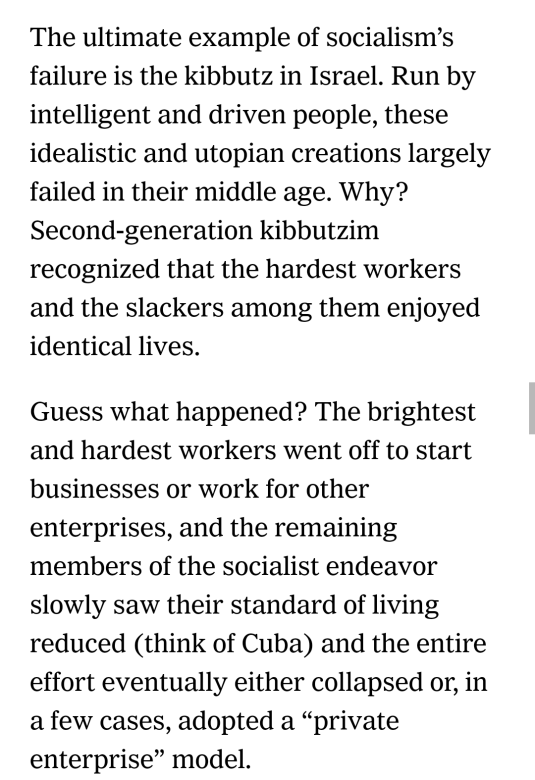
Would Socialism Better Our Lives? https://nyti.ms/2MFC2v8
Celebrating humanity's flourishing through the spread of capitalism and the rule of law
03 Sep 2018 Leave a comment
in applied price theory, Austrian economics, comparative institutional analysis, development economics, economic history, economics of bureaucracy, growth disasters, growth miracles, history of economic thought, industrial organisation, law and economics, Marxist economics, property rights, Public Choice, survivor principle Tags: fall of communism, kibbutzim
Would Socialism Better Our Lives? https://nyti.ms/2MFC2v8
19 Mar 2014 6 Comments
in Austrian economics, industrial organisation, labour economics, managerial economics, organisational economics, theory of the firm Tags: adverse selection, cooperative ownership, Jon Elster, kibbutzim, moral hazard, Ran Abramitzky, Robert Nozick, worker ownership
If workers’ cooperatives are so efficient, why are there so few cooperatives? Workers’ cooperatives should be able to slowly undercut other firms on price because they do not have to pay a profit to the capitalists.
Building societies, credit unions and some life insurance companies were mutually owned by their customers for a long time, but recently fell out of favour because of a growing lack of competitiveness and under-capitalisation.
Cooperatives are not economically viable because of intrinsic difficulties of entrepreneurship and management. And most workers prefer to work in firms for a wage rather than wait for the co-op to start up and hopefully break even before they get their first pay cheque. That could be a slow train coming.
The kibbutzim are Israeli agricultural communities initially organized on socialist lines, mostly between the 1910s and 1950s. The kibbutz is an example of voluntary socialism. The founders of kibbutzim were socialist idealists wanting to create a new human being.
Robert Nozick pointed out that few people actually join a kibbutz. Six per cent is the maximum proportion of any population who would voluntarily choose to live in these socialist communities. More recently, 2.6% of the Israeli population live on a kibbutz.
Originally, most kibbutzim followed strict socialist policies forbidding private property; they also required near-total equality of income regardless of differences in productivity, and in some cases, even abandoned the specialisation of labour. Kibbutzim are communities whose aim is equal sharing.
Kibbutzim were expected to fail because of moral hazard and adverse selection. Other organisations subject to adverse selection and moral hazard are professional partnerships, co-operatives, and labour-managed firms because they are all based on revenue sharing.
Kibbutzim have persisted for most of the twentieth century and are one of the largest communal movements in history. About 40% are still run on communist principles. Why is this so?
The kibbutz movement was founded by individuals who can be regarded as ex-ante homogeneous in their ability and potential income, and who came to a new land full of uncertainties. They were young unattached individuals who share a comparatively long period of social, ideological, and vocational training.
An even more durable example of voluntary collectivist living is Catholic monasteries and convents, but notice that these too were founded on a realization that close family ties are inimical to communal order.
Kibbutz founders wanted insurance, but their founders realised that members who would turn out to have high abilities might leave the Kibbutz.
Kibbutzim also put prospective members through lengthy trial periods to make sure they are made of the right stuff. Those raised on a kibbutz tend to have learned kibbutz-specific skills, such as agronomy, which also makes exit to the outside world even more difficult.
Kibbutzim are similar to law firms, medical and business partnerships that pool income for risk sharing purposes.
Mutual monitoring and peer pressure replace direct monetary incentives in mitigating moral hazard in a kibbutz (and in monasteries and convents) in the same way as in professional partnerships, cooperatives, and labour-managed firms with pooled assets and the option of exit.
The trade-off between insurance and adverse selection determines the level of equality within a kibbutz and its size, as with any other professional partnership:
Ran Abramitzky writes with great insight on the economics of the kibbutzim. He is writing a book The Mystery of the Kibbutz: How Socialism Succeeded. He found that high-ability individuals are more likely to leave a kibbutz. The brain drain would be worse if kibbutzim didn’t make it so costly to exit. Is this a familiar theme of socialism?
Many hybrid organisations exist in the market, ranging from joint ventures and agricultural seller and supermarket buyer co-ops to labour-owned firms such as in most of the professions.
But rarely do we find real life existing cooperatives with all workers and only workers having equal ownership rights. As Jon Elster noted, there are often non-working owners, non-owning workers and unequal distribution of shares in real life workers’ co-ops. All other types of co-ops and professional partnership share this feature.
Celebrating humanity's flourishing through the spread of capitalism and the rule of law
Scholarly commentary on law, economics, and more
Beatrice Cherrier's blog
Celebrating humanity's flourishing through the spread of capitalism and the rule of law
Celebrating humanity's flourishing through the spread of capitalism and the rule of law
Celebrating humanity's flourishing through the spread of capitalism and the rule of law
Why Evolution is True is a blog written by Jerry Coyne, centered on evolution and biology but also dealing with diverse topics like politics, culture, and cats.
Celebrating humanity's flourishing through the spread of capitalism and the rule of law
Celebrating humanity's flourishing through the spread of capitalism and the rule of law
A rural perspective with a blue tint by Ele Ludemann
DPF's Kiwiblog - Fomenting Happy Mischief since 2003
Celebrating humanity's flourishing through the spread of capitalism and the rule of law
The world's most viewed site on global warming and climate change
Tim Harding's writings on rationality, informal logic and skepticism
A window into Doc Freiberger's library
Let's examine hard decisions!
Commentary on monetary policy in the spirit of R. G. Hawtrey
Thoughts on public policy and the media
Celebrating humanity's flourishing through the spread of capitalism and the rule of law
Politics and the economy
A blog (primarily) on Canadian and Commonwealth political history and institutions
Reading between the lines, and underneath the hype.
Economics, and such stuff as dreams are made on
"The British constitution has always been puzzling, and always will be." --Queen Elizabeth II
Celebrating humanity's flourishing through the spread of capitalism and the rule of law
Celebrating humanity's flourishing through the spread of capitalism and the rule of law
WORLD WAR II, MUSIC, HISTORY, HOLOCAUST
Undisciplined scholar, recovering academic
Celebrating humanity's flourishing through the spread of capitalism and the rule of law
Res ipsa loquitur - The thing itself speaks
Celebrating humanity's flourishing through the spread of capitalism and the rule of law
Researching the House of Commons, 1832-1868
Articles and research from the History of Parliament Trust
Reflections on books and art
Posts on the History of Law, Crime, and Justice
Celebrating humanity's flourishing through the spread of capitalism and the rule of law
Exploring the Monarchs of Europe
Cutting edge science you can dice with
Small Steps Toward A Much Better World
“We do not believe any group of men adequate enough or wise enough to operate without scrutiny or without criticism. We know that the only way to avoid error is to detect it, that the only way to detect it is to be free to inquire. We know that in secrecy error undetected will flourish and subvert”. - J Robert Oppenheimer.
The truth about the great wind power fraud - we're not here to debate the wind industry, we're here to destroy it.
Celebrating humanity's flourishing through the spread of capitalism and the rule of law
Celebrating humanity's flourishing through the spread of capitalism and the rule of law
Economics, public policy, monetary policy, financial regulation, with a New Zealand perspective
Celebrating humanity's flourishing through the spread of capitalism and the rule of law
Restraining Government in America and Around the World
 Utopia, you are standing in it!
Recent Comments