How Syria’s Kurds are trying to create a democracy
16 Mar 2018 Leave a comment
in constitutional political economy, defence economics, Public Choice, war and peace Tags: Kurds, Syrian Civil War
What would be the opening offer of @jeremycorbyn at Syrian Civil War peace talks?
24 Nov 2015 1 Comment
in defence economics, war and peace Tags: British politics, game theory, Iraqi civil war, ISIS, Kurds, Middle-East politics, peace talks, Syrian Civil War, Turkey
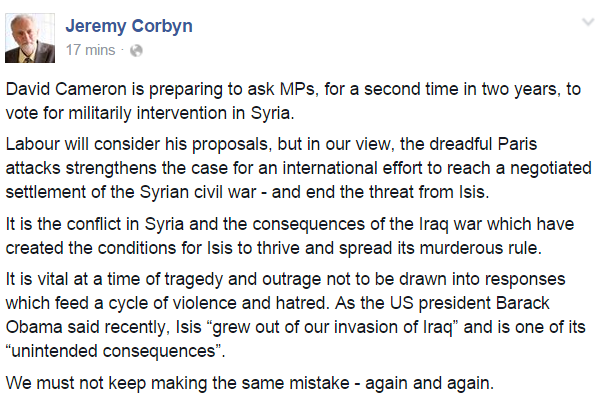
Exactly what would Jeremy Corbyn put on that negotiating table for a comprehensive peace settlement to the Syrian Civil War that:
- would end the military threat from ISIS in Syria, and
- allow the Kurdish succession opposed by all others plus Turkey, Iraq and Russia?
Without the resumption of military strikes as negotiating coin if such peace talks break down, why would anyone fighting on the ground in Syria care about what proposals the Western powers might put up?
The possibility of a temporary cessation in current and intensifying Western military airstrikes is one of the few reasons for the parties to sit down at a negotiating table with the Western powers and Russia if only to string out that cessation of those airstrikes while they regroup and re-equip. The parties to the Syrian Civil War only respect force, not moral authority.

The ability to negotiate a credible peaceful settlement between sovereign states depends on:
- the divisibility of the outcome of the dispute,
- the effectiveness of the fortifications and counterattacks with which an attacker would expect to have to contend, and
- on the permanence of the outcome of a potential war.
Central to any peace talks is that any peace agreement is credible – it will hold and not will not be quickly broken:
A state would think that another state’s promise not to start a war is credible only if the other state would be better off by keeping its promise not to start a war than by breaking its promise.
Peace talks occur only when there something to bargain about. As James Fearon explained,there must be
a set of negotiated settlements that both sides prefer to fighting.
When a war is over territory rather than annihilation of the other side, the challenge is to divide the disputed territory in a way that both are happy to keep the peace settlement rather than come back and fight in a few years.
Civil wars such as those in Syria and Iraq today are grubby affairs in terms of peace talks because of the greater inability to divide what is contested.
Who Does What to Whom in #Syria https://t.co/xO8PJHZwgW—
ian bremmer (@ianbremmer) November 04, 2015
Ending civil wars is even more difficult to make binding commitments because new groups such as ISIS can spring up to replace the signatories to the old peace treaty or introduce new agendas:
…if the constituent groups of a polity are deeply divided and, hence, are unwilling to accept meaningful limitations on the prerogatives of winners of constitutional contests, then civil war can be unavoidable.
The Kurds are helping fight #ISIS. Why is Turkey bombing them?
16 Aug 2015 Leave a comment
in defence economics, war and peace Tags: ISIS, Kurds, Turkey
This week in the Syrian civil war
02 Aug 2015 Leave a comment
in defence economics, war and peace Tags: Iran, ISIS, Kurds, Middle-East politics, Syria, Turkey, war against terror
https://twitter.com/ianbremmer/status/625742628450115587/photo/1
The worrying spread of terrorism in Africa http://t.co/C16YJy3szT—
ian bremmer (@ianbremmer) July 20, 2015
 Utopia, you are standing in it!
Recent Comments