A critical aspect of a land tax rarely addressed in public debate is its “economic incidence – or who actually bears the burden of the – tax as opposed to its statutory incidence, or who literally pays the tax.
John Key has floated a land tax as an option to deal with rising land prices in Auckland if a large number of buyers are foreign.
It is pretty standard public economics the elasticities of supply and demand essential to working out who actually pays tax rather than who sends the cheque.
More of the taxes paid by either the buyer or seller who is demand or supply is more inelastic; responds less to changes in price.
In the case of land, supply is looked upon as highly inelastic. Because of this lack of responsiveness of suppliers to changes in price, most to all of the tax is paid by sellers of land.

Since supply is fixed, the same amount of land is still available The owner now has a lower after-tax rental return of his land. As the Australian Treasury explains
As the capital value of the land is equal to the discounted present value of all the future expected rental returns, a lower rental return implies a one-off fall in the value of all land. Owners of land bear the incidence of the land value tax even if they sell their land in response to the tax.
This reduction in the rental value of land will mean future buyers will pay less for land. The price of land will fall in the future because returns are less after-tax.
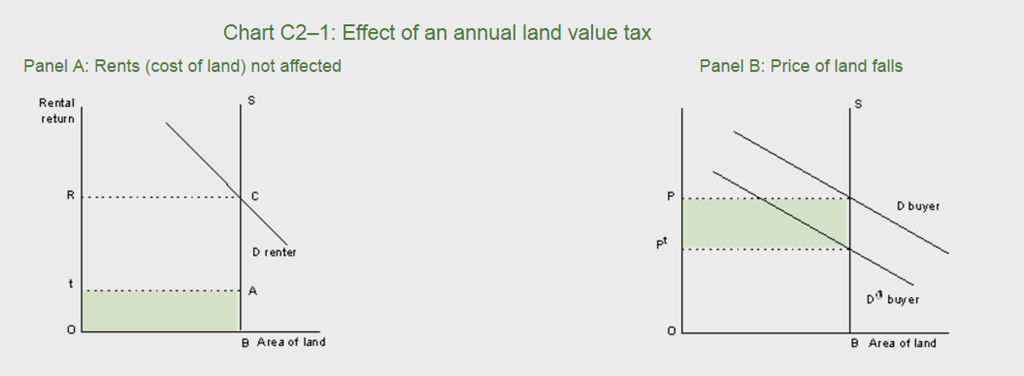
The introduction of a land tax by John Key will mean the price of land might fall by the present value of the land tax. Zodrow explains
In principle, the economic incidence of all of these capitalization effects is on the owners of land and housing at the time of the imposition of the tax, when the effects are “capitalized” as one-time changes in the prices of these assets..
 Utopia, you are standing in it!
Recent Comments