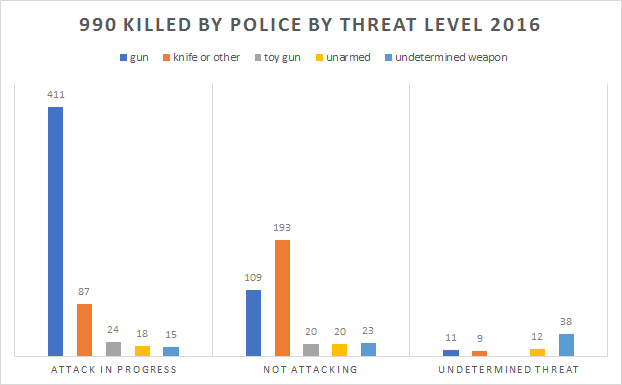
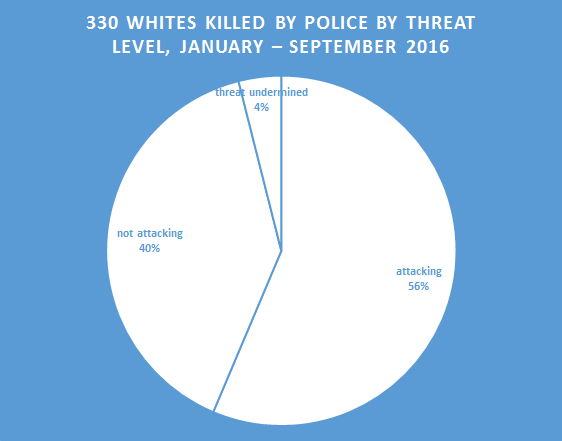
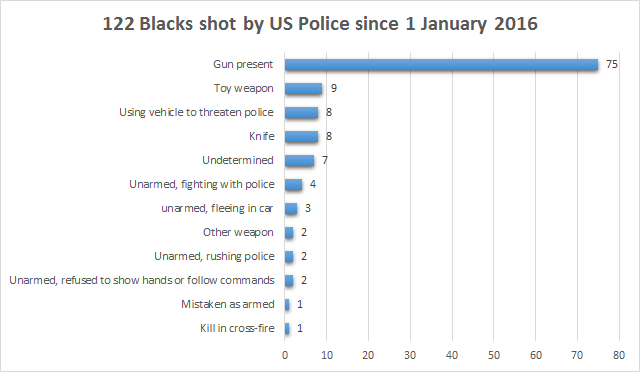
Blacks killed by police by threat level, January – September 2016
06 Oct 2016 Leave a comment
in economics of crime, law and economics, politics - USA Tags: crime and punishment, law and order, police shootings
The U.S. incarceration rate is more than six times that of many developed countries.
06 Oct 2016 Leave a comment
in economics of crime, law and economics, politics - USA Tags: crime and punishment, criminal deterrence, law and order
war against racks,
Blacks and whites killed by police by threat level by threat level, January – September 2016
01 Oct 2016 Leave a comment
in economics of crime, law and economics, politics - USA Tags: law and order, police shootings
How many British burglaries are home invasions?
06 Sep 2016 Leave a comment
in economics of crime, law and economics Tags: Burglary, law and order
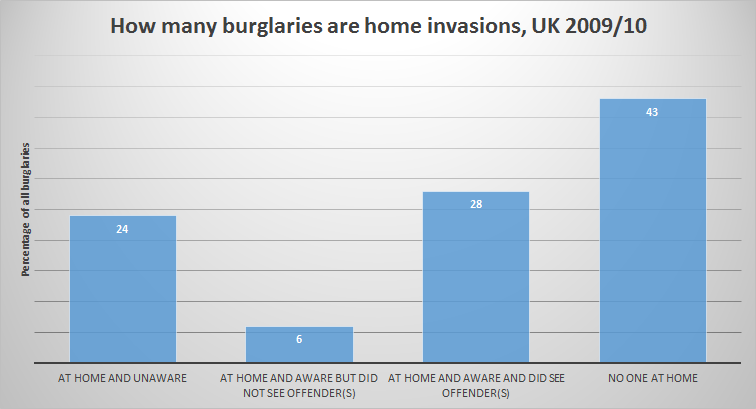
People are aware that their house has been invaded in 1/3rd of British burglaries and in a quarter of burglaries, they see the offender. No wonder that burglary and the threat of a burglary are regarded as invasive crimes. We never locked the house when we were young. That changed.
Source: Home Office via What burglars steal – and how they get in | News | theguardian.com.
How well do you know your local burglar?
05 Sep 2016 Leave a comment
in economics of crime, law and economics Tags: British economy, crime and punishment, law and order
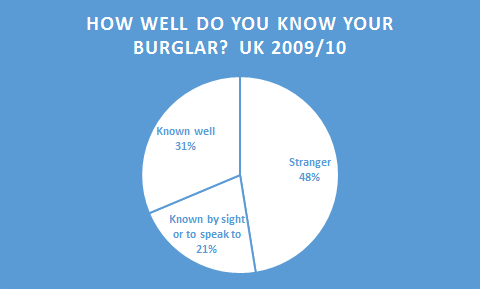
Something is known about the burglar in 45% of cases. In this rather invasive crime, half of burglaries are betrayals of trust or familiarity. More than a few of these burglaries might be committed by family members and friends wanting money for drugs but that is speculation.
Source: Home Office via What burglars steal – and how they get in | News | theguardian.com.
What is stolen in British burglaries?
05 Sep 2016 Leave a comment
in economics of crime, law and economics Tags: burglaries, law and order
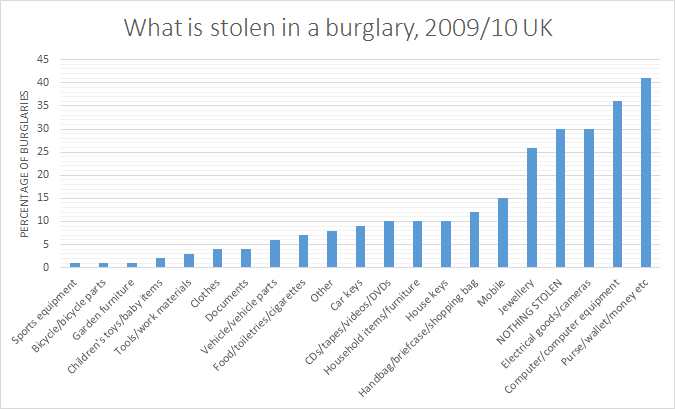
30% of British burglaries are completely unsuccessful. Many more are reliant on chancing across a wallet or a decent piece of electrical equipment. Back in the day, a TV or VCR was worth a week’s wages. Now the fencing value of these things would be quite minor. The data below is from 2010 so there has been plenty of time for cash to fade away as a item to steal.
Source: Home Office via What burglars steal – and how they get in | News | theguardian.com.
An adult start of a criminal career is uncommon
18 Aug 2016 Leave a comment
in economics of crime, human capital, labour economics, law and economics, occupational choice Tags: crime and punishment, criminal deterrence, law and order
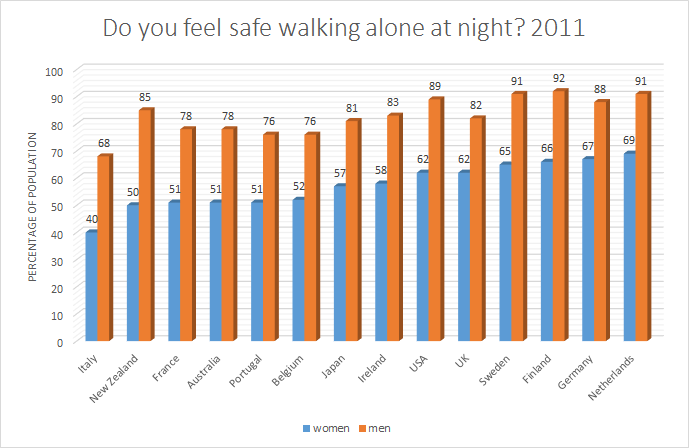
Do you feel safe walking alone at night? OECD by gender
18 Aug 2016 Leave a comment
in economics of crime, law and economics Tags: law and order
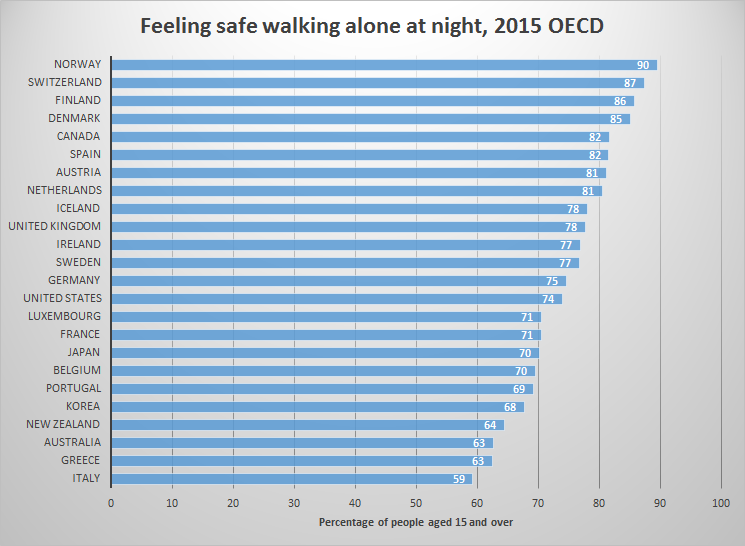
The Japanese are surprisingly worried and New Zealanders too. I lived in both countries. People go about at night without many fears except when it comes to answering Gallup surveys. I use the reliable test that a mugging will get on the front page because they are so unusual.
Source: Gallup.com Women Feel Less Safe Than Men in Many Developed Countries.
Feeling safe walking alone at night, 2015 OECD
16 Aug 2016 Leave a comment
in economics of crime, law and economics Tags: law and order
Police shootings by threat level since 1 January 2016
08 Jul 2016 Leave a comment
in economics of crime, law and economics, politics - USA Tags: law and order, police shootings
The Washington Post no longer classifies whether the deceased was attacking police or not in its online database. That filter on its 2016 database has been removed. It is possible to filter the data to say whether particular weapons were present.
Source: Fatal force: A Washington Post investigation of people shot and killed by police in 2016 – Washington Post. Downloaded at 10:25 p.m., 7 July 2016 New Zealand standard time.
Looking up individual shooting reports in the database provides information on whether the unarmed suspect was doing in terms of resisting police or not. The seven undetermined cases involve disputed facts over whether the suspect was armed or was resisting the police..
@350nz fossil fuel protesters admit plan was to intimidate ANZ, not peaceful protest
16 May 2016 Leave a comment
in comparative institutional analysis, constitutional political economy, economics of crime, energy economics, environmental economics, global warming, law and economics, politics - New Zealand, Public Choice, Rawls and Nozick, rentseeking Tags: climate activists, climate alarmism, law and order, non-violent direct action, peaceful protest, reactionary left
In a letter to the editor today in the Dominion Post defending a climate change protest that closed a branch of the ANZ bank, one of the participants Jimmy Green said
Of course our intention wasn’t to intimidate individuals – our intention was to intimidate ANZ into shifting its investments after the bank ignored us asking.
This honesty about the willingness to intimidate to advance a political agenda shows that climate protesters are engaging in plain thuggery. Peaceful protest has its role in any democracy.
What these thuggish protesters forgot about is how we resolve our differences in a democracy. That is by trying to persuade each other and elections. Let the people decide.
These protesters are keen to pass laws to save the environment but they’re more than happy to break laws they disagree with. I wonder if they extend that same courtesy to others they regard as less enlightened than them? They expect others to obey the laws for which they successfully lobbied.
Why do these climate action protesters think they can break laws that others secured through lawful, peaceful democratic action? Is some direct action more equal than others? Why do these climate action protesters think their vote counts more than mine?
John Rawls makes the point that the purpose of civil disobedience is not to impose your will upon others but through your protest to implore others to reconsider their position and change the law or policy you are disputing.
Rawls argues that civil disobedience is never covert or secretive; it is only ever committed in public, openly, and with fair notice to legal authorities. Openness and publicity, even at the cost of having one’s protest frustrated, offers ways for the protesters to show their willingness to deal fairly with authorities.
Rawls argues: for a public, non-violent, conscientious yet political act contrary to law being done (usually) with the aim of bringing about a change in the law or policies of the government; that appeals to the sense of justice of the majority; which may be direct or indirect; within the bounds of fidelity to the law; whose protesters are willing to accept punishment; and although civil disobedience involves breaking the law, it is for moral rather than selfish reasons, and the willingness to accept arrest is proof of the integrity of the act of peaceful protest.
Rawls argues, and too many forget, that civil disobedience and dissent more generally contribute to the democratic exchange of ideas by forcing the dominant opinion to defend their views.
The civil disobedient is attempting to appeal to the “sense of justice” of the majority and their willingness to accept arrest is proof of the integrity of the act as a contribution to democratic persuasion not intimidation says Rawls:
…any interference with the civil liberties of others tends to obscure the civilly disobedient quality of one’s act.
Rawls argues that the use or threat of violence is incompatible with a reasoned appeal to fellow citizens to move them to change a law. The protest actions are not a means of coercing or frightening others into conforming to one’s wishes.
The intimidation by the protesters at the ANZ bank and their promise to do it again as shown in the adjacent tweet is a breach of the principles of a just society. These climate change protesters blockading an ANZ bank branch were attempting to coerce and frighten others into conforming with their political views. That ‘might does not make right’ is fundamental to democracy and the rule of law. As United States Supreme Court Justice Antonin Scalia said
The virtue of a democratic system [with a constitutionally guaranteed right to free speech] is that it readily enables the people, over time, to be persuaded that what they took for granted is not so and to change their laws accordingly.
When the climate protesters lose at the ballot box, they always claim it is rigged by the corporate interests. This is just sore losers.
How the left-wing and liberal visions of democracy are different nymag.com/daily/intellig… http://t.co/Qk5vS9SaV4—
Jonathan Chait (@jonathanchait) August 13, 2015
The great strength of democracy is a small group of concerned and thoughtful citizens can band together and change things by mounting single issue campaigns or joining a political party and running for office and winning elections or influencing who wins.
Yesterday’s majority of the vote sooner or later and often sooner than they expect will break off into different minorities on the next big issue of the day. These newly formed minorities will use that same ability to band together as a minority to block vote to protect what they think is important and advance agendas they think are to be wider benefit despite the opinion of the current majority to the contrary. All reforms start as a minority viewpoint.
Indeed, it is a strength of democracy – small groups of concerned citizens banding together – is what is holding up legislating in many areas. It is not that minorities are powerless and individuals are voiceless. It is exactly the opposite.
Parliaments elected by proportional representation such as in New Zealand, and in Australian upper houses reinforces the ability of small groups of citizens to band together to win a seat.
Nothing stirs up the impassioned (and most other people as well) more than depriving them of their right to support or oppose what is important to them through political campaigns and at an election. The losing side, we all end up on the losing side at one time or another, are much more likely to accept an outcome if they had their say and simply lost the vote at the election or in Parliament. Scalia warned of, for example, the risks of the courts moving in advance of the popular will, and thereby poisoning the democratic process
We might have let the People decide. But that the majority will not do. Some will rejoice in today’s decision, and some will despair at it; that is the nature of a controversy that matters so much to so many. But the Court has cheated both sides, robbing the winners of an honest victory, and the losers of the peace that comes from a fair defeat. We owed both of them better. I dissent.
These climate change protesters want to rob the winners of their honest democratic victory over the balance between oil and coal exploration and other energy options. They are also robbing themselves of a fair defeat.
A fair defeat flows from laws and policies secured through normal democratic means knowing that one day you may be in a majority. Only by respecting the will of the majority when you are in the minority do you have any right to expect future minorities to respect your honest democratic victories as the majority of some future day. Democratic majorities of patched together through give-and-take and the reality that even the most important policies may be reversed in the future.

Climate change protesters should respect the political process because democracy alone can produce compromises satisfying a sufficient mass of the electorate on deeply felt issues so as to not poison the remainder of the democratic process. The losing side, we all end up on the losing side at one time or another, are much more likely to accept an outcome if they had their say and simply lost the vote at the election or in Parliament.
Blacks shot dead by US police by threat level, January – April 2016
08 May 2016 Leave a comment
in economics of crime, law and economics, politics - USA Tags: crime punishment, law and order, media bias, police shootings
This is what the Washington Post and The Guardian said on the 5 blacks the Washington Post classified as unarmed and not attacking police:
“Antronie Scott, an unarmed 36-year-old black man, was shot on Feb. 4, 2016, in San Antonio, Tex. Undercover San Antonio police officers were monitoring Scott, who had outstanding arrest warrants. When a uniformed officer approached Scott, he spun around with something in his hand. Police later determined that Scott was holding a cellphone.” Source: Fatal force: A Washington Post investigation of people shot and killed by police in 2016 – Washington Post
Source: The Counted: people killed by police in the United States – interactive | US news | The Guardian.
"David Joseph, an unarmed 17-year-old black male, was shot on Feb. 8, 2016, in Austin, Tex. Austin police were responding to reports of an erratic, aggressive person. Joseph, who was naked, rushed toward the officer." Source: Fatal force: A Washington Post investigation of people shot and killed by police in 2016 – Washington Post.
Source: The Counted: people killed by police in the United States – interactive | US news | The Guardian.
"Calin Roquemore, an unarmed 24-year-old black man, was shot on Feb. 13, 2016, in Beckville, Tex. Roquemore fled a traffic stop by a Texas state trooper. Roquemore refused the trooper’s orders to show his hands. No weapon was found at the scene." Source: Fatal force: A Washington Post investigation of people shot and killed by police in 2016 – Washington Post.
Source: The Counted: people killed by police in the United States – interactive | US news | The Guardian.
"Marquintan Sandlin, an unarmed 32-year-old black man, was shot on Feb. 21, 2016, in Inglewood, Calif. The man was a passenger in a car stopped at an intersection. Inglewood police approached the car and noticed that the woman who was driving had a gun. Officers shot and killed Sandlin and the woman, Kisha Michael." Source: Fatal force: A Washington Post investigation of people shot and killed by police in 2016 – Washington Post.
Source: The Counted: people killed by police in the United States – interactive | US news | The Guardian.
"Peter Gaines, an unarmed 37-year-old black man, was shocked with a stun gun and shot on March 12, 2016, in Houston, Tex. A Houston police officer approached Gaines after he vandalized a traffic sign. Gaines lunged at the officer.” Source: Fatal force: A Washington Post investigation of people shot and killed by police in 2016 – Washington Post.
Source: The Counted: people killed by police in the United States – interactive | US news | The Guardian.
I will leave it up to readers to work out how many of these police shootings were suspicious and indicate police misconduct.
Recent Comments