This thriller is surprisingly good. I did not particularly want to go because it was foreshadowed to include graphic violence, which it does include.
Gone Girl passes the key test of good thrillers, great thrillers. It is pointless watching this movie a second time because you know how it finishes and all the plot turns. The movie really grows on you and you don’t notice it is 149 minutes long. Not a scene is wasted.
Silence of the Lambs is a similar movie in the sense of it is pointless watching that movie the second time. Silence of the Lambs is plain boring if you try and watch it a second time .
Gone Girl is about the disappearance of Amy Dunne (Rosamund Pike) on her wedding anniversary, and the whodunit investigation that followed. Support cast is made up of unknowns who fill out their roles excellently.
Oddly enough, on the morning before going to the movie, I was thinking about who are the great actors and actresses.
The obvious is Meryl Streep to she dissolves into any role. You don’t remember the movies that Meryl Streep appeared in because she was such a part of the movie that you don’t remember the movie because Meryl Streep was in it.
Alec Guinness is another brilliant actor who dissolved into any role he was cast. Sean Penn is his modern match, although Penn spends too much time in art house movies trying to persuade you to like Fidel Castro and his philosophy and outlook on life.
When I was drawing up this list, Ben Affleck got a mention as someone who can just appear in the movie and you pay no attention to what his previous roles were or even remember what they were. Ben Affleck is rising actor these days
Two millionaires, one on the left and one on the right, set up parties to get into Parliament in the recent New Zealand election. The millionaire of the left failed abysmally. The millionaire on the right made progress towards getting into Parliament in the 2017 election.
Each spent vast sums of money by New Zealand standards on their party:
Kim.com gave $4.5 million to his Internet – Mana party; and
Colin Craig gave about $1.5 million to his Conservative party with another millionaire giving $750,000 to the Conservative party.
By way of context, the maximum that a political party can spend on campaign expenses in the three months prior to the election is $1.1 million, plus $25,000 per electorate seat It is contesting. None of this is spent on radio and television advertising because this is allocated for free by the electoral commission based on previous election performance.
One of the major rationales for election finance regulation is to stop the rich buying elections by flooding the airways and billboards with their call to arms and buying politicians short of campaign donations:
Conventional wisdom holds that money plays a central and nefarious role in American politics.
Underlying this belief are two fundamental assumptions:
(1) elective offices are effectively sold to the highest bidder, and
(2) campaign contributions are the functional equivalent of bribes.
Campaign finance regulations are thus an attempt to hinder the operation of this political marketplace.
John Milyo
New Zealand is a good example of how difficult it is to buy votes if you’re underlying message does not work. This is a key point to remember.
The millionaire of the left, Kim.com, gave money to a far left party in New Zealand, recycled a couple of middle-aged lefties, ran a hard left campaign, and won all of 2000 extra party votes over last time out of electorate of about 2 million.
He came unstuck because his sitting electorate MP lost 3000 votes and lost his seat. If he had kept his seat, his party would have been also entitled to a List MP seat because his party won 1.3% of the party vote. Under the New Zealand system of mixed member proportional representation, if you win a seat in Parliament, you’re entitled to list seats to ensure that your representation in Parliament is equal to your party vote.
The millionaire of the right, Colin Craig, ran a socially conservative, economic nationalist campaign and won 4% of the vote. A party needs 5% of the party vote to get into Parliament if your party does not win an electorate seat.
Both of these parties that did not get into Parliament outspent the winning national party which won 60 of the 121 seats in Parliament.
The failure of Kim.com and Colin Craig to buy their way Parliament should be no surprise. Most systematic studies find no effect of marginal campaign spending on the electoral success of candidates.
Levitt noted that previous studies of congressional spending have found a large positive effect of challenger spending, but little evidence for effects of incumbent spending. Those studies did not adequately control for inherent differences in vote-getting ability across candidates.
His paper examined elections in which the same two candidates face one another on more than one occasion; differencing eliminates the influence of any fixed candidate or district attributes.
His estimates of the effects of challenger spending are an order of magnitude below those of previous studies. Campaign spending has an extremely small impact on election outcomes, regardless of who does the spending.
Jeff Milyo also found that a more systematic analysis of the electoral fortunes of wealthy candidates found no significant association between electoral or fund-raising success and personal wealth. For example, see Jeffrey Milyo and Timothy Groseclose, “The Electoral Effects of Incumbent Wealth,” Journal of Law and Economics 42 (1999): 699–722.
A range of rich candidates have attempted to buy Senate seats and gubernatorial posts with little success if they were themselves unappealing candidates.
The best explanation to date for the minor effect of campaign spending on electoral success is competent candidates are adept at both convincing contributors to give money and convincing voters to give their vote.
The finding that campaign spending and electoral success are highly correlated exaggerates the importance of money to a candidate’s chances of winning.
Campaign donors give more money to the expected winners because they want to be on the winning side. What lobbyist doesn’t want to be that the best new friend of the incoming minister?
Legislators tend to act in accordance with the interests of donors, but this is not because of a quid pro quo. Instead, donors tend to give to like-minded candidates. See Steven Levitt, “Who are PACs Trying to Influence with Contributions: Politicians or Voters?” Economics and Politics 10, no. 1 (1998): 19–36.
It is a much surer thing to give donations to a party that already agrees with you, rather than persuade someone to change their minds with campaign donations. That is a much less certain bet.
Studies of legislative behaviour indicate that the most important determinants of an incumbent’s voting record are constituent interests, party, and personal ideology. These three factors explain nearly all of the variation in incumbents’ voting records. See Steven Levitt, “How Do Senators Vote? Disentangling the Role of Party Affiliation, Voter Preferences and Senator Ideology,” American Economic Review 86 (1996): 425–441.
As an aside, the hard left campaign was instructive in another regard. The hard left honestly believes that there is a large number of people out willing to vote hard left if only their message was properly funded and got a hearing. These would be hard left voters are currently parking their vote elsewhere, such as with the right wing parties, apparently.
A massively funded hard left campaign in New Zealand won 1.2% of the party vote. In the 2011 election, the same hard left party, when woefully underfunded, won 1.1% of the party vote. Getting the message out appears to have absolutely no effect on the party vote of the hard left. The median voter theory rules.
The Conservative party was much more successful because the Christian parties in New Zealand usually get about 4% of the vote, except when they’re fighting with each other over who was following the Word of God better, which is rather common.
Furthermore, about 10-15% of the New Zealand election is both socially conservative and economically nationalist. They used to be called working-class Tories. Much of this vote currently votes for the New Zealand First Party– a one-man party – and its leader will be 72 at the next election.
When I feud with strangers on other blogs about neoliberalism, I often asked them is to nominate which parties are neoliberal. Obviously the right-wing parties are neoliberal.
What is routine, however, is for this remnant of the Left over Left to nominate the Labour Party as a cauldron of neoliberalism as well. Tony Blair, Bob Hawke, and Paul Keating are hate figures as is Roger Douglas in New Zealand.
Neoliberalism is more about smearing labour parties than the right-wing parties, and, in particular, factional enemies further to the right with you on the old Left. Looks like to be a neoliberal is what it was like to be a capitalist running dog in the days of the cultural revolution.
As global ringmasters go, they have a crap website. The super profits of supreme power should at least extend to a decent website.
Eric Crampton was tweeting live from his first meeting of the Mont Pelerin Society a few weeks ago. I asked him how did it feel to be in the inner circles of supreme power. His tweet was they must hold all the conspiratorial meetings in side rooms because he did not feel any more powerful than the previous day at his desk at his University
No one had ever heard of the Mont Pelerin society until the Twitter Left put it at the centre of a global conspiracy.
It is much easier to do to explain your defeat at elections on a conspiracy, rather than on your ideas having been tried and failed time and again.
These allegations of a secret conspiracy led by the Mont Pelerin society is a rarity in the stock and fair of conspiracy theories. The leader of the conspiracy is actually unknown. Most conspiracy theories allege that the secret machinations are by relatively well-known people you are trying to smear or don’t like.
These allegations of a global conspiracy led by academics is the ultimate ego trip by proxy. Academics dream of supreme power. When they do not have this power themselves, they fantasise that the right-wingers at the other end of the corridor at their university have it instead.
The American Left used to be patriotic. In its heyday, Eugene V. Debs never attacked America, and the socialist vision he advocated was in his eyes a way to realize the promise of America.
As for the American Communist Party, in reality the tool of Stalin’s USSR, it pretended in the 1940s to be pro-American, and its chairman, Earl Browder, coined the slogan “Communism is 20th century Americanism.” This pretence came to an end during the Cold War, when the Left supported the Soviet bloc and all of its policies, and argued that America was in the process of becoming a nascent fascist state.
The remnants of the ’60s New Left identified with America’s new enemies, especially North Vietnam, Communist Cuba, the PLO, and, in the ’80s, Sandinista Nicaragua. After 9/11, many of its adherents took the position that the United States had the terror attack coming to it, since the perpetrators had taken 3000 lives in protest against America’s imperial ambitions and control.
This led Michael Walzer, the social-democratic intellectual, to pen an article called “Can There Be a Decent Left?” Walzer courageously took on many of those on his side of the spectrum, hitting them for accepting the “blame America first” doctrine to explain foreign policy defeats; for not criticizing any peoples or nations in the Third World; for believing in what he called “rag-tag Marxism”; for failing to oppose dangerous jihadists and Islamist states; and for refusing to blame anyone else for the world’s wrong except the United States.
I wonder what Walzer would write today if he examined his article anew. If one looks around at the Left’s response to Hamas’ actions in Gaza and its attacks on Israel, and its view of Islamist fascism in countries like Iran, Syria and among the ISIS forces seeking to take over Iraq, it is clearer than ever that the Left has one function — to support the enemies of democracy.
Operating in the United States, Britain and France, the Western Left takes the opportunity to speak freely in the democracies in which they live, to openly support and express their solidarity with democracy’s most fervent enemies.
With the withering away of the proletariat because of the great enrichment, the Left over Left coined the word precariat.
The precariat is a social class formed by people suffering from precarity: a condition of existence without predictability or security, affecting material or psychological welfare as well as being a member of a proletariat class of industrial workers who lack their own means of production and hence sell their labour to live. Specifically, it is applied to the condition of lack of job security, in other words intermittent employment or underemployment and the resultant precarious existence. The term is a portmanteau obtained by merging precarious with proletariat.
Very similar to the Karl Marx’s Lumpenproletariat: the layer of the working class that is unlikely ever to achieve class consciousness and is therefore lost to socially useful production, of no use to the revolutionary struggle, and perhaps even an impediment to the realization of a classless society.
One of the drawbacks of the precariat is they are inconveniently happier than Left over Left are willing to give them credit. For example, a lot of women in part-time jobs are happier than those in full-time jobs because of the greater worklife balance. Casual and seasonal jobs pay more too.
Useful idiot is a term for people perceived as propagandists, initially Lenin, for a cause whose goals they are not fully aware of, and who are used cynically by the leaders of the cause.
Many confused and misguided sympathisers will unwittingly support a malignant cause which they naïvely believe to be a force for good.
The rotation of power is common in democracies, and the worst rise to the top, so it is wise to design constitutional safeguards to minimise the damage done when those crazies to the right or left of you get their chance in office, as they will.
Too many policies and ideas of the Left assume that they are the face of the future, rather than just another political party that will hold power as often as not.
Privatisation and deregulation is a lot slower in a federal system with an effective upper house elected by proportional representation. Regulatory powers and public asset ownership is spread over different levels of federations, with different parties always in power at various levels at the same time, all worried about losing office by going to far away from what the majority wants.
The will of the people is constantly tested and measured in a federal system with elections at one level or another every year or so contested on a mix of local and national issues. Any failings of privatisation or deregulation in pioneering jurisdictions would quickly become apparent and would not be copied by the rest of the country. These errors could be undone where they originated by incoming progressive governments.
The Left may want to protect the rights of the unpopular and the unpleasant, and to want constitutional safeguards to slow an impassioned majority down is, in part, because they could be next if they lose the next election to the latest right-wing populist.
In a unitary unicameral parliament, those crazies to the right or left of you are tempered by an occasional general election only every 3 to 5 years. Little wonder that UK Labor reconsidered devolution, an assembly for London, and regional government after 15 years of Maggie Thatcher, good and hard, with her unfettered right to ask the house of commons to make or unmake any law whatsoever.
Developing positive alternatives on the Left includes what to do about the rotation of power and fettered versus unfettered parliamentary and executive power. The failure of the Left to develop its own constitutional political economy is a major strategic shortcoming. Frequenting wine bars, cafes and blogs muttering to each other ‘our day will come, our day will come’ is not enough.
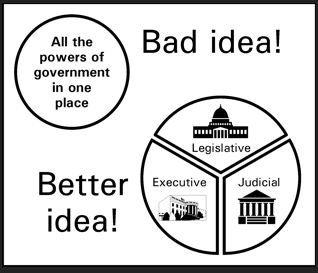
State power was something that the classical liberals feared, and the problem of constitutional design is insuring that such power would be effectively limited.
Sovereignty must be split among several levels of collective authority; federalism was designed to allow for a decentralization of coercive state power.
At each level of authority, separate functional branches of government were deliberately placed in continued tension, one with the other. The legislative branch is further restricted by the establishment of two strong houses, each of which organised on a separate principle of representation
Why Evolution is True is a blog written by Jerry Coyne, centered on evolution and biology but also dealing with diverse topics like politics, culture, and cats.
“We do not believe any group of men adequate enough or wise enough to operate without scrutiny or without criticism. We know that the only way to avoid error is to detect it, that the only way to detect it is to be free to inquire. We know that in secrecy error undetected will flourish and subvert”. - J Robert Oppenheimer.


 No one had ever heard of the Mont Pelerin society until the Twitter Left put it at the centre of a global conspiracy.







 Utopia, you are standing in it!
Recent Comments