
Both the proletariat and the middle class are withering away these days thanks to capitalism and freedom.

Celebrating humanity's flourishing through the spread of capitalism and the rule of law
08 Feb 2016 Leave a comment
in applied welfare economics, economic history, labour economics, politics - USA, poverty and inequality Tags: living standards, rational ignorance, rational irrationality, withering away of proletariat
Both the proletariat and the middle class are withering away these days thanks to capitalism and freedom.
31 Jan 2016 Leave a comment
in applied price theory, applied welfare economics, economic history, labour economics, labour supply, unions Tags: 40 hour week, hours worked, living standards, union power, union wage premium, working hours, working week
08 Jan 2016 Leave a comment
in economic history, labour economics, politics - New Zealand, poverty and inequality Tags: child poverty, family poverty, Leftover Left, living standards, Maori economic development, Twitter left
https://twitter.com/sbancel/status/654162844884205568
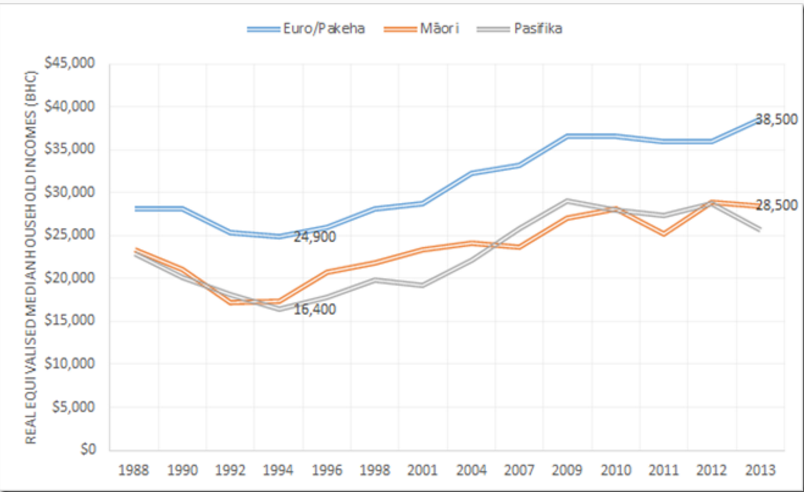
Pakeha and Pasifika real household incomes increased by 55% since the low point of 1994. Maori household incomes increased by 65% since 1994.
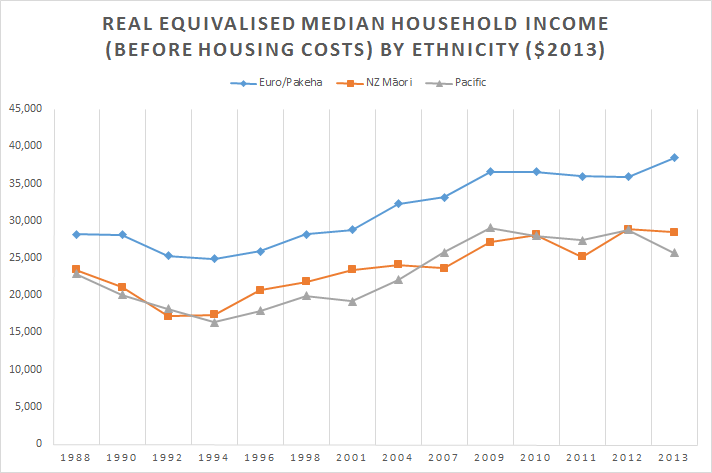
Source: Bryan Perry, Household Incomes in New Zealand: trends in indicators of inequality and hardship 1982 to 2014 – Ministry of Social Development, Wellington (August 2015), Table D.6.
07 Jan 2016 Leave a comment
in politics - Australia, politics - New Zealand, politics - USA, population economics, urban economics Tags: housing economics, living standards
There are quite large differences in the number of rooms per person in the European offshoots and the countries in Europe. Americans have much more room per person than the much exalted welfare states of northern Europe.
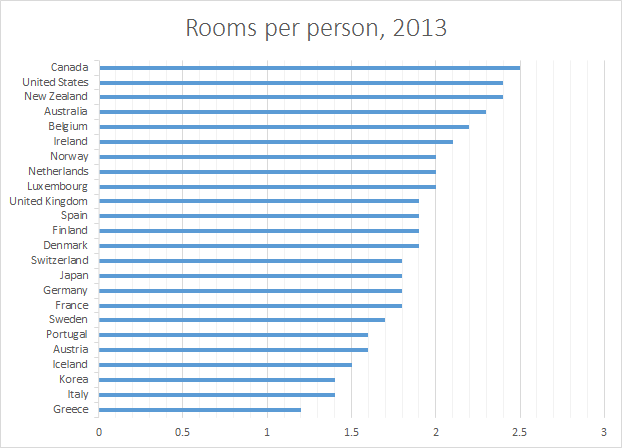
Source: OECD Better Life Index – Data extracted on 07 Jan 2016 06:55 UTC (GMT) from OECD.Stat
16 Dec 2015 Leave a comment
in economics of media and culture, industrial organisation Tags: creative destruction, Internet, Internet access, living standards
26 Nov 2015 1 Comment
in applied welfare economics, development economics, economics of media and culture, entrepreneurship, growth miracles, industrial organisation Tags: cell phones, creative destruction, international technology diffusion, living standards, mobile phones, technology diffusion
07 Nov 2015 Leave a comment
in economic history, politics - New Zealand Tags: housing affordability, living standards, RMA, The Great Enrichment
It is those below median household income that are suffering more from rising housing costs in New Zealand since 1982. Those on low incomes in particular have suffered the most.
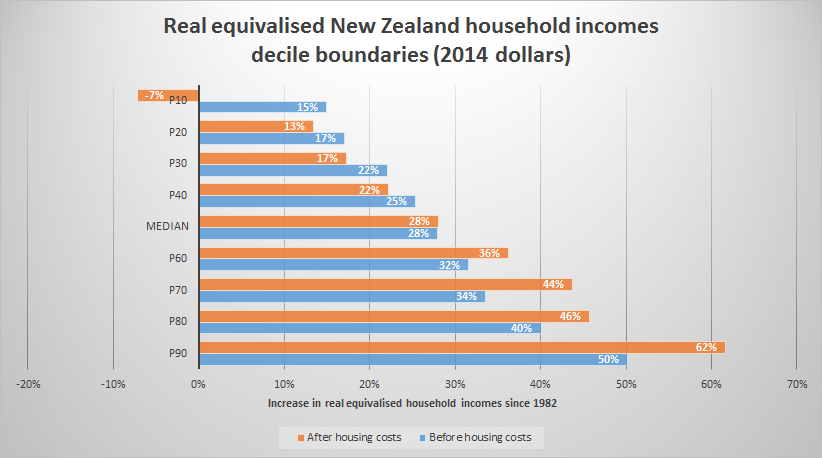
Source: Bryan Perry, Household Incomes in New Zealand: trends in indicators of inequality and hardship 1982 to 2014 – Ministry of Social Development, Wellington (August 2015), Tables D3 and D4.
The data for the lowest decile is somewhat unreliable because there are so many implausibly low and zero incomes in that decile.
06 Nov 2015 Leave a comment
in econometerics, economic history, labour economics, labour supply, minimum wage, politics - USA, unions Tags: conspiracy theories, conspiracy theorists, Leftover Left, living standards, Maori economic development, neoliberalism, top 1%, Twitter left, union power, union wage premium
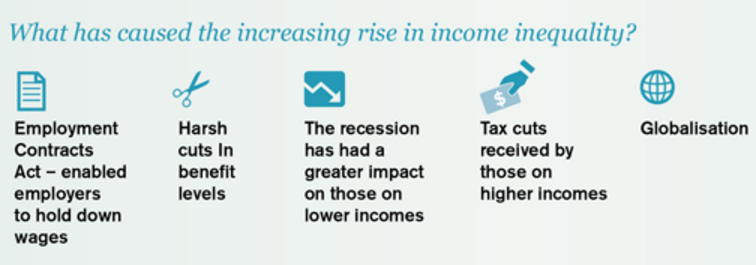
The Council of Trade Unions and Closer Together Whakatata Mai charted similar statistics to show that everything has gone to hell in a hand basket since neoliberalism seized power in New Zealand in 1984 and in particular after the passing of the Employment Contracts Act in 1991.
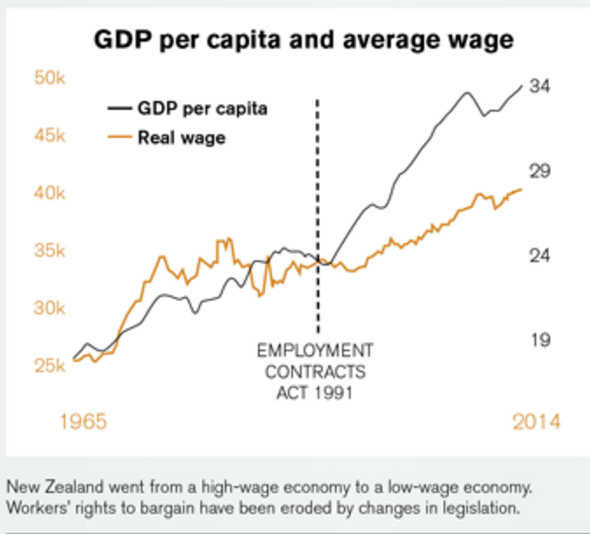
Source: Income Gap | New Zealand Council of Trade Unions – Te Kauae Kaimahi.
The passage of the Employment Contracts Act greatly reduced union power and union membership and with it wages growth in New Zealand, according to what is left of the New Zealand union movement.
Source: Income Gap | New Zealand Council of Trade Unions – Te Kauae Kaimahi.
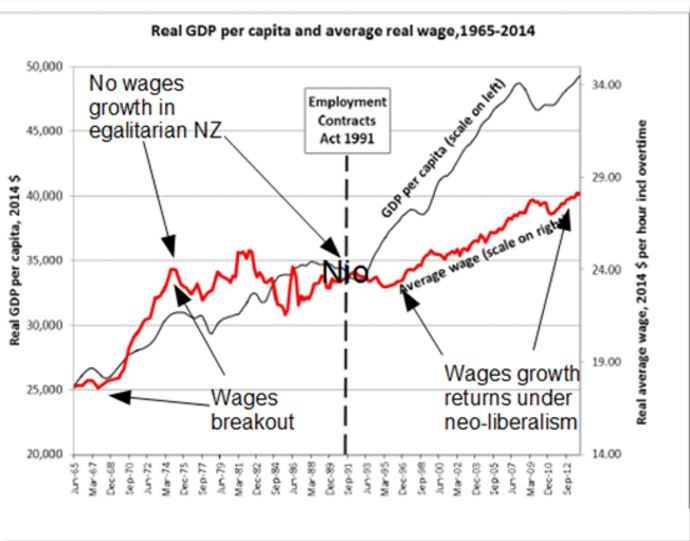
Unfortunately, both charts of the same statistics show the exact opposite to what was intended by The Council of Trade Unions and Closer Together Whakatata Mai.
Even the most casual inspection of the data charted above and reproduced below with some annotations shows that real wages growth returned to New Zealand in the early 1990s after 20 years of real wage stagnation.
Source: Income Gap | New Zealand Council of Trade Unions – Te Kauae Kaimahi.
The reforms of the 1980s stopped what was a long-term decline in average real wages. The reforms of the early 1990s including the passing of the Employment Contracts Act was followed by the resumption of sustained growth in average real wages with little interruption since.
Closer Together Whakatata Mai has even stumbled onto the great improvements in household incomes across all ethnicities since the early 1990s.
The increase in percentage terms of Maori and Pasifika real household income is much larger than for Pakeha. As Bryan Perry (2015, p. 67) explains when commenting on the very table D6 sourced by Closer Together Whakatata Mai:
From a longer-term perspective, all groups showed a strong rise from the low point in the mid 1990s through to 2010. In real terms, overall median household income rose 47% from 1994 to 2010: for Maori, the rise was even stronger at 68%, and for Pacific, 77%. These findings for longer- term trends are robust, even though some year on year changes may be less certain. For 2004 to 2010, the respective growth figures were 21%, 31% and 14%.
Source: Bryan Perry, Household Incomes in New Zealand: trends in indicators of inequality and hardship 1982 to 2014 – Ministry of Social Development, Wellington (August 2015), Table D6.
As Closer Together Whakatata Mai documented, incomes increased in real terms by 14% for the bottom and 19% for the middle.
Perry noted that in the lowest decile had too many implausible incomes including many on zero income so he was wary of relying on it. I have therefore charted the second, median and top decile before and after housing costs below. All three deciles charted showed substantial improvements in incomes both before and after housing costs.

Source: Bryan Perry, Household Incomes in New Zealand: trends in indicators of inequality and hardship 1982 to 2014 – Ministry of Social Development, Wellington (August 2015).
Naturally, measuring changes in living standards over long periods of time is fraught with under-estimation. There are new goods to be accounted for and product upgrades too.
The apps in your smartphone cost $900,000 thirty years ago —@datarade https://t.co/pjw7q4QGDp—
Vala Afshar (@ValaAfshar) October 29, 2015
05 Nov 2015 Leave a comment
in economic history, politics - USA Tags: 2016 presidential elections, antimarket bias, good old days, Leftover Left, living standards, pessimism bias, rational ignorance, rational rationality, The Great Enrichment, Twitter left
03 Nov 2015 Leave a comment
in applied welfare economics, politics - USA Tags: living standards, The Great Enrichment
29 Oct 2015 Leave a comment
in applied welfare economics, economic history, politics - USA Tags: 2016 presidential election, good old days, Leftover Left, living standards, Twitter left
HT: Stephen Berry.
30 Sep 2015 Leave a comment
in applied welfare economics, economic history, Marxist economics, politics - New Zealand, politics - USA Tags: good old days, living standards, measurement error, middle class stagnation, productivity measurement, The Great Enrichment, wage stagnation
https://twitter.com/RobinHoodTax/status/648963471690698752/photo/1
For Economic Justice, America Badly Needs Some Raises goo.gl/iA3Ecp #RobinHoodTaxUSA robinhoodtax.org/why http://t.co/0wx4kCpb4Q—
Robin Hood Tax (@RobinHoodTax) September 23, 2015
Innovation is letting us accomplish more with less. Learn more: buff.ly/1LmtAZD #tech #progress http://t.co/e2kQlGu3NA—
HumanProgress.org (@humanprogress) June 22, 2015
Celebrating humanity's flourishing through the spread of capitalism and the rule of law
Scholarly commentary on law, economics, and more
Beatrice Cherrier's blog
Celebrating humanity's flourishing through the spread of capitalism and the rule of law
Celebrating humanity's flourishing through the spread of capitalism and the rule of law
Celebrating humanity's flourishing through the spread of capitalism and the rule of law
Why Evolution is True is a blog written by Jerry Coyne, centered on evolution and biology but also dealing with diverse topics like politics, culture, and cats.
Celebrating humanity's flourishing through the spread of capitalism and the rule of law
Celebrating humanity's flourishing through the spread of capitalism and the rule of law
A rural perspective with a blue tint by Ele Ludemann
DPF's Kiwiblog - Fomenting Happy Mischief since 2003
Celebrating humanity's flourishing through the spread of capitalism and the rule of law
The world's most viewed site on global warming and climate change
Tim Harding's writings on rationality, informal logic and skepticism
A window into Doc Freiberger's library
Let's examine hard decisions!
Commentary on monetary policy in the spirit of R. G. Hawtrey
Thoughts on public policy and the media
Celebrating humanity's flourishing through the spread of capitalism and the rule of law
Politics and the economy
A blog (primarily) on Canadian and Commonwealth political history and institutions
Reading between the lines, and underneath the hype.
Economics, and such stuff as dreams are made on
"The British constitution has always been puzzling, and always will be." --Queen Elizabeth II
Celebrating humanity's flourishing through the spread of capitalism and the rule of law
Celebrating humanity's flourishing through the spread of capitalism and the rule of law
WORLD WAR II, MUSIC, HISTORY, HOLOCAUST
Undisciplined scholar, recovering academic
Celebrating humanity's flourishing through the spread of capitalism and the rule of law
Res ipsa loquitur - The thing itself speaks
Celebrating humanity's flourishing through the spread of capitalism and the rule of law
Researching the House of Commons, 1832-1868
Articles and research from the History of Parliament Trust
Reflections on books and art
Posts on the History of Law, Crime, and Justice
Celebrating humanity's flourishing through the spread of capitalism and the rule of law
Exploring the Monarchs of Europe
Cutting edge science you can dice with
Small Steps Toward A Much Better World
“We do not believe any group of men adequate enough or wise enough to operate without scrutiny or without criticism. We know that the only way to avoid error is to detect it, that the only way to detect it is to be free to inquire. We know that in secrecy error undetected will flourish and subvert”. - J Robert Oppenheimer.
The truth about the great wind power fraud - we're not here to debate the wind industry, we're here to destroy it.
Celebrating humanity's flourishing through the spread of capitalism and the rule of law
Celebrating humanity's flourishing through the spread of capitalism and the rule of law
Economics, public policy, monetary policy, financial regulation, with a New Zealand perspective
Celebrating humanity's flourishing through the spread of capitalism and the rule of law
Restraining Government in America and Around the World
 Utopia, you are standing in it!
Recent Comments