Everything’s Amazing and Nobody’s Happy
18 Aug 2015 Leave a comment
in applied welfare economics, development economics, economic history, economics of information, economics of media and culture, growth disasters, growth miracles, liberalism Tags: antimarket bias, Bryan Caplan, capitalism and freedom, life expectancies, living standards, pessimism bias, The Great Enrichment, The Great Escape, The Great Fact
Creative destruction in family spending in the USA
12 Aug 2015 Leave a comment
in applied welfare economics, economic history, politics - USA Tags: creative destruction, living standards
https://twitter.com/VisualEcon/status/508957190129188864/photo/1
Family spending across a different income groups bit.ly/195NbKb http://t.co/mSbc0DRICY—
Catherine Mulbrandon (@VisualEcon) September 01, 2014
The Great Enrichment by household type in the 20th century
09 Aug 2015 2 Comments
in applied welfare economics, economic history Tags: creative destruction, entrepreneurial alertness, living standards, The Great Enrichment
https://twitter.com/VisualEcon/status/501347052878823425/photo/1
Share of Income Before & After Federal Taxes "An Illustrated Guide to Income" bit.ly/1tfXrse #inequality http://t.co/DnkSWZ6Yov—
Catherine Mulbrandon (@VisualEcon) April 24, 2014
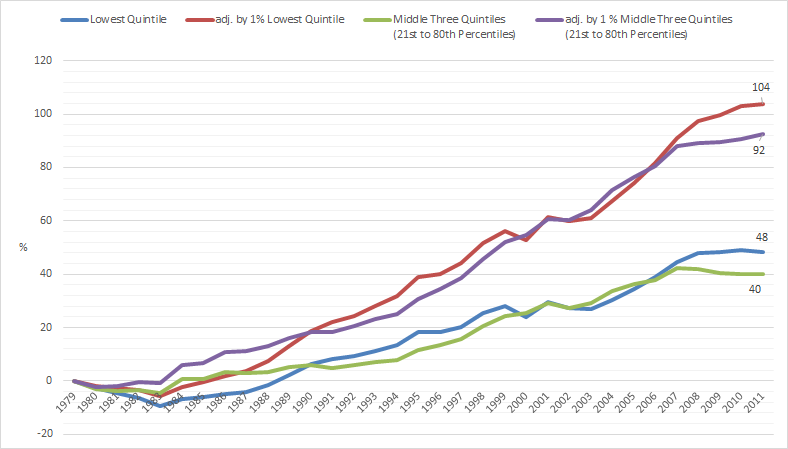
Cumulative Growth in Average Inflation-Adjusted After-Tax Income by Before-Tax Income Group, 1979 to 2011 with 1% annual adjustment for inflation measurement bias
01 Aug 2015 Leave a comment
in applied price theory, applied welfare economics, economic history, politics - USA Tags: CPI bias, living standards, measurement errors, The Great Enrichment
The Congressional Budget Office did its best to adjust after-tax incomes for inflation between 1979 in 2011. In figure 1, I added an extra 1% inflation adjustment in every year from 1979. 1% per annum is a common estimate of the inflation bias introduced by the inability of most measures of inflation to account for new goods and upgrades in the quality of existing goods to name but a few bias is in the measurement of consumer price inflation.
Figure 1: Cumulative Growth in Average Inflation-Adjusted After-Tax Income, by Before-Tax Income Group, USA, 1979 to 2011, 1% upward annual adjustment for inflation bias for new goods and quality upgrades
Source: derived from Congressional Budget Office, The Distribution of Household Income and Federal Taxes, 2011.
As can be seen from figure 1, with a 1% up left for measurement bias, instead of increases of 48% and 40% in the incomes of the lowest quartile in the middle three quartiles respectively, their after-tax, after inflation incomes about doubled since 1979.
"The rich got richer, true. But…" —@DeirdreMcClosk buff.ly/1Imdv4o http://t.co/M3ERx3JTIn—
HumanProgress.org (@humanprogress) June 28, 2015
Well done, capitalism. Everyone was on a working class income in the 1970s is now on a middle-class income. Such are the joys of compounding 1% per year over more than 30 years.
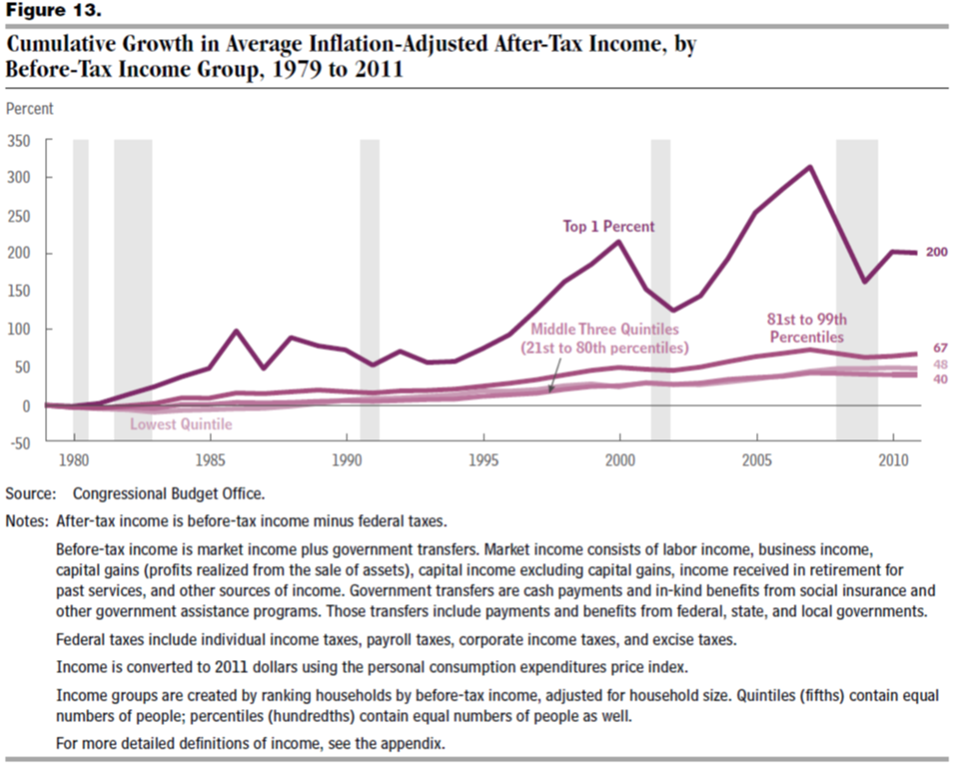
Source: Congressional Budget Office, The Distribution of Household Income and Federal Taxes, 2011.
The original Congressional Budget Office diagram above with the higher income quartiles is presented for comparison. I didn’t present the top quartiles in figure 1 because it made it unreadable because of the dominant influence of the top 1%’s increase in income.
The lesson for the day is small inaccuracies in the measurement of prosperity can over several decades through compounding lead to massive misunderstandings of the increases in prosperity.
Down and out in America
28 Jul 2015 Leave a comment
in labour economics, politics - USA, poverty and inequality Tags: child poverty, family poverty, living standards, The Great Enrichment
Down and out in America in 2009
28 Jul 2015 Leave a comment
in applied welfare economics, labour economics, politics - USA, population economics, poverty and inequality Tags: living standards, The Great Enrichment

Household living space really is getting bigger
25 Jul 2015 Leave a comment
in population economics Tags: living standards
CHART: Today’s new homes are 1,000 square feet larger than in 1973, and average living space per person has doubled http://t.co/vdBTwWsygG—
Mark J. Perry (@Mark_J_Perry) June 27, 2015
Creative destruction in family spending in the 20th century
24 Jul 2015 Leave a comment
in applied welfare economics, economic history, politics - USA Tags: creative destruction, living standards, The Great Enrichment
Change in Family spending in the 20th c. bit.ly/195NbKb http://t.co/9wd27BGzpT—
Catherine Mulbrandon (@VisualEcon) September 08, 2014
Creative destruction in popular consumer goods
06 Jul 2015 Leave a comment
in applied welfare economics, economic history, entrepreneurship, technological progress Tags: capitalism and freedom, creative destruction, entrepreneurial alertness, living standards
Globalisation & technological progress have led to some pretty spectacular, but beneficial long term price deflation http://t.co/QWxJ2rYHuq—
RBS Economics (@RBS_Economics) April 18, 2015
Down and out in Australia as measured by consumer durables affordability
30 Jun 2015 Leave a comment
in applied welfare economics, economic history Tags: Australia, living standards, The Great Enrichment
Economic freedom improves everyone's lives – especially the poor – as this graph from the IPA's @NovakMikayla shows: http://t.co/5qHIRcVRcN—
InstofPublicAffairs (@TheIPA) April 17, 2015
Televisions in the good old days
30 Jun 2015 Leave a comment
in economic history, technological progress Tags: living standards, The Great Enrichment
How does the consumer price index cope with the Great Enrichment?
08 May 2015 1 Comment
in entrepreneurship, technological progress Tags: creative destruction, entrepreneurial alertness, living standards, mismeasurement of prosperity, Moore's law, The Great Enrichment, The Great Fact


The price of air conditioning in the good old days
08 May 2015 Leave a comment
in economic history, technological progress Tags: good old days, living standards, The Great Enrichment
Down and out in Australia ain’t what it used to be
18 Apr 2015 Leave a comment
in labour economics, politics - Australia, poverty and inequality Tags: Australia, living standards, The Great Enrichment
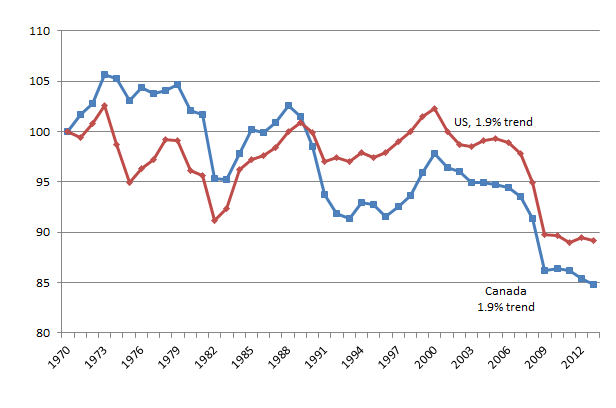
Real GDP per Canadian and American aged 15-64, 2013 price level, updated 2005 EKS PPP, detrended, 1970-2013
15 Apr 2015 Leave a comment
in economic growth, economic history, macroeconomics, politics - USA Tags: Canada, living standards
Figure 1: Real GDP per Canadian and American aged 15-64, converted to 2013 price level, updated 2005 EKS purchasing power parities, detrended 1.9%, 1970-2013, base 1970
Source: Computed from OECD Stat Extract and The Conference Board, Total Database, January 2014, http://www.conference-board.org/economics
A flat line means growth at the trend rate of 1.9%; a falling line means below trend rate of growth ; a rise in line means above trend rate of growth. Canada appears to have mostly been falling behind the USA.
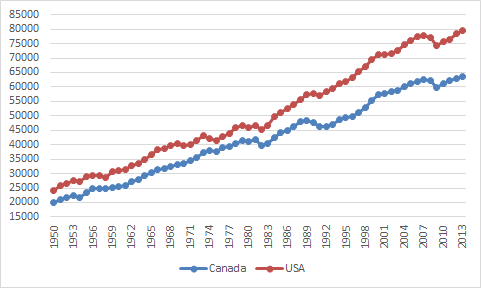
Figure 2: Real GDP per Canadian and American aged 15-64, converted to 2013 price level, updated 2005 EKS purchasing power parities, 1950-2013
Source: Computed from OECD Stat Extract and The Conference Board, Total Database, January 2014, http://www.conference-board.org/economics.
 Utopia, you are standing in it!
Recent Comments