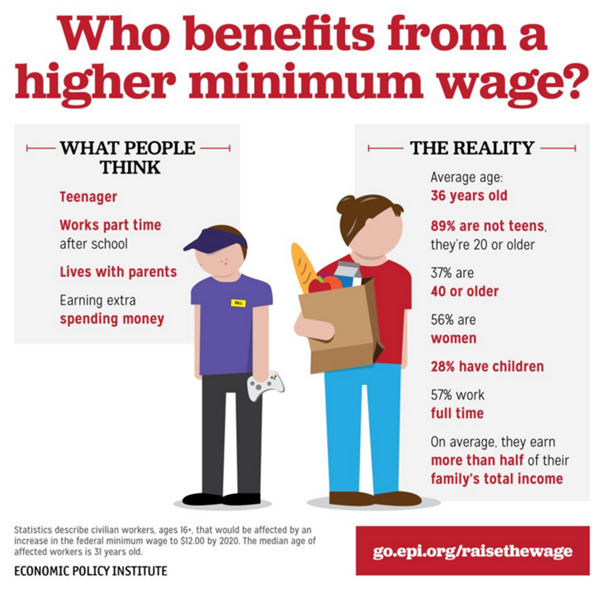
@Economicpolicy shows that most minimum wage workers are adults who do not have children to support

image

Image

A Mall divided by different city minimum wage laws @SueMoroney @GreenCatherine

The Westfield Valley Fair Mall is half in San Jose city and half in Santa Clara city. In 2012, San Jose raised its minimum wage from $8 to $10 per hour.

National Public Radio in 2014 had a brilliant broadcast on the implications of this new city minimum wage law on the Westfield Valley Fair Mall. As the broadcast said:

This change created two economic worlds within a single, large building. Employees doing more or less the same work, just steps away from each other, started making different wages.

The radio show discussed what happened on the $8 side of the Mall and then on the $10 side through interviews with employers and workers.

On the then $8 per hour minimum wage side of the Mall, employers quickly noticed that many of their employees quit to jobs elsewhere in the same Mall. These same employees found that the quality of job applicants also fell away seriously. There were noticeable differences in the personalities traits and dress standards presented by the $8 an hour job applicants and $10 an hour job applicants.

As is to be expected because information about job opportunities is costly, some of the minimum wage employees did not know that other parts of the Mall paid more.

(This change in job turnover rates and applicant pool quality subsequent to the minimum wage increase in San Jose has implications for the inequality of bargaining power between workers and employers. Minimum wage workers do keep an eye on competing opportunities and take them up when better options arise – JR aside).

Since 2012, the minimum wage rates in the Mall have changed again: Santa Clara’s minimum wage initially increased to $9 an hour – the state-wide minimum wage, which had increased from $8 per hour; San Jose’s $10.15 per hour.

Those city minimum wages were increased further this year to $11 in Santa Clara city and $10.30 in San Jose city respectively by the respective city councils.

The state-wide minimum wage in California is to increase to $15 per hour by 2020 under a law just passed. California’s current $10-per-hour minimum wage is already among the highest in the country — only Washington, DC, has a higher minimum wage at $10.50 per hour.

Getting back to what was said in the National Public Radio broadcast, the show then moved on to the Gap Store, which straddled the two city boundaries.

image

Source: Episode 562: A Mall Divided : Planet Money : NPR.

The Gap Store had the option of keeping a record of how much time employees spent in each city within its store and pay accordingly under each city law. The Gap raised everybody’s wage to $10.

There was then a fascinating interview with a Pretzels store owner. The question she asked herself every time she bought anything was how many pretzels se had to sell to cover the cost. She quickly concluded that she could not sell enough additional pretzels to cover the wage rise.

There is another Pretzels store just around the corner from her in the same mall but in the other city so she could not raise her prices by that much. She had a picture of that day’s menu and price list of the competing Pretzels store on her smart phone.

She instead took a cut in her profit. This flowed back to her employers because they received an annual bonus based on 15% of each year’s profit. They did not like that reduction in their bonus.

In a delicious irony, this same entrepreneur owned another Pretzels store in a different part of the Mall but which was in the other city subject to the lower minimum wage law. She owned two of the three pretzels stores in that Mall.

She solved the problem in staff morale by rotating her staff in alternate weeks between her two stores in the same Mall but different cities and paying them accordingly.

In my opinion, this NPR story is pretty much a vindication of standard microeconomics of minimum wage laws. Minimum wage workers are alert to their opportunities and take the best ones available to them but this is not perfect because of cost of information. As Manning observed in his superb book Monopsony in Motion:

That important frictions exist in the labor market seems undeniable: people go to the pub to celebrate when they get a job rather than greeting the news with the shrug of the shoulders that we might expect if labor markets were frictionless.

And people go to the pub to drown their sorrows when they lose their job rather than picking up another one straight away. The importance of frictions has been recognized since at least the work of Stigler (1961, 1962).

As George Stigler argued, information is costly to obtain in the labour market and this leads to price and wage dispersion with this variance related to the cost of searching for information. He concluded that the one-price (one-wage) market will occur only where the cost of information about the prices (wages) offered by buyers and sellers is zero.

Finally, minimum wages rises threaten the profitability of businesses and therefore their survival. That puts low-pay jobs at risk. As Bhaskar, Manning and To (2002) explain in their survey paper on monopsony:

Notice also that because a binding minimum wage reduces employers’ profits when there is free entry into and exit out of the labor market, some employers will be forced to exit. Employer exit has a negative effect on total employment through the loss of exiting employer payrolls.

That is, although establishments that remain after the imposition of a minimum wage increase their employment, some employers are forced out of business.

Thus, minimum wages have two opposing effects: the employment-increasing “oligopsony” effect and the employment-reducing “exit” effect. The overall effect of a minimum wage depends on which effect dominates.

An increase in the family tax credit puts no jobs at risk and is a superior alternative to minimum wage laws. Minimum wage increases throw some low page workers onto the social scrapheap.

Some look upon these large minimum state and city wage increases as worthwhile policy experiments. As Dube said:

… 30 to 40 percent of the California workforce will get a raise … This will be a big experiment. It’s far outside of our evidence base… If you’re risk-averse, this would not be the scale at which to try things.

On the other hand, if you think that wages are really low and they’ve been low for a really long time and we can afford to take some risks, doing things at this scale will get us more evidence.

“Big experiments” to use Dube’s words such as these with state and city minimum wages laws are wrong as Robert Lucas explained in 1988:

I want to understand the connection between in the money supply and economic depressions.

One way to demonstrate that I understand this connection–I think the only really convincing way–would be for me to engineer a depression in the United States by manipulating the U.S. money supply.

I think I know how to do this, though I’m not absolutely sure, but a real virtue of the democratic system is that we do not look kindly on people who want to use our lives as a laboratory. So I will try to make my depression somewhere else.

What a $15 Minimum Wage Would Do

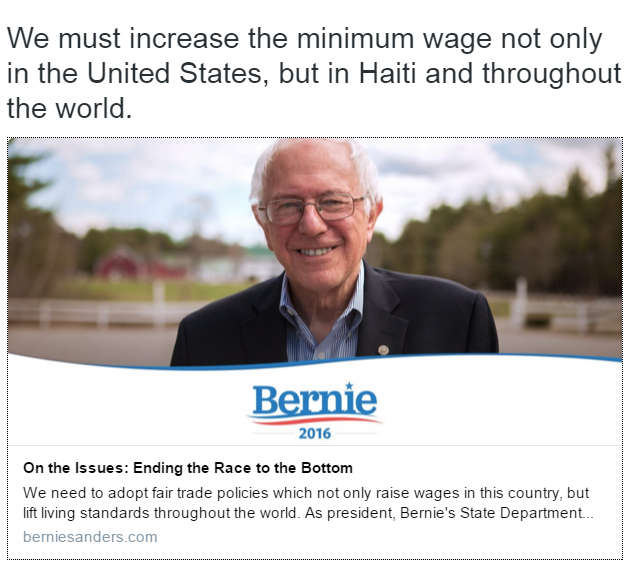
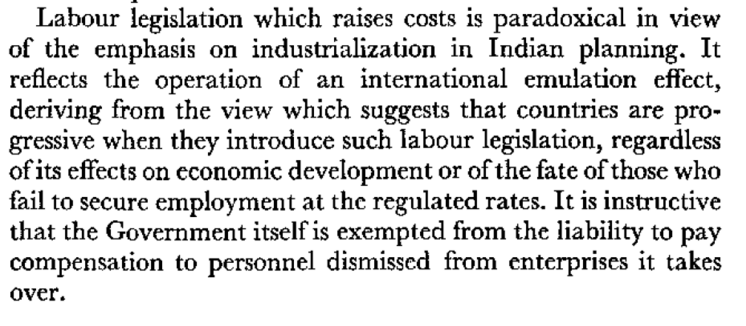
P.T. Bauer on @BernieSanders extending #fightfor15 to entire Third World!

India tried that in the 1950s as part of its five-year plans. It did not work that well. Bauer said that in development economics there is a “need to restate the obvious.”

image

Source: Ending the Race to the Bottom – Bernie Sanders.

image

Source: Indian Economic Policy and Development – P. T. Bauer (1959) – Google Books

<p><img src="http://quotes.lifehack.org/media/quotes/quote-George-Orwell-we-have-now-sunk-to-a-depth-39424.png" /></p>  <p>

More on the Minimum Wage

Source: More on (Guess What?) the Minimum Wage – Cafe Hayek

How to tell if you are a modern progressive – a two-part test by Scott Sumner

image

Source: How to tell if you are a modern progressive, Scott Sumner | EconLog | Library of Economics and Liberty.

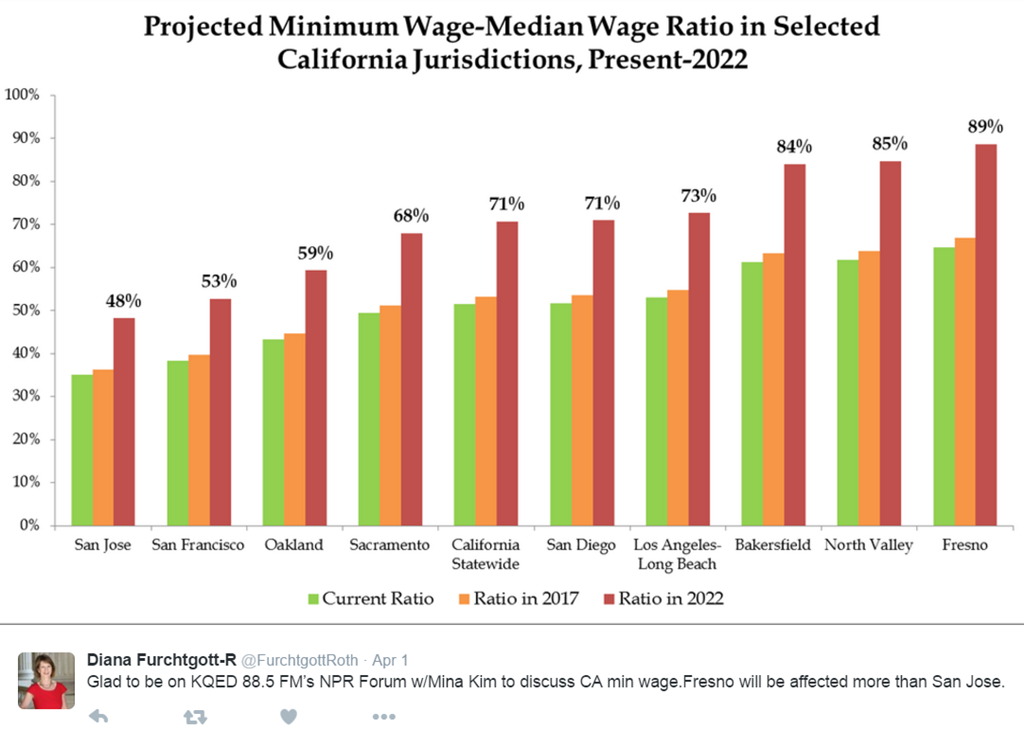
The impact of the living wage rise on different parts of California

image

Image

Do minimum wages stimulate productivity? @BernieSanders @livingwageNZ

image

Source: IZA World of Labor – Do minimum wages stimulate productivity and growth?

Is the #livingwage racist?

Image

The brutal utilitarian calculus of @NoahSmith @livingwageNZ @berniesanders

The bleeding heart concerns of the Left for job losses from economic policy changes such as from trade liberalisation disappears as soon as they discuss the losers from a living wage increase.

image

Instead of may the heavens may fall but a manufacturing job must not be lost from trade liberalisation, a brutal utilitarian calculus overtakes Noah Smith and the living wage movement about the small number of job losses that result from modest increases in the minimum wage.

Most are those who support the minimum wage shift gears their applied welfare economics in all other social context to emphasise how the losers should be given priority and greater weight when adding up the social gains and social losses of economic change.

image

The social cost of the minimum wage is not discussed in this way: how many jobs are lost and that these job losses are much more important than any gains to society.

All that is done is the number of jobs lost is compared with some other social metrics such as how much the wages go up for those that still have a job and that is enough to conclude that there is a socially beneficial change from a minimum wage increase.

Any low paid workers affected by the minimum wage increase are just reduced to numbers and added and subtracted with great ease and few moral compunctions about interpersonal comparisons of utility.

image

A minimum wage increase is not free if one worker loses their job. The Paretian Criterion states that welfare is said to increase or decrease if at least one person is made better off or worse off with no change in the positions of others.

As Rawls pointed out, a general problem that throws utilitarianism into question is some people’s interests, or even lives, can be sacrificed if doing so will maximize total satisfaction. As Rawls says:

[ utilitarianism] adopt[s] for society as a whole the principle of choice for one man… there is a sense in which classical utilitarianism fails to take seriously the distinction between persons.

Minimum wage advocates fail to take seriously that low paid workers who lose their jobs because of minimum wage increases are real living people who suffer when their interests are traded off for the greater good of their fellow low paid workers, some of whom come from much wealthier households.

As Rawls pointed out, a general problem that throws utilitarianism into question is some people’s interests, or even lives, can be sacrificed if doing so will maximize total satisfaction. As Rawls says:

[ utilitarianism] adopt[s] for society as a whole the principle of choice for one man… there is a sense in which classical utilitarianism fails to take seriously the distinction between persons.

Minimum wage advocates fail to take seriously that low paid workers who lose their jobs because of minimum wage increases are real living people who suffer when their interests are traded off for the greater good of their fellow low paid workers, some of whom come from much wealthier households. Obviously the teenagers and adults thrown onto the scrapheap of society by an increased minimum wage don’t count in the brutal utilitarian calculus Noah Smith and the living wage movement employs.

@TBillTheProf unintentionally destroys the case for a #livingwage @Mark_J_Perry @arindube

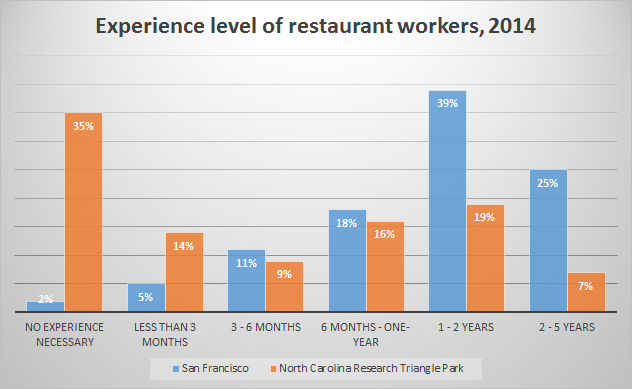
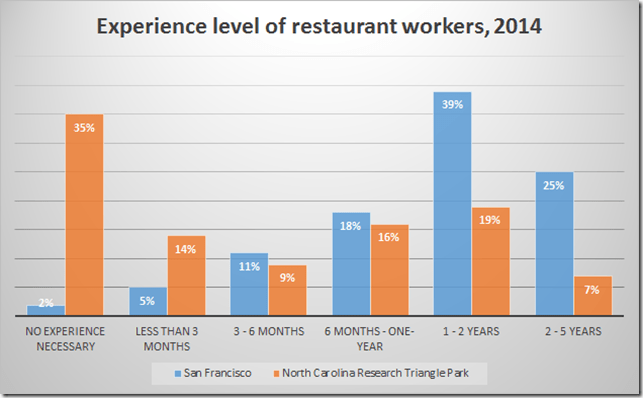
Living wage advocate William Lester published a briefing for the Washington Centre for Equitable Growth that destroys the case for a living wage. He did not intend this but he documented in detail the exclusion of inexperienced workers from the restaurant industry in San Francisco after a living wage was imposed. He compared San Francisco’s minimum wage of $12 per hour with North Carolina which only pays the federal minimum of $7.25 per hour.

What Lester found was a systematic increase in hiring standards. The living wage in San Francisco of $12 all but ended the hiring of inexperienced workers as shown in the chart below. This is exactly what basic price theory predicts. I put the two pie charts in his paper into a single bar chart so this powerful effect of the living wage on hiring standards is not lost.
image

Source: The consequences of higher labor standards in full service restaurants – Equitable Growth.

The most fundamental criticism of living wage and minimum wage increases is they exclude workers who do not meet the new labour productivity level required to make it profitable for employers to hire them.  UK research found the same thing – an increase in hiring standards and tougher shortlisting. Lester welcomes this transition of the restaurant industry in San Francisco into a career for professionals. As he says in his briefing paper:

Concurrent with this wage compression was a rise in professional standards as employers sought to hire and keep already well-trained workers at higher wages and with expanded benefits. Both developments reduced turnover and attracted more professional employees who maintain a high level of customer service.

As with all minimum wage and living wage advocates, he is incurious as to what happens to those low skilled, inexperienced workers and new workforce entrants who no longer meet the hiring standards of San Francisco restaurants because of the large minimum wage increase.

As Lester concedes in his conclusions about what will happen if the San Francisco minimum wage of $12 an hour, the highest in the country, is extended to other cities and states:

Higher professional standards may limit entry-level opportunities within the industry, while lower standards may result in more employer-provided training for new workers.

Employer funded on-the-job training is often a major part of a job package. It is well-known in the labour economics literature since the time of Adam Smith that any job is a package of wages and other attributes including learning opportunities.

Workers sell their services and buy learning opportunities; firms buy labour services and sell jobs with varying learning possibilities (Rosen 1972, 1975, 1976). The rational allocation of time results in most careers starting with large investments in full-time schooling and then mostly investments in on-the-job training (Becker 1975; Ben-Porath 1967, 1970; Weiss 1987).

As the training provided by restaurant employers is useful to other employers, the trainee must fund it through trading off wages for this training. Once trained, the employee can command a higher pay because other employers are willing to pay them more now that they are trained. Again, this is a standard result in the human capital literature.

Where the human capital is more specialised to one firm or job, the employer and the trainee share the cost. A classic example of this is an apprenticeship.

Source: IZA World of Labor – Do firms benefit from apprenticeship investments?

In San Francisco, employers expect recruits to be fully trained and experienced. They provide little in the way of on-the-job training. Their recruits must have been able to afford to fund this in their previous jobs by trading off wages for training as Lester notes in his working paper:

…San Francisco employers were less likely to report lengthy formal training periods for either front-of-house or back-of-house workers. Instead, there is an overall higher level of skill expectation and—as is the case for many professions—workers are expected to acquire and exhibit industry specific knowledge on their own. 

In North Carolina, as Lester notes, the restaurant industry hires younger workers with less formal education and offers them intensive on-the-job training:

The restaurant industry in the Research Triangle region tends to hire younger workers with a lower level of formal education. Specifically, 49.5 percent of workers in there are under age 24 or have less than a high school education, compared to  38.9 percent in San Francisco. Conversely, 40.6 percent of workers in San Francisco have some college or a bachelor’s degree or higher, compared to 29.7 percent in the Research Triangle Region.

North Carolina restaurants sought to hire unskilled workers who were friendly and reliable as Lester notes:

One manager of a neighbourhood bistro in Raleigh explained what he looks for in a new front-of-house worker: “Basically, we require [that a server] can work a four-shift minimum per week and go an entire shift, an entire eight-hour shift without smoking a cigarette and [without] any facial piercings or anything. Beyond that, just come in with a smile on your face.”

The restaurant industry in North Carolina is willing to give people low skilled,  poorly educated and inexperienced a chance to work if they are willing to work. Lester reports this when quoting an upscale bar-and-grill manager on his hiring standards:

We look for at least one year’s experience, but the biggest thing we look for is we look for the person. We don’t look for the skill. I could teach anybody how [to] wait tables [and] pour drinks. I can teach anybody how to cook steaks. What I can’t teach is how to be a good person.

Lester then discusses with some degree of approval the hiring standards in the San Francisco where restaurants are professional careers:

Rather than viewing servers as essentially interchangeable labourers who can be trained quickly and easily if they possess a modicum of personal hygiene and a friendly personality, employers in San Francisco exhibited a clear description of what a “professional server” was.

One mid-scale restaurant employer said of her front-of-house staff: “We have a lot of people who have made it a career and they’re investing in the knowledge of the product and learning their trade or already know their trade because they’ve done it for years.”

Much to the surprise of believers in the inherent inequality of bargaining power between employers and workers, employers invest heavily in low-skilled employees despite the fact this makes them employable elsewhere. Lester again:

“Training is a huge investment for us and it is constant,” [a manager] said. “Training days depend on the position. Bartending training is ten days and servers require eight days. In the kitchen it’s probably about ten days. Every day they write note cards on all their recipes. But they’ll take a final. When they take their final, their test in the kitchen, they have to know every ingredient, every ounce, and every item, for the entire station. That’s why we require them to write note cards.

Even at higher-end restaurants, employers in the region have built a human resource system that accepts a high rate of turnover. “We try to stay ahead of the game so that we’re always hiring, we’re always interviewing, but hopefully it’s not desperation hires,” says another manager. “And we try to have a mix of needs like people who need fulltime, who can work lunches and brunches and all of that, to servers who really want very part time so that you can kind of over staff on busy shifts and then there’s always someone that wants to go home. There’s always a student that would like a Saturday night off.”

Lester paints a picture of a San Francisco restaurant industry that expects workers to fund their own industry specific human capital. In North Carolina, employers provide those training opportunities to minimum wage workers despite this making these up-skilled employees an attractive proposition for rivals to poach. By depriving low skilled workers of this opportunity of both wages and employer-funded training, a living wage would make them worse off.

I am at a loss here. How can the progressive left regard the exclusion of low paid, low skilled workers as a good thing? How do they put food on the table in San Francisco other than through a welfare check? How do they get their first job?

@BernieSanders no living wage for interns @HillaryClinton hires interns illegally

Bernie Sanders is the only presidential candidate who pays interns. He pays a princely $10.10 per hour.

Bernie Sanders pays well below the $15 living wage he expects all other employers to be by law required to pay out of their equally limited budgets. His revolution will be built on near starvation wages for the work of the worker bees.

The good old days are now

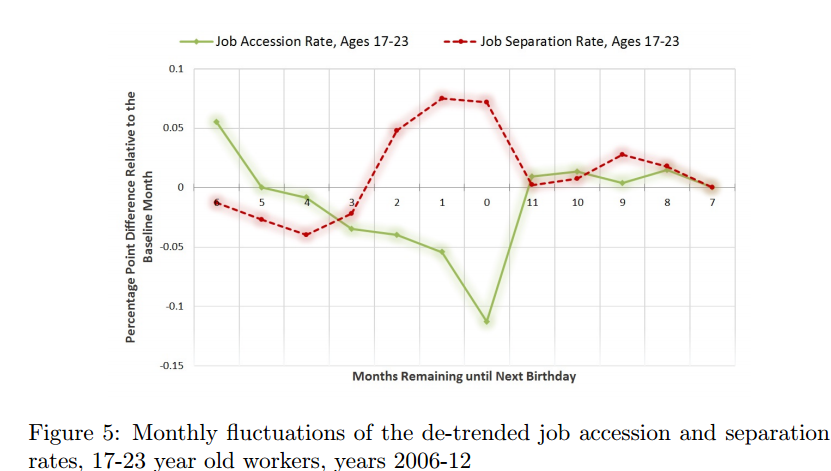
Happy birthday – you’re fired! #livingwage and youth job losses

The Dutch minimum wage increases with every birthday until the age of 23. Not surprisingly, there is a surge in job losses and a recession in hiring around birthdays. What is even worse is employment opportunities are redistributed from a group with a high rate of unemployment, teenagers and young people, towards prime age adults who have a much lower rate of unemployment.

image

Source: Happy birthday, you’re fired! Effects of the age-dependent minimum wage in the Netherlands | IZA Newsroom.

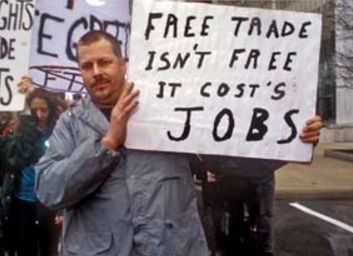
#Wages are the #prices of #labor, and what happens when prices rise?

Previous Older Entries Next Newer Entries

Bassett, Brash & Hide

Celebrating humanity's flourishing through the spread of capitalism and the rule of law

Truth on the Market

Scholarly commentary on law, economics, and more

The Undercover Historian

Beatrice Cherrier's blog

Matua Kahurangi

Celebrating humanity's flourishing through the spread of capitalism and the rule of law

Temple of Sociology

Celebrating humanity's flourishing through the spread of capitalism and the rule of law

Velvet Glove, Iron Fist

Celebrating humanity's flourishing through the spread of capitalism and the rule of law

Why Evolution Is True

Why Evolution is True is a blog written by Jerry Coyne, centered on evolution and biology but also dealing with diverse topics like politics, culture, and cats.

Down to Earth Kiwi

Celebrating humanity's flourishing through the spread of capitalism and the rule of law

NoTricksZone

Celebrating humanity's flourishing through the spread of capitalism and the rule of law

Homepaddock

A rural perspective with a blue tint by Ele Ludemann

Kiwiblog

DPF's Kiwiblog - Fomenting Happy Mischief since 2003

The Dangerous Economist

Celebrating humanity's flourishing through the spread of capitalism and the rule of law

Watts Up With That?

The world's most viewed site on global warming and climate change

The Logical Place

Tim Harding's writings on rationality, informal logic and skepticism

Doc's Books

A window into Doc Freiberger's library

The Risk-Monger

Let's examine hard decisions!

Uneasy Money

Commentary on monetary policy in the spirit of R. G. Hawtrey

Barrie Saunders

Thoughts on public policy and the media

Liberty Scott

Celebrating humanity's flourishing through the spread of capitalism and the rule of law

Point of Order

Politics and the economy

James Bowden's Blog

A blog (primarily) on Canadian and Commonwealth political history and institutions

Science Matters

Reading between the lines, and underneath the hype.

Peter Winsley

Economics, and such stuff as dreams are made on

A Venerable Puzzle

"The British constitution has always been puzzling, and always will be." --Queen Elizabeth II

The Antiplanner

Celebrating humanity's flourishing through the spread of capitalism and the rule of law

Bet On It

Celebrating humanity's flourishing through the spread of capitalism and the rule of law

History of Sorts

WORLD WAR II, MUSIC, HISTORY, HOLOCAUST

Roger Pielke Jr.

Undisciplined scholar, recovering academic

Offsetting Behaviour

Celebrating humanity's flourishing through the spread of capitalism and the rule of law

JONATHAN TURLEY

Res ipsa loquitur - The thing itself speaks

Conversable Economist

Celebrating humanity's flourishing through the spread of capitalism and the rule of law

The Victorian Commons

Researching the House of Commons, 1832-1868

The History of Parliament

Articles and research from the History of Parliament Trust

Books & Boots

Reflections on books and art

Legal History Miscellany

Posts on the History of Law, Crime, and Justice

Sex, Drugs and Economics

Celebrating humanity's flourishing through the spread of capitalism and the rule of law

European Royal History

Exploring the Monarchs of Europe

Tallbloke's Talkshop

Cutting edge science you can dice with

Marginal REVOLUTION

Small Steps Toward A Much Better World

NOT A LOT OF PEOPLE KNOW THAT

“We do not believe any group of men adequate enough or wise enough to operate without scrutiny or without criticism. We know that the only way to avoid error is to detect it, that the only way to detect it is to be free to inquire. We know that in secrecy error undetected will flourish and subvert”. - J Robert Oppenheimer.

STOP THESE THINGS

The truth about the great wind power fraud - we're not here to debate the wind industry, we're here to destroy it.

Lindsay Mitchell

Celebrating humanity's flourishing through the spread of capitalism and the rule of law

Alt-M

Celebrating humanity's flourishing through the spread of capitalism and the rule of law

croaking cassandra

Economics, public policy, monetary policy, financial regulation, with a New Zealand perspective

The Grumpy Economist

Celebrating humanity's flourishing through the spread of capitalism and the rule of law

International Liberty

Restraining Government in America and Around the World