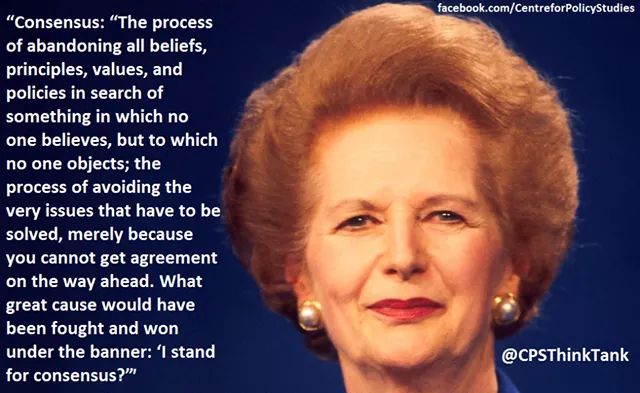
Thatcher on the fall of communism
10 Nov 2014 Leave a comment
in liberalism Tags: fall of communism, Margaret Thatcher

The state has no sources of money other than the money people earn themselves
28 Jul 2014 Leave a comment
in liberalism, public economics Tags: Margaret Thatcher
Margaret Thatcher’s brilliant last Prime Minister’s Question Time
20 Jul 2014 Leave a comment
in politics Tags: Margaret Thatcher
Thatcher’s brilliant critique of socialism and how it is happy for the poor to be poor
16 Jul 2014 Leave a comment
in comparative institutional analysis, income redistribution, liberalism, politics Tags: Margaret Thatcher, socialism

Margaret Thatcher, Hayek & Friedman | Margaret Thatcher Foundation
19 May 2014 Leave a comment
in Austrian economics, F.A. Hayek, macroeconomics, Milton Friedman Tags: credibility, gradualism, Margaret Thatcher, neoliberalism, Thomas Sargent
Thatcher read Hayek’s Road to Serfdom as an undergraduate at Oxford. She took away two key lessons for her life: you cannot compromise with socialism, even the mild social democratic forms; and she saw her own party was doing just that, which put her deeply at odds with its leadership.

After she became Leader of the Opposition, Thatcher cut short a leftish member of her own Conservative Party Research Department by showing him a copy of The Constitution of Liberty, slamming it down on the table declaring “this is what I believe”.
Thatcher’s relationship with Milton Friedman was different to that of Hayek and not as long standing. Friedman met Thatcher for the first time at a dinner in 1978.
After Thatcher came to office in 1979, Friedman was a critic of the monetary regime of the Thatcher government, questioning her monetary policy targets, questioning the raising of the value added tax to finance income tax cuts, and urging deeper spending cuts in the 1979 budget. Friedman was also a strong critic of the monetary policies of the Fed at that time as well, arguing that they lacked credibility, transparency and were very erratic.
In a letter to the Times on 3 March 1980 Friedman stated that he opposed “fine-tuning” and strongly preferred:
a steady monetary and fiscal policy announced long in advance and strictly adhered to
Hayek disagreed with Friedman about the role of gradualism in a letter to the Times on 26 March 1980:
The chief practical issue today is how fast inflation can be and ought to be stopped.
On this, I am afraid, my difference from Friedman makes me take an even more radical position.
The reason is that I believe that the artificial stimulus which inflation gives to business and employment lasts only so long as inflation accelerates, that is, so long as prices turn out to be higher than expected.
Inflation clearly cannot accelerate indefinitely, but as soon as it ceases to accelerate, all the windfalls due to prices turning out higher than expected, which kept unprofitable businesses and employment going, disappear.
Every slowing down of inflation must therefore produce temporary conditions of extensive failures and unemployment.
No inflation has yet been terminated without a “stabilization crisis”.
To advocate that inflation should be slowed down gradually over a period of years is to advocate a long period of protracted misery. No government could stand such a course.
Milton Friedman’s general views on Britain when Thatcher first came to office were clear-cut and were also stated in his letter to the Times on 3 March 1980:
…while monetary restraint is a sufficient condition for controlling inflation, it is a necessary but not sufficient condition for improving Britain’s productivity – the fundamental requirement for restoring Britain to full economic health.
That requires measures on a broader front to restore and improve incentives, promote productive investment, and give a greater scope for private enterprise and initiative.
Both Hayek and Friedman wrote privately about the Thatcher policies of the early 1980s, decrying them as gradualism. So much for the retired professors as the ring masters of neo-liberalism and Thatcher as their pawn.
Friedman and Hayek disagreed with each other, in important respects, about both gradualism in monetary policy and macroeconomics in general.
Thatcher did not follow their conflicting policy advice to her. At best, Thatcher was a wayward disciple of squabbling prophets.
Friedman was a strong critic of Austrian macroeconomics and its supposed role in the 1930s policy response or lack of a response to the Great Depression:
I think the Austrian business-cycle theory has done the world a great deal of harm.
If you go back to the 1930s, which is a key point, here you had the Austrians sitting in London, Hayek and Lionel Robbins, and saying you just have to let the bottom drop out of the world.
You’ve just got to let it cure itself. You can’t do anything about it. You will only make it worse. You have Rothbard saying it was a great mistake not to let the whole banking system collapse.
I think by encouraging that kind of do-nothing policy both in Britain and in the United States, they did harm.
Hayek was equally critical of the macroeconomics of Milton Friedman and his methodology in general:
I do indeed regard the abandonment of the whole macroeconomics nonsense as very important, but it is for me a very delicate matter and I have for some time avoided stating my views too bluntly and would not have time to state them adequately.
The source of the difficulty is the constant danger that the Mont Pelerin society might split into a Friedmanite and a Hayekian wing.
I have long regretted my failure to take time to criticise Friedman’s Positive Economics almost as much as my failure to return to the critique of Keynes General Theory after I had dealt with his Treatiese.
It still seems to me paradoxical that Keynes, who was rather contemptuous of econometrics, should have become the main source of the revival of macroeconomics – which incidentally was also the reason why Milton was for a time a Keynesian.
I believe a good and detailed critical analysis of macroeconomics would be very desirable.
Brad Delong pointed out in 2000 that the New Keynesian macroeconomic research program was developed in the 20th century monetarist tradition mostly in the work of Milton Friedman.
Tom Sargent argued in 1981 that Thatcher’s medium term economic strategy was gradualism, and the sustained budget deficits would result in unpleasant monetarist arithmetic:
…In order that the current British plan be viewed as credible it is necessary that the large prospective government deficits over the next several years be counterbalanced by prospective surpluses further down the line.
It is difficult to point to much either in current legislation, or equally importantly, in the general British political climate that could objectively support such an outlook.
…Gradualism invites speculation about future reversals with U-turns in policy.
Large contemporary government deficits unaccompanied by concrete prospects for future government surpluses promote realistic doubts about whether monetary restraint must be abandoned sooner or later to help finance the deficits.
Such doubts not only call into question the likelihood that the plan can successfully permanently reduce inflation, but also can induce high real cost in terms of depressed industry and lengthened unemployment in response to what may be viewed as only temporary downward movements in nominal aggregate demand that the monetary restraint induces.
What did Thatcher actually do?
by discrediting socialism so thoroughly, she prompted in due course the adoption by the Labour Party of free market economics, and so, as she wryly confessed in later years, “helped to make it electable”.
The archives of the Margaret Thatcher foundation has released extensive correspondence and other documents about Thatcher, Hayek and Friedman.
 Utopia, you are standing in it!
Recent Comments