Be careful for what you wish for when you call for moderation and bipartisanship in politics
20 Apr 2015 Leave a comment
in economic history, income redistribution, politics - USA, Public Choice, rentseeking Tags: bipartisanship, expressive voting, growth in government, ideology, median voter theorem, political polarisation, rational irrationality
Hillary is running as some sort of class war warrior against the big end of town
14 Apr 2015 Leave a comment
in income redistribution, politics - USA, Public Choice, rentseeking Tags: 2016 presidential election, campaign finance report form, expressive voting, Hillary Clinton, median voter theorem, rational ignorance, rational irrationality, special interests
Top 20 Hillary Clinton campaign contributors, 1999-2014, in case you were wondering. http://t.co/c8KTOkJ30X—
Downtown Josh Brown (@ReformedBroker) April 14, 2015
Public opinion and incarceration rates in the USA
02 Mar 2015 Leave a comment
in economics of crime, law and economics, Public Choice Tags: incapacitation, incarceration rates, law and order, median voter theorem, prison numbers

The working class is missing from US political discourse
14 Feb 2015 Leave a comment
in income redistribution, politics - USA, Public Choice Tags: 2008 presidential election, Director's Law, expressive voting, median voter theorem, voter demographics, Withering away of the proletariat
One of the things I noticed in the 2008 US presidential campaign was everyone was appealing for the middle class vote. Presidential primary and general election debates were about how things were getting harder for the middle-class and the Republican or Democratic candidate who happen to be pitching for votes would stand up for the middle-class better than their competition in the presidential primary or general election at hand.
Another big feature in the 2008 presidential campaign was Joe the plumber. This was the small businessman who asked then candidate Obama at a rope line three days before the final presidential debate about his plans to put up taxes. Obama replied he wanted to spread the wealth around. Obama’s response was
It’s not that I want to punish your success. I just want to make sure that everybody who is behind you, that they’ve got a chance at success, too… My attitude is that if the economy’s good for folks from the bottom up, it’s gonna be good for everybody.
If you’ve got a plumbing business, you’re gonna be better off… if you’ve got a whole bunch of customers who can afford to hire you, and right now everybody’s so pinched that business is bad for everybody and I think when you spread the wealth around, it’s good for everybody
Andrew Cherlin did the service counting up references to the working class in State of the Union addresses since President Obama was elected.
In his State of the Union addresses, Obama has used the term middle class 28 times. But he has never said “working class” except in 2011, when he described Vice President Biden, who was seated behind him, as “a working-class kid from Scranton.”
This dearth of references to the working class is no surprise in light of Director’s Law and the median voter theorem. Politicians who do not pitch to the American middle class will not win elections unless there is a lot of expressive voting by the educated middle class. In general social surveys of Americans, 44% identify as working class and 44% identify as middle class.

Republicans consistently win voters making $50,000 or more – the U.S. median income. The margin doesn’t vary much: In 2012, Mitt Romney got 53% of this group’s vote; in 2010, Republican House candidates got 55%.
The margin by which the Republicans win income brackets above 50,000 doesn’t vary much if you just look at those earning above $100,000 or those earning between $50,000 and $75,000. These margins only matter in a close election, a very close election.
Democrats consistently win voters making less than the median but the margin varies. Whether the Democrats win these voters earning less than $50,000 by a 10-point or a 20-point margin tells you who won every national election for the past decade.

The Democrats would also do well among the college educated vote. Obama won this over Romney and 2012 by 10 percentage points. This may explain why the Democrats are slightly conflicting: they must win the working class vote as well as the college educated vote to win.
Andrew Cherlin didn’t give many reasons for the disappearance of working class from modern American political discourse, but he showed some insight into expressive politics when he observed that:
Politicians may prefer to call working-class families by the class position they aspire to rather than the one they hold.

The median voter theorem
08 Jul 2014 Leave a comment
in Public Choice Tags: median voter theorem
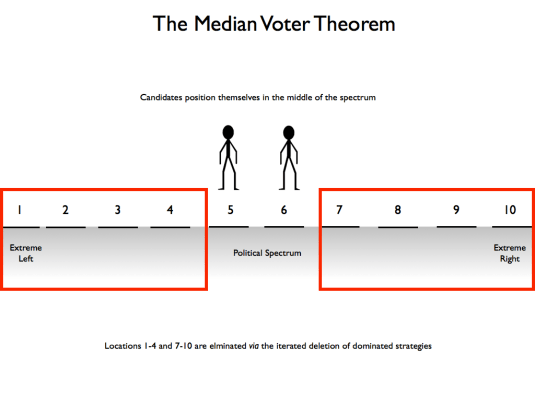
The median voter is the voter in the middle: the voter who has as many voters on either side of him.
 Utopia, you are standing in it!
Recent Comments