The average quality of goods: new goods and improved versions of older goods can provide variety and entirely new products and services previously unavailable at any price.
Measurement of the impact of new goods is ‘pretty much guesswork at present’ and ‘some very large gains in consumer welfare’ may be missed (Moulton 1996, p. 173).

An important bias affecting the measurement of prosperity is greater longevity.
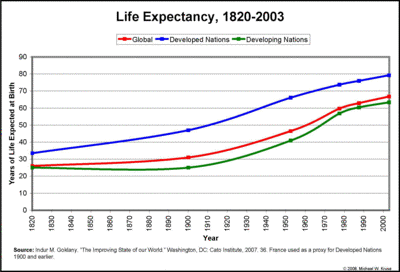
The life expectancy of males at birth improved by 5.9 years between 1970-72 and 1995-97, and by another 3.6 years by 2005-2007 (Statistics New Zealand 2009a). Life expectancy of males at birth increased by a mere 1.3 years from 1950-52 to 1970-72!
Becker et al. (2005) estimated that the six year increase in New Zealand life expectancy between 1965 and 1995 amplified the 34.3 per cent increase in New Zealand GDP per capita to the income equivalent of a 47.3 per cent rise. Becker et al. (2005) estimated that the 73.5 per cent rise in Australian GDP per capita between 1965 and 1995 was enhanced to 95.5 per cent after adjustment for the seven year increase in life expectancy.
Reality television programmes are common-place using the large differences in even 20th century living standards as their theme. The latest niche targeting younger audiences is programmes about the technological backwardness of the 1970s and even the 1980s.
 Utopia, you are standing in it!
Recent Comments