Mobile broadband could reach saturation even faster than the mobile phone before it econ.st/1LJ3mhy http://t.co/2809LNCWwZ—
The Economist (@ECONdailycharts) May 27, 2015
Creative destruction in Internet diffusion
10 Jul 2015 Leave a comment
in economic history, economics of media and culture, entrepreneurship Tags: cell phones, Digital poverty, entrepreneurial alertness, Internet, mobile phones, technology diffusion
Extreme poverty is not the same thing as digital poverty
01 Jul 2015 Leave a comment
Percentage of people around the world who own smartphones, via @conradhackett. Note #China. http://t.co/wAOmIklVbW—
Legatum Institute (@LegatumInst) May 30, 2015
Global poverty in the digital age
02 May 2015 Leave a comment
in development economics, growth disasters, growth miracles Tags: cell phones, Digital poverty, extreme poverty, global poverty, Internet access, mobile phones, technology diffusion
How the Internet is changing the lives of the poor — if they can get on on.wsj.com/1IGuFqL http://t.co/LuBE72AQPW—
Wall Street Journal (@WSJ) April 22, 2015
Facebook makes most of its money from mobile ads
12 Apr 2015 Leave a comment
in economics of media and culture, entrepreneurship, industrial organisation, survivor principle Tags: advertising, creative destruction, entrepreneurial alertness, Facebook, mobile phones
Third World poverty isn’t what it used to be given mobile phone penetration
22 Mar 2015 Leave a comment
in development economics, economics of media and culture, growth disasters, growth miracles Tags: cell phones, global poverty, mobile phones, The Great Fact

Map: How global access to the internet varies by country pewrsr.ch/1BSAHm6 http://t.co/N1bxCyMzvq—
Pew Research Center (@pewresearch) March 19, 2015
Landlines are certainly on the way out
21 Mar 2015 Leave a comment
in economics of media and culture, entrepreneurship, industrial organisation, survivor principle Tags: cell phones, creative destruction, mobile phones, network industries
Capitalism and the abolition of extreme poverty – mobile phones addition
07 Mar 2015 Leave a comment
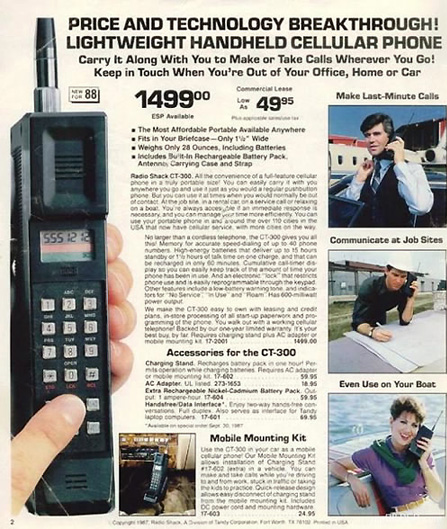
30 Years Of Cell Phones
03 Feb 2015 Leave a comment
Six of the world’s seven billion people have mobile phones – but only 4.5 billion have a toilet, according to a U.N. report
06 Sep 2014 Leave a comment

How much would an IPhone cost in 1991? | Techpolicy Daily
12 May 2014 Leave a comment
in entrepreneurship, technological progress Tags: mobile phones, standards of living, The Great Fact
In the beginning, mobile phones were just a walkie-talkie. iPhones have the same capabilities of 13 distinct electronics gadgets worth more than $3,000 in a 1991.

An iPhone incorporates a computer, CD player, phone, and video camera, among other items.
In 1991, a gigabyte of hard disk storage cost around $10,000. Today, it costs around four cents.
Back in 1991, a gigabyte of flash memory, which is what the iPhone uses, would have cost something like $45,000, or more. (Today, it’s around 55 cents ($0.55).)
The mid-level iPhone 5S has 32 GB of flash memory. Thirty-two GB, multiplied by $45,000, equals $1.44 million.
The iPhone used 20,500 millions of instructions per second which in 1991 would have cost around $620,000.
In 1991, a mobile phone used the AMPS analog wireless network to deliver kilobit voice connections.
A 1.44 megabit T1 line from the telephone company cost around $1,000 per month.
Today’s LTE mobile network is delivering speeds in the 15 Mbps range.
Safe to say, the iPhone’s communication capacity is at least 10,000 times that of a 1991 mobile phone.
The 1991 cost of mobile communication was something like $100 per kilobit per second.
Fifteen thousand Kbps (15 Mbps), multiplied by $100, is $1.5 million.
Considering only memory, processing, and broadband communications power, duplicating the iPhone back in 1991 would have (very roughly) cost: $1.44 million + $620,000 + $1.5 million = $3.56 million.
This doesn’t even account for the MEMS motion detectors, the camera, the iOS operating system, the brilliant display, or the endless worlds of the Internet and apps to which the iPhone connects us.
via Techpolicy Daily and Cafe Hayek
 Utopia, you are standing in it!
Recent Comments