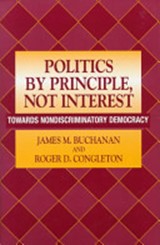
It seems to me that far too much of our politics is favourable treatment or unfavourable treatment for particularised groups. If we could somehow introduce into politics the requirement that would be analogous to the rule of law, that is, don’t treat one group differently from another group.
That has a lot of implications. That would not necessarily mean we’d have much smaller politics or government. It would mean there’d be a quite different characteristic of government…
The normative thrust of my current work is to try to push the generalization principle to the maximum extent possible, that is, so you don’t have particularised exemptions. One person gets it, everybody gets it. It cuts in favour of something like a flat tax. It cuts against means testing.
Buchanan has said that all successful welfare states (such as Sweden) apply a generality norm in some form or another.
For Buchanan, the very logic of majority rule implies unequal treatment or discrimination. If left unconstrained, majority coalitions will promote the interests of their own members at the expense of others.
Buchanan proposed a non-discriminatory democracy through the principle of generality:
- If extended to any single industry, tariff or quota protection also be extended and on equal terms to all industries.
- Tax structures would necessarily become simple, since the same tax rate would have to apply across-the-board on all sources or uses of tax base. Flat rate or proportional taxes on all incomes would broadly meet the generality norm.
- On the transfer side of the budget account, payments would have to be made in demogrants, equally available to all persons.
This is equivalent to Rawls’ veil of ignorance: choices must be without knowing where you lie in society so you make choices that are to the benefit of all.
Buchanan argued that if politics generates undesirable results, it is better to examine the rules than to argue about different policies or to elect different representatives. He build on Hayek who called a constitutional amendment that should read:
Congress shall make no law authorizing government to take any discriminatory measures of coercion.
Hayek went on say that, with such an amendment, all of the other rights would be unnecessary. In a non-discriminatory democracy, government choices are limited to those that benefit all.
 Utopia, you are standing in it!
Recent Comments