Can Cities Sue Oil Companies for Climate Change? [POLICYbrief]
09 Aug 2019 Leave a comment
in economic history, economics of information, energy economics, environmental economics, global warming, law and economics, politics - USA, property rights, Public Choice, rentseeking Tags: nuisance suits
Climate Change Nuisance Suits Federalist Society
19 Nov 2018 Leave a comment
in economics of bureaucracy, energy economics, environmental economics, global warming, law and economics, politics - USA, property rights, Public Choice, rentseeking Tags: nuisance suits
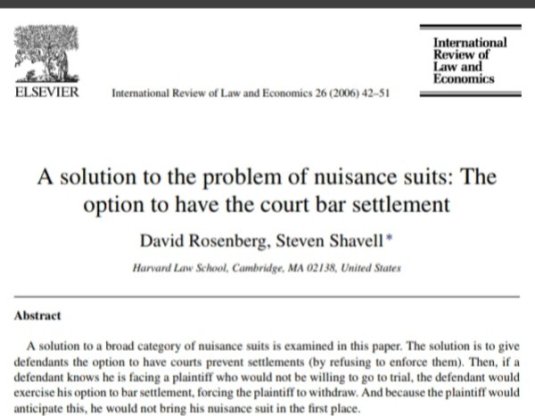
Stop nuisance suits by burning your bridges: make other party go to expense of trial. But solution assumes he will show up at trial and otherwise invest further in suit.
12 Nov 2018 Leave a comment
in law and economics Tags: nuisance suits
@GreenpeaceNZ should not support the vexatious claims of climate refugees @NZGreens
22 Sep 2015 Leave a comment
in Economics of international refugee law, environmental economics, global warming, international economics, law and economics, politics - New Zealand Tags: climate refugees, global warming, Greenpeace, Kiribati, nuisance suits, political refugees, vexatious litigation, war refugees
Political support is tenuous enough for admitting more political refugees and war refugees to New Zealand without visa overstayers trying it on with claims for asylum on the basis of climate change – that they are a climate refugee.
Currently New Zealand small refugee quota of 750 is under review. Chances of that been increased to 1000 are reasonable. If people are trying to open the floodgates to millions of people as potential refugees of climate change, if Greenpeace’s own alarmist rhetoric about global warming is to be believed, Greenpeace only strengthens the hand of the anti-immigration and xenophobic parties such as New Zealand First and within the National Party caucus.
Not everyone is a worthy cause, particularly those who make vexatious legal claims that were always going to fail in court. The High Court, the Court of Appeal and the Supreme Court all ruled that it is not their place to expand the scope of the international refugee convention to cover those displaced by climate change. As the Court of Appeal ruled
No-one should read this judgment as downplaying the importance of climate change. It is a major and growing concern for the international community. The point this judgment makes is that climate change and its effect on countries like Kiribati is not appropriately addressed under the Refugee Convention.
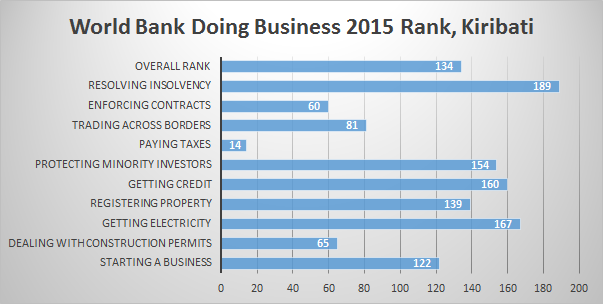
Source: Doing Business in Kiribati – World Bank Group
Kirabati can do a lot more to help itself rather than looking to others to solve its problems. It is ranked 133rd in the World Bank’s Doing Business database. This means it can do a lot to help its own development, which strengthens its resilience against climate change and rising sea levels. In the High Court, Priestley J observed:
The economic environment of Kiribati might certainly not be as attractive to the applicant and his fellow nationals as the economic environment and prospects of Australia and New Zealand. But he would not, if he returns, be subjected to individual persecution…
The appellant raised an argument that the international community itself was tantamount to the “persecutor” for the purposes of the Refugee Convention. This completely reverses the traditional refugee paradigm. Traditionally a refugee is fleeing his own government or a non-state actor from whom the government is unwilling or unable to protect him. Thus the claimant is seeking refuge within the very countries that are allegedly “persecuting” him.
Kiribati’s Human Development Index value for 2012 is 0.629—in the medium human development category—positioning the country at 121 out of 187 countries and territories. The rank is shared with Indonesia and South Africa. Kiribati is not unusually poor if it is similar in human development index ranking is to Indonesia and South Africa. Since 1980, Kiribati life expectancy at birth has increased from 55 years to 68 years. Average years of schooling is nearly 8 years and expected years of schooling for their children is now 12 years.
Do vaccines cause autism?
14 Jul 2015 Leave a comment
in economics of crime, health economics, law and economics Tags: anti-vaccination movement, conjecture and refutation, nuisance suits, Quacks, scientific fraud, vaccines
On the economics of nuisance suits
10 Oct 2014 Leave a comment
in law and economics Tags: Eric Rasmusen, law and economics, nuisance suits, vexatious litigation
A lawsuit with a low probability of success at trial, brought even though the plaintiff knows that his probability of prevailing would not justify his costs if the judicial process were to be completed instantly.
There are a range reasons why plaintiffs bring suits with little or no chance of success; some of these reasons include extracting a small cash settlement from a respondent who is too busy to spend time in court, and preparing for court. In the area of intellectual property law, nuisance suits are sometimes called patent trolls. Patent trolls are a real problem with major corporations spending large sums of money to defend these suits.
Courts are increasingly used as a high-cost, last-resort venue of business negotiation for parties who are unable to negotiate more economically.
It is costly to respond to the plaintiff’s nuisance suit and failure to respond will lead to a default judgment against the defendant. The defendant will settle with a plaintiff for any amount less than the cost of responding to the plaintiff’s complaint even if the suit is wholly meritless.
The source of nuisance suits is the ability of the plaintiff cheaply to place the defendant in a position where he would lose unless he engaged in a relatively costly defence.
Nuisance suits actually have quite a simple solution in the case of plaintiffs who really don’t want to go to court even in the American system where each party pays their own legal fees.
That solution is to call their bluff by tying your own hands in terms of offering a settlement out of court. Introduce a legal rule that gives defendants the right to have courts declare that settlement agreements will not be enforced. Defendants can simply waive their right to settle out of court and have any such settlements enforced in courts.

This burning of the bridges by the defendant on any option of settlement puts the vexatious litigant in the position of having to go to court even though they don’t want to incur those expenses.
The vexatious litigant will drop the case because they have nothing to gain, and something to lose by going to court, especially in the English system where the losing party pays part of the other side’s costs. Anticipating that the defendant would elect to prevent court enforcement of any settlement, the plaintiff would not bring his nuisance suit in the first place.
The optional for going the right to settle out of court will not deter all nuisance suits.
- The suits might be a a grudge suit or official vindication of one’s cause.
- The plaintiff may value the publicity as is commonly suspected of public prosecutors who bring sensational but legally dubious civil or criminal suits.
- The plaintiff may value the delay that litigation brings. If the suit includes a preliminary injunction, or if the plaintiff can win with a biased lower court even if he knows he will lose on appeal, he is able to delay something costly to them. The defendants may be able to delay yielding up property or complying with rules. Also, especially in land-use disputes, delay may enable a litigant to lobby to change the relevant law to his advantage.
There are limited versions of this prevention of the enforcement of offers of settlement through payment into court and Calderbank offers of settlement without prejudice save as to costs.
Under each of these litigation cost rules, if an offer of settlement is made without prejudice save as to costs, if the plaintiff does no better in court than he does under a prior settlement offer made without prejudice save as to costs, he is not entitled to recover costs of litigation beyond the point where the settlement offer was made.
The issue with which of the American and English system of liability for costs deters low value litigation is for another blog. As a hint, the English system where the losing party pays a substantial part of the winning party’s costs, makes strong cases stronger and weak cases weaker. Strong cases are more likely to go to trial because they also get the costs back.
A loser-pays rule for legal fees doesn’t work if the nuisance suit is filed with the intention of never ending up in court, but rather to waste the time of defendant, and that time is sufficiently valued by the defendant that it will pay a small cash sum for the suit to go away.
Nuisance suits are different to suits that profit from errors of law by the courts. Many suits that appear ridiculous win. Their problem is not procedure, but substance.
The proper derogatory term is court error and unjust law, depending on whether other courts would replicate the same bad result. Such suits may make up the bulk of what the public complains of as nuisance suits, but are hard to remedy by procedural reform.
HT: Eric Rasmusen
 Utopia, you are standing in it!
Recent Comments