David Horowitz – Radical Son: A Generational Odyssey (Part 1)
07 Nov 2019 Leave a comment
in Marxist economics, politics - USA Tags: Old Left
.@ESRA_NZ really were watching the other channel when the Berlin Wall fell
17 Aug 2018 Leave a comment
in Marxist economics Tags: Old Left
Soda Tax hurts the Poor says @SenSanders @TaxpayersUnion @EricCrampton
26 May 2018 Leave a comment
in applied price theory, applied welfare economics, health economics, politics - New Zealand, politics - USA Tags: nanny state, Old Left, regressive left, sugar taxes
Deirdre McCloskey on the origins of the #minimumwage
01 Dec 2016 Leave a comment
in applied price theory, economic history, history of economic thought, labour economics, minimum wage Tags: Deirdre McCloskey, eugenics, Leftover Left, New Left, Old Left
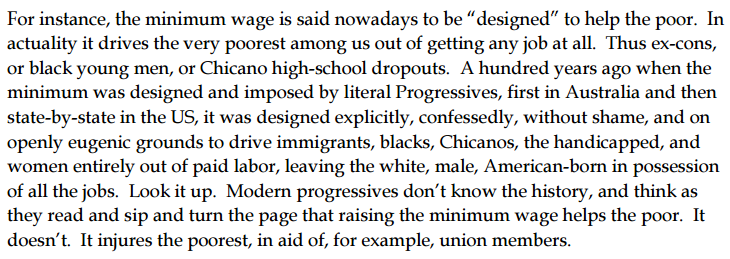
Source: Liberalism, Neoliberalism, and the Literary Left Interview by W. Stockton and D. Gilson (forthcoming).
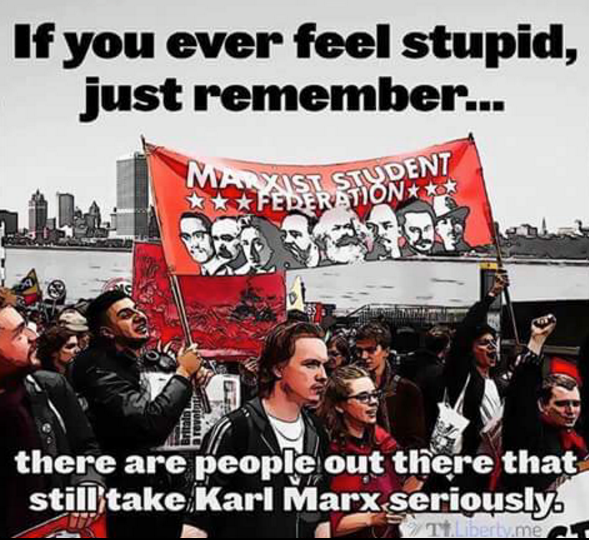
Who is the real stupid party? #Corbyn @jeremycorbyn #toriesforcorbyn
03 Nov 2016 Leave a comment
in applied price theory, constitutional political economy, development economics, economics of bureaucracy, growth disasters, Marxist economics, Public Choice Tags: British politics, economics of socialism, Leftover Left, Old Left, The Great Escape, Venezuela
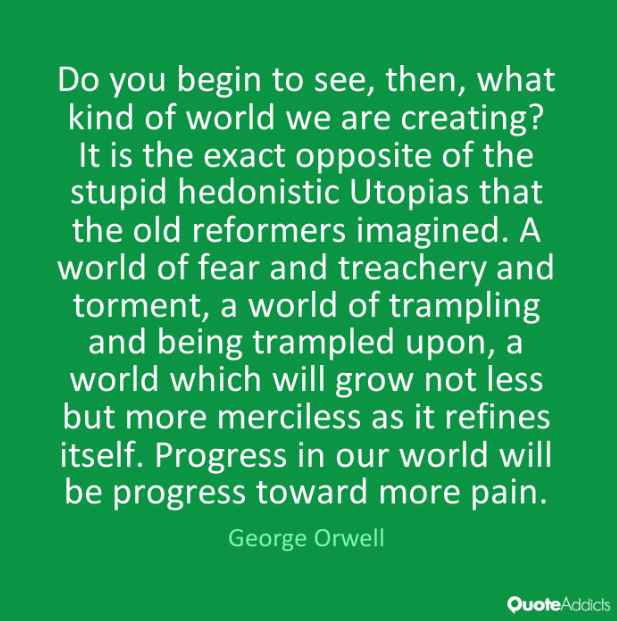
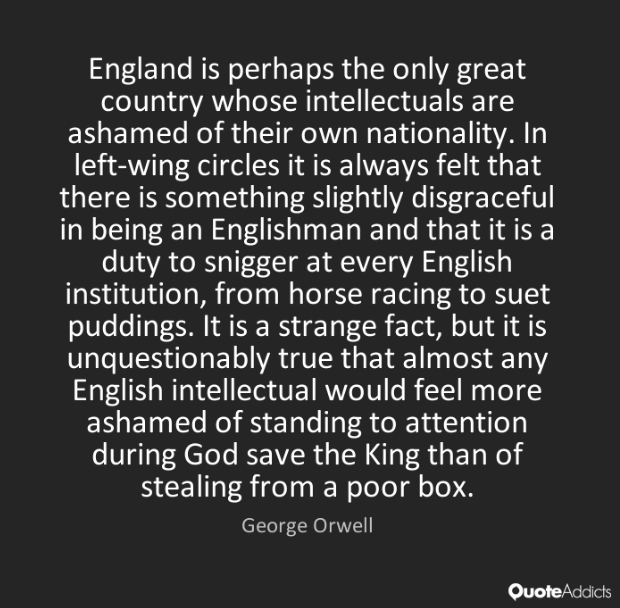
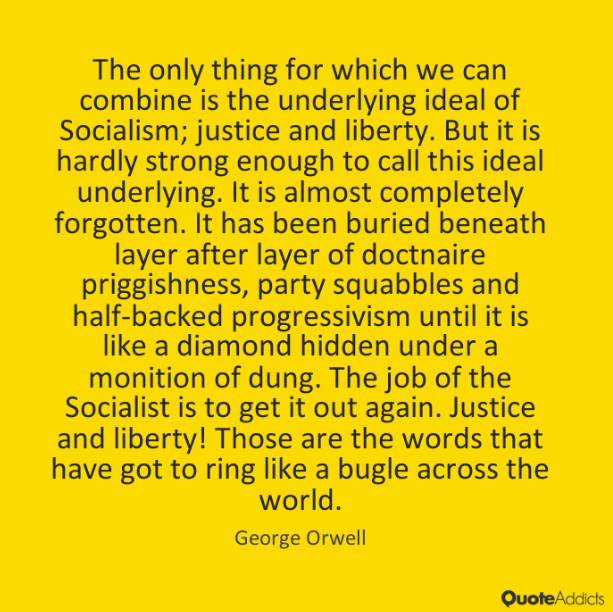
#GeorgeOrwell on #Corbyn’s patriotism? #ToriesforCorbyn
26 Sep 2016 Leave a comment
in liberalism, Marxist economics Tags: British politics, George Orwell, Leftover Left, New Left, Old Left, political correctness
.
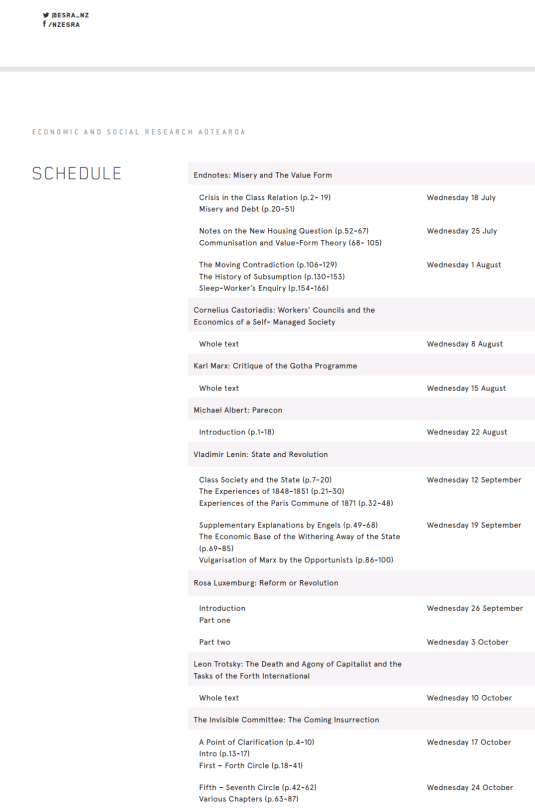
.@esra_nz discovers constitutional political economy because far-left flops at elections
04 Sep 2016 Leave a comment
in constitutional political economy, politics - New Zealand Tags: Leftover Left, Old Left, progressive left
The far left has decided to establish its own think tank to carry on the fight against neoliberalism. Obviously, the university sociology and history departments are not carrying their weight anymore in research and idea dissemination.
The new far left think tank convened by Sue Bradford has several enquiry groups. The one that intrigued me was into political and organisation. Its mission statement is
We are interested in the different ways in which people organise politically, including novel forms of organisation operating outside of the traditional parliamentary sphere. We situate ourselves within a period of international political experimentation and innovation, and are committed to conducting research from a strongly anti-capitalist position.
By working with activists, academics, unionists, workers, beneficiaries, and others, we aim to facilitate rigorous and useful research that can further political thinking and organisational practices.
This is a welcome development. Maybe the far left has finally noticed how dismally it has performed in the last two New Zealand elections under the banner of the Mana party.
In 2011, it was assured of a seat in parliament, but Mana struggled to win more than 1% of the vote. I was deeply surprised at how small the far left boat was in New Zealand. The massively funded hard left campaign in the 2014 election won 1.2% of the party vote. The sitting Mana party MP lost his seat.
In the 2011 election, the same hard left party, when woefully underfunded, won 1.1% of the party vote. Getting the message out appears to have absolutely no effect on the party vote of the hard left. The median voter theory rules.
The British Labour Party under the leadership of Tony Blair also had a metamorphosis similar to this new far left think tank when it came to political organisation. In the House of Commons, those crazies to the right or left of you are tempered by a general election only every 5 years.
Little wonder UK Labor reconsidered devolution, an assembly for London, and regional government after 15 years of Maggie Thatcher, good and hard, with her unfettered right to ask the house of commons to make or unmake any law whatsoever.
Developing positive alternatives on the Left includes what to do about the rotation of power and fettered versus unfettered parliamentary and executive power. The failure of the Left to develop its own constitutional political economy is a major strategic shortcoming. Frequenting wine bars, cafes and blogs muttering to each other ‘our day will come, our day will come’ is not enough.
Too many on the left, in Richard Posner’s view, want to remake democracy with the faculty workshop as their model but followed up by a street march wherever possible. Such deliberation has demanding requirements for popular participation in the democratic process, including a high level of knowledge and analytical sophistication and a severe curtailment of self-interested motives.
The biggest challenge this new far left think tank must consider is democratic socialism is pointless because electoral power is fleeting: sooner or later, the left wing parties representing the socialist alternative lose power, and capitalism is resorted. How can democratic socialism work without entertaining the certain prospects of the right-wing winning office in 6, 9, 12 years time and undoing everything?
Under pension fund socialism, with the majority of the share market owned by superannuation funds, any call for wide-spread nationalisations is political suicide for the far left. The same for re-nationalisation later when the left-parties get another turn in office.

The rotation of power is common in democracies, and the worst rise to the top. So it is wise to design constitutional safeguards to minimise the damage done when those crazies to the right or left of you get their chance in office, as they will. New Zealand Parliamentary elections are always close because of proportional representation. This makes reality of ending up in the minority again very quickl at the next election if not the one after very real.
It is unfortunate that this far left think tank is starting to think of extra-parliamentary means of social change. The great strength of democracy is a small group of concerned and thoughtful citizens can band together and change things by mounting single issue campaigns or joining a political party and running for office and winning elections or influencing who wins.
That is how new Australian parties in the 20th century such as the Australian Labour Party, the Country Party, Democratic Labour Party, Australian Democrats and Greens changed Australia. Most of these parties started in someone’s living room, full of concerned citizens aggrieved with the status quo. In the 21st century, Australian democracy could not be more democratic, with a wide range of totally obscure new political parties winning seats in the state upper houses and the Senate.
The recent Senate election in Australia vindicates the view that the wrong sort of people get into parliament all the time. By wrong I mean people that the establishment parties would prefer not to be there including the establishment of the Australian Greens.
Indeed, it is that very strength of democracy – small groups of concerned citizens banding together – is what is holding up legislating on an end of life choice. It is not that minorities are powerless and individuals are voiceless. Exactly the opposite.
It is wise to design constitutional safeguards to minimise the damage done when those crazies to the right or left of you get their chance in office, as they will sooner or later rather than focus on the powers you and those that currently agree with you should have in your few days in which you fleetingly have a majority.
Too many policies and ideas of the one political party or another assume that they are the face of the future, rather than just another political party that will hold power as often as not and always for an uncertain time. Too many policies and ideas of the Left assume that they are the face of the future, rather than just another political party that will hold power as often as not.
State power was something that the classical liberals feared, and the problem of constitutional design is insuring that such power would be effectively limited. Sovereignty must be split among several levels of collective authority; federalism was designed to allow for a decentralization of coercive state power. At each level of authority, separate branches of government were deliberately placed in continued tension, one with the other. The legislative branch is further restricted by the establishment of two strong houses, each of which organised on a separate principle of representation.
Unfettered power loses its shine when it must be shared with your political opponents at least once a decade. The far left should look favourably upon federalism as a brake on neoliberalism.
Privatisation and deregulation is a lot slower in a federal system with an effective upper house elected by proportional representation. Regulatory powers and public asset ownership is spread over different levels of federations, with different parties always in power at various levels at the same time, all worried about losing office by going to far away from what the majority wants.
The will of the people is constantly tested and measured in a federal system with elections at one level or another every year or so contested on a mix of local and national issues. Any failings of privatisation or deregulation in pioneering jurisdictions would quickly become apparent and would not be copied by the rest of the country. These errors could be undone where they originated by incoming progressive governments.
As James Buchanan pointed out in 1954, the great strength of democracies is majorities are temporary so the exploitation by the majority of the minority is never permanent. If electoral majorities are other than temporary, the minority would have no choice but to fight.
Because of political ignorance and apathy, Richard Posner championed Schumpeter’s view of democracy. Schumpeter disputed the widely held view that democracy was a process by which the electorate identified the common good, and that politicians carried this out:
- The people’s ignorance and superficiality meant that they were manipulated by politicians who set the agenda.
- Although periodic votes legitimise governments and keep them accountable, their policy programmes are very much seen as their own and not that of the people, and the participatory role for individuals is limited.
Schumpeter’s theory of democratic participation is that voters have the ability to replace political leaders through periodic elections. Citizens do have sufficient knowledge and sophistication to vote out leaders who are performing poorly or contrary to their wishes.
The power of the electorate to turn elected officials out of office at the next election gives elected officials an incentive to adopt policies that do not outrage public opinion and administer the policies with some minimum honesty and competence. That is the best that the hard left can do. Help throw the rascals out in the hope that the replacements might be a bit better.
The preference for this new far left think tank for extra-parliamentary action is a confession. In Australia, it is possible for just about anyone except a Trot to win a seat at the next election on issues that are important to them because they don’t need that many others to share their concerns and aspirations to win that last upper house seat on preferences.
The hard left in general failed abysmally in taking advantage of the unrest after the global financial crisis. Bernie Sanders can be explained by Clinton being a terrible candidate for president despite her practice run in 2008. Gary Johnson is attracting attention simply because Clinton and Trump are such appalling candidates. Corbyn got were he got because the 35 heroes of #Tories4Corbyn did understand the role of MPs in filtering out fringe candidates.
Europe elected centre-right governments in the aftermath of the global financial crisis. The parties that are on the rise are anti-immigration, anti-foreigner populist parties that support the welfare state. They currently play identity politics better than the left.
#feelthebern will raise your taxes
09 Jun 2016 Leave a comment
in applied price theory, applied welfare economics, economics, entrepreneurship, health economics, labour economics, minimum wage, politics - USA, public economics Tags: 2016 presidential election, antimarket bias, expressive voting, living wage, Old Left, pessimism bias, rational irrationality
Bryan Bruce’s boy’s own memories of pre-neoliberal #NewZealand @Child_PovertyNZ
23 May 2016 Leave a comment
in applied welfare economics, comparative institutional analysis, economic history, economics of regulation, income redistribution, industrial organisation, politics - New Zealand, poverty and inequality, Public Choice, rentseeking Tags: child poverty, conspiracy theories, expressive voting, family poverty, Leftover Left, living standards, neoliberalism, Old Left, pessimism bias, rational irrationality, reactionary left, top 1%
New work by Chris Ball and John Creedy shows substantial *declines* in NZ inequality.
initiativeblog.com/2015/06/24/ine… http://t.co/f94fw4Bhae—
Eric Crampton (@EricCrampton) June 24, 2015
You really are still fighting the 1990 New Zealand general election if Max Rashbrooke makes more sense than you on the good old days before the virus of neoliberalism beset New Zealand from 1984 onwards.
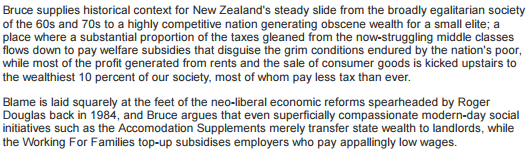
Source: Mind the Gap: Why most of us are poor | Stuff.co.nz.
Bryan Bruce in the caption looks upon the New Zealand of the 1960s and 70s as “broadly egalitarian”. Even Max Rashbrooke had to admit that was not so if you were Maori or female.
The present rate of technology adoption is nearly a vertical line —@blackrock https://t.co/3oS3YAI4ld—
Vala Afshar (@ValaAfshar) January 22, 2016
Maybe 65% of the population of those good old days before the virus of neoliberalism. were missing out on that broadly egalitarian society championed by Bryan Bruce.
As is typical for the embittered left, the reactionary left, gender analysis and the sociology of race is not for their memories of their good old days. New Zealand has the smallest gender wage gap of any of the industrialised countries.
The 20 years of wage stagnation that proceeded the passage of the Employment Contracts Act and the wages boom also goes down the reactionary left memory hole.
That wage stagnation in New Zealand in the 1970s and early 80s coincided with a decline in the incomes of the top 10%. When their income share started growing again, so did the wages of everybody after 20 years of stagnation. The top 10% in New Zealand managed to restore their income share of the early 1970s and indeed the 1960s. That it is hardly the rich getting richer.
Film review: Gone Girl starring Ben Affleck
14 Oct 2014 Leave a comment
in movies Tags: Alec Guinness, Ben Affleck, Gone Girl, Leftover Left, Meryl Streep, movies, Old Left, Sean Penn

This thriller is surprisingly good. I did not particularly want to go because it was foreshadowed to include graphic violence, which it does include.
Gone Girl passes the key test of good thrillers, great thrillers. It is pointless watching this movie a second time because you know how it finishes and all the plot turns. The movie really grows on you and you don’t notice it is 149 minutes long. Not a scene is wasted.
Silence of the Lambs is a similar movie in the sense of it is pointless watching that movie the second time. Silence of the Lambs is plain boring if you try and watch it a second time .
Gone Girl is about the disappearance of Amy Dunne (Rosamund Pike) on her wedding anniversary, and the whodunit investigation that followed. Support cast is made up of unknowns who fill out their roles excellently.
Oddly enough, on the morning before going to the movie, I was thinking about who are the great actors and actresses.
The obvious is Meryl Streep to she dissolves into any role. You don’t remember the movies that Meryl Streep appeared in because she was such a part of the movie that you don’t remember the movie because Meryl Streep was in it.
Alec Guinness is another brilliant actor who dissolved into any role he was cast. Sean Penn is his modern match, although Penn spends too much time in art house movies trying to persuade you to like Fidel Castro and his philosophy and outlook on life.
When I was drawing up this list, Ben Affleck got a mention as someone who can just appear in the movie and you pay no attention to what his previous roles were or even remember what they were. Ben Affleck is rising actor these days
What is a useful idiot?
06 Aug 2014 Leave a comment
in environmentalism, liberalism, political change, politics, war and peace Tags: bootleggers and baptists, environmentalists, Leftover Left, New Left, Old Left, political manipulation, propaganda, useful idiots
Useful idiot is a term for people perceived as propagandists, initially Lenin, for a cause whose goals they are not fully aware of, and who are used cynically by the leaders of the cause.

Many confused and misguided sympathisers will unwittingly support a malignant cause which they naïvely believe to be a force for good.
 Utopia, you are standing in it!
Recent Comments