A New Year’s celebratory practice where I am holidaying: Where Do Bullets Go When Fired Into The Air?
31 Dec 2014 Leave a comment
in economics of media and culture Tags: health and safety, Philippines
Politics and disaster aid in the Philippines – The Washington Post
11 Dec 2014 Leave a comment
in applied welfare economics, development economics, economics of natural disasters, growth disasters, growth miracles Tags: corruption, natural disaster relief, Philippines, rent seeking, Tacloban

The good news is that we find that fund allocations do indeed respond to the location and intensity of typhoons and tropical storms.
However, political ties between members of Congress and local mayors, specifically party and clan ties, are also associated with greater funding for a given municipality.
One of the most devastated cities in the aftermath of Typhoon Haiyan is Tacloban City, with a population of 221,174 people.
Our research suggests that for a municipality of this size, a match in party affiliation between the member of Congress and the mayor increases the distribution of funds by PHP 1.74 million ($40,000), while a match in clan affiliation increases this distribution by PHP 6.23 million ($142,000).
The result that clan ties have a much larger effect than party ties on the distribution of per capita reconstruction funds underscores the relative importance of clan loyalty in decision-making by Philippine congressional representatives.
via Politics and disaster aid in the Philippines – The Washington Post.
The politics of the Philippines’ vulnerability to natural disasters – The Washington Post
11 Dec 2014 Leave a comment
in applied welfare economics, development economics, economics of natural disasters, growth disasters, growth miracles Tags: corruption, disaster relief, Philippines, rent seeking

Regrettably, we find no evidence that poverty, vulnerability to disasters, or other objective measures of infrastructure needs are determinants of road construction and repair expenditures at the local level.
Instead, our evidence highlights the importance of political connections and electoral strategies.
Consistent with the story in many other countries in the developing world, we find that mayors divert construction funding to electorally contested areas where they need to win more votes, while congressmen use their discretionary funding to shore up political connections by allocating funding to localities where the mayor is an ally.
via The politics of the Philippines’ vulnerability to natural disasters – The Washington Post.
Vote buying in Thailand and the Philippines
23 Mar 2014 Leave a comment
in constitutional political economy, development economics, Public Choice Tags: Japanese politics, Philippines, secret ballot, Thailand, vote buying
Paying for votes is common in the Philippines and Thailand. The Thai Prime Minister, on the eve of the East Asian crisis, was the rural politician Banharn Silpa-archa. His nickname was Mr. Mobile ATM because of all the bribes he handed out.

Politicians are corrupt partly because developing country politics is ‘retail politics’: helping people with small loans, mediating disputes and getting children into better schools or universities.
A vicious circle develops. Politicians take bribes to build a war chest to bribe their voters to re-elect them. More honest politicians do not win office unless they stoop to paying cash for votes.
Japan is similar. LDP politicians have personal support networks that are 50,000 or more strong which are based on giving and receiving personal favours over their entire term of office.
Robert Tollison wrote a paper on the price of votes and the history of open vote trading in Great Britain and the United States prior to the 20th century.
Tollison found that the winners from the introduction of secret ballots were the middle class because the working class could no longer sell their votes to the rich.
Because the poor tend to face extremely high costs of organization, it may have been technically possible, although economically inefficient, to organize as a bloc of voters in order to secure net wealth transfers to themselves as a group.
From the standpoint of the individual poor voter, a more attractive alternative than tilting at the windmills of redistribution would have been to sell his vote to the highest bidder…
After the passage of the secret ballot in 1872 in Great Britain, the percentage of Commons seats held by landed interests dropped like a rock.
The Thai and Filipino middle classes hate the way the votes of the rural poor can be bought with bribes (and public services paid by taxing the middle class in the cities).
The Japanese, Thai and Philippine parliaments all have multi-member constituencies where the 3, 4 or 12 candidates with the most votes are elected.
This election system forces candidates from the same party to run against each other and build personal support networks to win elections off their own mantle.
This splitting of voter support works well for incumbents who have personal name recognition and a war chest based on bribes extorted during their previous term to fund cash for votes to win re-election.
An Austrian school economist visits Tacloban
12 Mar 2014 Leave a comment
in Austrian economics, development economics, economics of natural disasters, liberalism Tags: capitalism, development economics, economics of natural disasters, Liberalism, Philippines, Tacloban
When we landed at Tacloban airport just before New Year’s Day, the devastation from Typhoon Haiyan (Yolanda to the locals) was everywhere. Most of the walls of the airport were missing but the supporting beams survived and there was a make-shift roof. We drove for an hour before the damage was no more than lost roofs.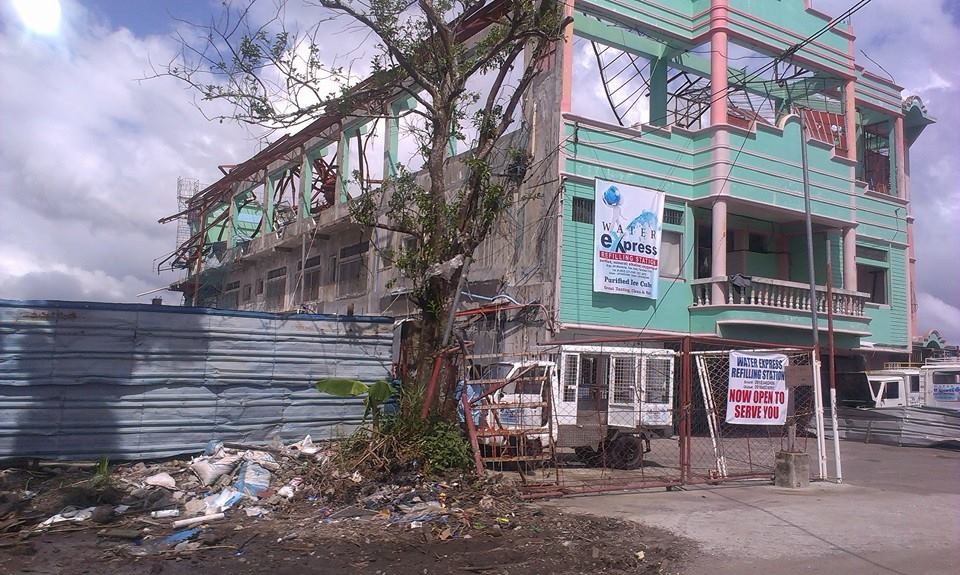
At the airport, there were no barriers between the departure area and the tarmac.
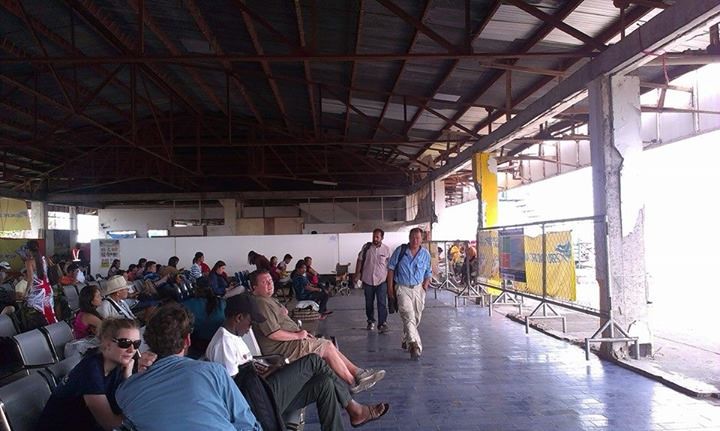
A little known use of those lost walls was stopping the jet engines blasting into the waiting lounge. No photo because I was too busy running.
The Tacloban airport is named after an uncle of Imelda Marcos. The city mayor is her nephew; you may have seen him on CNN. Other relatives of Imelda on the island of Leyte have been congressmen, provincial governors or town mayors in a dynasty that rotates between offices because of term limits.
The café next to the airport where I had breakfast when I was last in Tacloban in January 2012 was washed away, sadly along with its owner.
I remember reading the local newspapers in that café in January 2012. A feature story was about the private armies employed by local politicians. These private armies could be 40 strong. Cronyism and a lack of a rule of law could explain why Leyte is among the poorest islands in the Philippines.
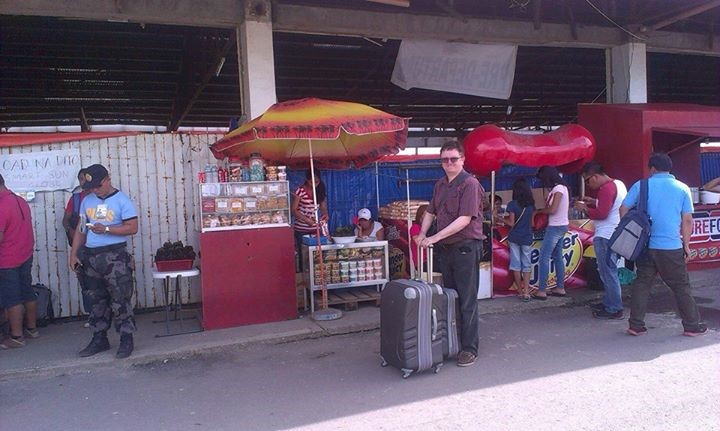
All the surrounding restaurants were wiped out. But the food vendors are back at the airport – the entrepreneurial spirit is very resilient! Tacloban airport was one of the few places where I could get diet coke in all of Leyte.
The only upside of the typhoon was Imelda’s large sea-side walled compound was washed away. There is a god: a vengeful god!?
We dropped in on a friend on the way to my parents-in-law. He had lost power. He said that straight after the typhoon, entrepreneurs were going door to door selling bottled water.
By the time we had arrived, everyone on the island of Leyte had received five-weekly rations of five kilos of rice and other essentials from the town hall. My mother-in-law had no need for this ration so she gave it to less well-off neighbours. Her town was not damaged much at all by the typhoon. They are on the other side of the mountain from Tacloban.
My in-laws living on an island further north of Leyte lost their roof and a wall. Terrifying.
Local merchants must find it hard to rebuild their businesses when everyone is getting food for free from the town hall many weeks after the disaster. This includes areas that suffered little damage.
The consular travel warning for all of Leyte was very ‘high risk’ – one below ‘avoid all travel’. Advised to be self-sufficient and be on guard for bandits, etc.
The owners of a very nice 5-room chalet at the other end of Leyte where my sister-in-law and her family stayed were most unimpressed by the over-inclusive consular travel warnings.There were many cancellations so their business was just ticking over rather than in a profit. Little wonder that the girl behind the makeshift car rental desk in the arrivals lounge at Tacloban airport did not seem to get much business when we arrived.
 Utopia, you are standing in it!
Recent Comments