After a natural disaster, both the economic and social fabric and the survival of individual employers each become weakest-shot public goods. The provision of these public goods temporarily depend by much more than is usual on the minimum individual contributions made – the weakest shots made for the common good. The supply of most public goods usually is not dependent on the contributions of any one user.
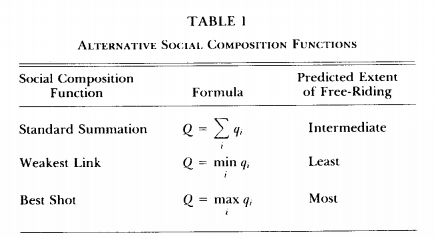
The classic example of a weakest shot public good by that brilliant applied price theorist Jack Hirschleifer is a dyke or a levee wall around a town. It is only as good as the laziest person contributing to its maintenance on their part of the levee. Vicary (1990, p. 376) lists other examples:
Similar examples would be the protection of a military front, taking a convoy across the ocean going at the speed of the slowest ship, or maintaining an attractive village/landscape (one eyesore spoils the view).
Many instances of teamwork involve weak-link elements, for example moving a pile of bricks by hand along a chain or providing a theatrical or orchestral performance (one bad individual effort spoils the whole effect.)
Most doing the duty is essential to the survival of all after a natural disaster. The alliances we call societies and the firm, normally not in danger of collapse, are threatened if there is a natural disaster. In these highly unusual circumstances, alliance-supportive activities, greater cooperativeness and self-sacrifice become an important public good.
In normal periods when threats are small, what social control mechanisms that are in place are sufficient and there is no need for exceptional behaviour and self-sacrifice.
Everyone has an interest in the continuity of the economic and social fabric and the survival of their employers in times of adversity. Individual contributions to these national and local public goods become much more decisive after a natural disaster.
In normal times people behave in a conventionally cooperative way because individually they find it profitable to do so. There is some slippage around the edges and there are social control mechanisms to deter illegal conduct and supply public goods.
As the threat to the social and economic fabric grows after a natural disaster, eventually the social and economic balance may hang by a hair. When this is so, any single person can reason that his own behaviour might be the social alliance’s weakest link. International military and political alliances also rise and fall on this weakest link basis.
 Utopia, you are standing in it!
Recent Comments