
.@NZLabour abandons Blackstone’s ratio
30 Apr 2017 Leave a comment
in economics of crime, law and economics, politics - New Zealand Tags: presumption of innocence
@radleybalko @thecounted How did the 169 unarmed people killed by police in 2015 die? @Mark_J_Perry updated
11 Sep 2015 2 Comments
in economics of crime, law and economics, politics - USA Tags: body cameras, crime and punishment, criminal deterrence, law and economics of evidence, law and order, Leftover Left, police, police shootings, presumption of innocence, William Blackstone
The Guardian is so anti-police that they included in their interactive database a drunk that drove into a police car and some poor bastard run over by the police cruiser searching for him at night.
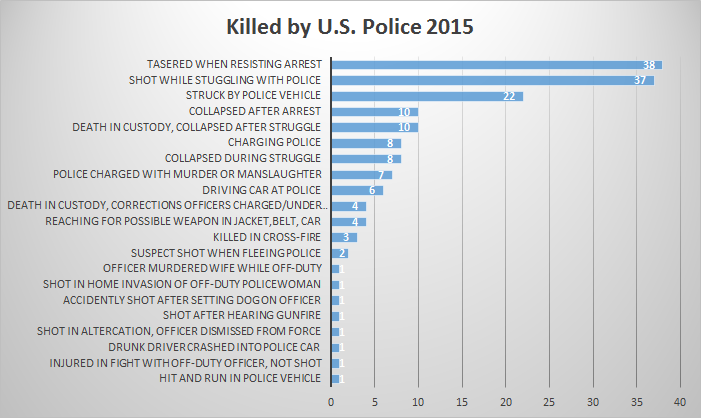
Another handy hint for an unarmed suspect is do not flee police by stealing a police cruiser with the officer dragging behind you. He may well shoot you. Police will certainly shoot an unarmed suspect if they flee arrest in a police cruiser, kidnapping the two children who happened to be in the back – their parents expect no less.

Most of the police killings of the unarmed in circumstances where better evidence would resolve doubts.

The Guardian would do a lot better by arguing that all Tasers should have cameras on them, all police cruisers should have cameras in them, and all police officers should have cameras on their lapels. These cameras are excellent for collecting evidence against criminals. There should also be plenty of cameras in police stations.

The first randomized controlled trial of police body cameras in the USA showed that cameras sharply reduce the use of force by police and the number of citizen complaints. In Seattle, the police department has set up its own YouTube channel, broadcasting a stream of blurred images to protect privacy.
Update: I recoded charging police and reaching for a possible weapon on your person or in a car into separate categories


 Utopia, you are standing in it!
Recent Comments