NZ taxpayers made a $20 million profit on its $30 billion state owned enterprises portfolio!

KiwiRail is such a dog that the Treasury reports on the rate of return to the taxpayer on the state owned enterprises portfolio by excluding KiwiRail from its calculations of rates of return.

The Treasury doesn’t do similar adjustments for state owned enterprises that are performing unusually well, so total shareholder return figures should be reported without this KiwiRail exception. If you buy a dog, you should own up to the fleas it spreads to the rest of your portfolio.

Trying to pretend that KiwiRail is just not there, or survives on the largess of someone other than the one and only New Zealand taxpayer, does no one any favours. This KiwiRail exception will have to apply for at least 10 years to the annual commercial portfolio report of the Treasury. I want to know the total shareholder return, including KiwiRail every year without exception or special pleading.

That total shareholder return of -8.2% in 2012 is worthy of comment too:

The portfolio generated a net loss after tax of $1.8 billion driven by a restructuring of KiwiRail’s balance sheet and reductions in bottom line results for Meridian and Solid Energy, affected by hydrology and coal market deterioration respectively.

Yet another successful privatisation of the electricity industry

Image

Alfred Marshall on state owned enterprises

Image

It’s not easy to be green: the cost of fossil fuels divestments to the New Zealand superannuation fund

The Green Party of New Zealand wants the New Zealand superannuation fund to sell its $676 million in fossil fuel investments. For those not in the know, this government investment fund is worth about $25 billion and is funded by present taxes to pay for the universal old age pension in New Zealand. Its current investment strategy seems to rely heavily on index linked funds that minimise management and trading costs.

The Government uses the Fund to save now in order to help pay for the future cost of providing universal superannuation.

In this way the Fund helps smooth the cost of superannuation between today’s taxpayers and future generations.

In common with the endowment funds of the American universities, that $676 million is about 2% of the total New Zealand superannuation portfolio of about NZ$25 billion.

Any portfolio manager risks considerable fees if she must monitor the entire portfolio because 2% is of dubious moral stature.

The main cost of divestiture is compliance costs to prevent fossil fuel investments drifting back into the portfolio through the routine day to day investments of other companies within their portfolios as these other firms expand into new businesses or diversified. The entire portfolio must be monitored for this risk.

American universities found that fossil fuels divestment rules out indexed linked funds as a class, along with their low management and trading fees. Ethical investors must move to actively managed investment funds which are perhaps a third more expensive in management fees.

If a move to a fossil fuel free portfolio rules out  passive indexed linked funds, that is a major risk to future returns of the New Zealand superannuation fund. Would this fossil fuels disinvestment including selling the recently acquired Z petrol station network  by the New Zealand superannuation fund?

Z Energy now owns and manages these businesses, which include:

  • a 15.4 per cent stake in Refining NZ who runs New Zealand’s only oil refinery.
  • a 25 per cent stake in Loyalty New Zealand who run Fly Buys
  • over 200 service stations
  • about 90 truck stops
  • pipelines, terminals and bulk storage

As usual, in the course of argument for disinvestment by the government investment fund, the Green Party makes an excellent argument for the privatisation not only of state owned enterprises but of the New Zealand superannuation fund.

Rather than have one victory at a time, the  Greens want the NZ superannuation fund to use the funds from the disinvestment to reinvest in pet projects of politicians. The green party co-leader said:

Money released from divestment can be reinvested in the rapidly growing renewable energy and energy efficiency sectors, helping to hasten the transition of our economy to a low-carbon future.

This makes government investment funds the playthings of politicians so they can never match the returns of a genuinely privately owned investment fund.
The curious attitude of government owned businesses to rising demand

Image

State owned enterprises continue to be a bad investment for the NZ taxpayer

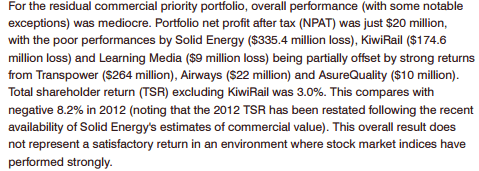
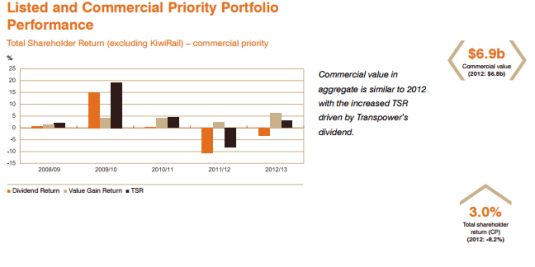
In a Briefing to the Incoming Minister just released, the Treasury said that in 2013, total shareholder return from state owned enterprises to the taxpayer was just 3 per cent. This is a little bit better than leaving the money in the bank.

image

Note:  KiwiRail is excluded because of significant changes in its valuation methodologies over the past few years, including the significant write down in its asset values in 2012. . Total shareholder return for 2012 has been restated to include Solid Energy.

KiwiRail lost $248 million in 2013, after a $174.4 million loss a year earlier. Solid Energy lost $182 million last year last year. This $182m loss follows a $335.4m loss in the June 2013 year and a $40m loss the year before that.

The quality of public policy debate in NZ: is the sale of surplus public housing an asset sale (privatisation)?

Prior to the October 2014 election, Prime Minister Key promised that there will be no further asset sales.

After the election, he announced an intention to possibly sell billions of dollars in public housing to use the sales to buy new public housing in other parts of New Zealand, such as in the suburbs and the perimeter of cities.

This was immediately denounced by the opposition as a broken election promise. Apparently a promise not to sell any further state owned enterprises is now interpreted not to sell any assets in the government balance sheet.

Journalists swallowed this criticism of the opposition, hook, line and sinker. The media seems to think that buying and selling of surplus government assets by Housing New Zealand and other social agencies is somehow unusual or new.

Any sensible observer would think it would be barmy for Housing New Zealand to have a whole bunch of old, rundown public houses purchased in the middle of the 20th century in the inner cities that are now worth a million of dollars each and not consider selling them.

These million-dollar public houses could be sold to finance the construction or purchase of several new houses for social housing purposes out in the suburbs.

What is the purpose of public housing? It is supposed to have something to do with helping the poor.

That would include managing the stock of public houses so that inner-city houses now worth a fortune are sold to finance more houses in the suburbs where most of the poor live.

Six of the world’s seven billion people have mobile phones – but only 4.5 billion have a toilet, according to a U.N. report

Image

Sweden’s March Towards Capitalism – Reason.com

Sweden is not a socialist success story but instead owes its economic growth to the lowered tax rates and deregulation of the early 1990s, which allowed innovation and investment to flourish.

Bergh also discusses how Sweden’s national voucher program revitalized the country’s educational system

via Sweden’s March Towards Capitalism – Reason.com.

So privatisation, deregulation and tax cuts in Australia were mistakes?

The test of a mistake is if you can, you undo it.

The Most Dangerous Landing Page Mistakes & How You Can Fix Them

The classic in Australia is Kim Beazley in the 1998 federal election:

  • He was asked by a journalist that if the GST is a mistake, as he claimed, would he repeal the GST if he won office at some later time.
  • Beazley waffled about you can’t unscramble an egg and so on. He could not admit the truth.

If deregulation was a mistake, campaign for a reintroducing of the two-airline policy, the bank regulation that suppressed competition, high tariffs on cars, electrical goods and clothes, and media regulation that outlawed cable TV. Campaign for a repeal of the GST and for 66% tax rates again on the middle class!

The Left must campaign for a buy back of the Commonwealth Bank, Qantas and Telecom. They will be a good buy. Public ownership is said by them to be as least as efficient as private ownership, and the cost of capital cost for state owned enterprises is allegedly less.

Go for it. It will ensure another 60 years is the wilderness for the Left. The only Left-wing government that held office in Australia since 1949 was the Whitlam Government from 1972 to 1975.

Next Newer Entries

Bassett, Brash & Hide

Celebrating humanity's flourishing through the spread of capitalism and the rule of law

Truth on the Market

Scholarly commentary on law, economics, and more

The Undercover Historian

Beatrice Cherrier's blog

Matua Kahurangi

Celebrating humanity's flourishing through the spread of capitalism and the rule of law

Temple of Sociology

Celebrating humanity's flourishing through the spread of capitalism and the rule of law

Velvet Glove, Iron Fist

Celebrating humanity's flourishing through the spread of capitalism and the rule of law

Why Evolution Is True

Why Evolution is True is a blog written by Jerry Coyne, centered on evolution and biology but also dealing with diverse topics like politics, culture, and cats.

Down to Earth Kiwi

Celebrating humanity's flourishing through the spread of capitalism and the rule of law

NoTricksZone

Celebrating humanity's flourishing through the spread of capitalism and the rule of law

Homepaddock

A rural perspective with a blue tint by Ele Ludemann

Kiwiblog

DPF's Kiwiblog - Fomenting Happy Mischief since 2003

The Dangerous Economist

Celebrating humanity's flourishing through the spread of capitalism and the rule of law

Watts Up With That?

The world's most viewed site on global warming and climate change

The Logical Place

Tim Harding's writings on rationality, informal logic and skepticism

Doc's Books

A window into Doc Freiberger's library

The Risk-Monger

Let's examine hard decisions!

Uneasy Money

Commentary on monetary policy in the spirit of R. G. Hawtrey

Barrie Saunders

Thoughts on public policy and the media

Liberty Scott

Celebrating humanity's flourishing through the spread of capitalism and the rule of law

Point of Order

Politics and the economy

James Bowden's Blog

A blog (primarily) on Canadian and Commonwealth political history and institutions

Science Matters

Reading between the lines, and underneath the hype.

Peter Winsley

Economics, and such stuff as dreams are made on

A Venerable Puzzle

"The British constitution has always been puzzling, and always will be." --Queen Elizabeth II

The Antiplanner

Celebrating humanity's flourishing through the spread of capitalism and the rule of law

Bet On It

Celebrating humanity's flourishing through the spread of capitalism and the rule of law

History of Sorts

WORLD WAR II, MUSIC, HISTORY, HOLOCAUST

Roger Pielke Jr.

Undisciplined scholar, recovering academic

Offsetting Behaviour

Celebrating humanity's flourishing through the spread of capitalism and the rule of law

JONATHAN TURLEY

Res ipsa loquitur - The thing itself speaks

Conversable Economist

Celebrating humanity's flourishing through the spread of capitalism and the rule of law

The Victorian Commons

Researching the House of Commons, 1832-1868

The History of Parliament

Articles and research from the History of Parliament Trust

Books & Boots

Reflections on books and art

Legal History Miscellany

Posts on the History of Law, Crime, and Justice

Sex, Drugs and Economics

Celebrating humanity's flourishing through the spread of capitalism and the rule of law

European Royal History

Exploring the Monarchs of Europe

Tallbloke's Talkshop

Cutting edge science you can dice with

Marginal REVOLUTION

Small Steps Toward A Much Better World

NOT A LOT OF PEOPLE KNOW THAT

“We do not believe any group of men adequate enough or wise enough to operate without scrutiny or without criticism. We know that the only way to avoid error is to detect it, that the only way to detect it is to be free to inquire. We know that in secrecy error undetected will flourish and subvert”. - J Robert Oppenheimer.

STOP THESE THINGS

The truth about the great wind power fraud - we're not here to debate the wind industry, we're here to destroy it.

Lindsay Mitchell

Celebrating humanity's flourishing through the spread of capitalism and the rule of law

Alt-M

Celebrating humanity's flourishing through the spread of capitalism and the rule of law

croaking cassandra

Economics, public policy, monetary policy, financial regulation, with a New Zealand perspective

The Grumpy Economist

Celebrating humanity's flourishing through the spread of capitalism and the rule of law

International Liberty

Restraining Government in America and Around the World