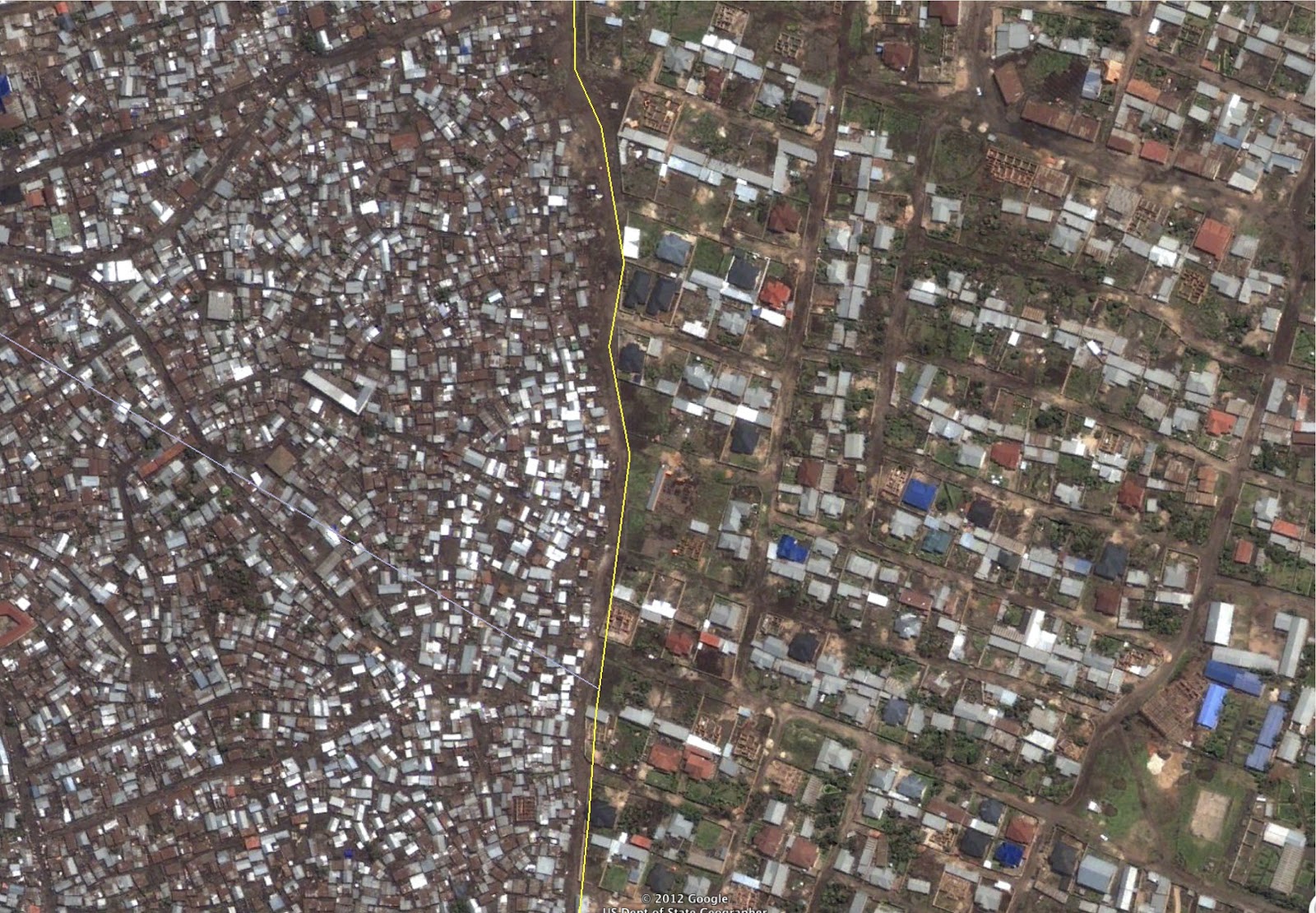
Rwanda has better institutions than the congo.

Haiti and the dominican republic share the same island but not the same property rights.
Celebrating humanity's flourishing through the spread of capitalism and the rule of law
18 Jul 2014 Leave a comment
in development economics, law and economics, property rights Tags: border effects, property rights
Rwanda has better institutions than the congo.
Haiti and the dominican republic share the same island but not the same property rights.
20 Jun 2014 Leave a comment
in applied welfare economics, economics of climate change, Public Choice Tags: Gary Libecap, global commons, global environmental externalities, global warming, property rights, transaction costs
Gary D. Libecap, “Addressing Global Environmental Externalities: Transaction Costs Considerations.” Journal of Economic Literature (2014).

Abstract
Is there a way to understand why some global environmental externalities are addressed effectively, whereas others are not?
The transaction costs of defining the property rights to mitigation benefits and costs is a useful framework for such analysis. This approach views international cooperation as a contractual process among country leaders to assign those property rights.
Leaders cooperate when it serves domestic interests to do so. The demand for property rights comes from those who value and stand to gain from multilateral action.
Property rights are supplied by international agreements that specify resource access and use, assign costs and benefits including outlining the size and duration of compensating transfer payments, and determining who will pay and who will receive them.
Four factors raise the transaction costs of assigning property rights:
(i) scientific uncertainty regarding mitigation benefits and costs;
(ii) varying preferences and perceptions across heterogeneous populations;
(iii) asymmetric information; and
(iv) the extent of compliance and new entry.
These factors are used to examine the role of transaction costs in the establishment and allocation of property rights to provide globally valued national parks, implement the Convention on the International Trade in Endangered Species of Wild Fauna and Flora, execute the Montreal Protocol to manage emissions that damage the stratospheric ozone layer, set limits on harvest of highly-migratory ocean fish stocks, and control greenhouse gas emissions.
13 Apr 2014 Leave a comment
in applied welfare economics, Armen Alchian, market efficiency Tags: Armen Alchian, price system, property rights
From Alchian’s and William Allen’s 1968 “What Price Zero Tuition?“
Since the fiasco in the Garden of Eden, mankind has suffered from scarcity: there cannot be enough goods and services to satisfy completely all the wants of all the people all the time.
Consequently, man has had to learn the hard way that in order to obtain more of this good he must forego some of that: most goods carry a price, and obtaining them involves the bearing of a cost.
Poets assure us that the best things in life are free. If so, education is a second-best good, for it decidedly is not free. But if education is not free, if a price must be paid, who is to pay it?
By developed instinct, the economist initially presumes it to be appropriate that payment of the price should be made by those who receive the good.
"Those who get should pay" is a strong rule of thumb; the economist will deviate from it only for profoundly compelling reasons.
via Quotation of the Day…. Cafe Hayek
Alchian and Allen wrote the best economics textbook ever.

Exchange and Production: Competition, Coordination and Control in 1977
12 Apr 2014 Leave a comment
in development economics, law and economics, property rights Tags: Australia, colonisation, property rights, rhino
Doug Allen in The Rhino’s Horn explains why owners sometimes reduce the value of certain attributes of their property because this reduces the incentives for others to steal it. These attributes may be of little value to you but of much greater value to those seeking to steal it.
The rhino’s horn is cut off to stop poaching. The horn is a mass of hair so removing it is painless. This is much cheaper than hiring bodyguards for every Rhino.

My garage door was tagged last year. I do not have this small tag cleaned-off because it would just invite another tagger to have a go.
Allen argued that it is cheaper to reduce the value of that part of the asset that others want to steal than spend a fortune defending it against potential theft. With regard to Australia, he said:
The country had, ironically, been discovered and claimed first by the Dutch, who at the time were a significant force in the region.
Starting in 1772, the French began their first claim to the territory. Although ignored by the British, the French sent expeditions in 1785 and 1792, making significant explorations of southern Australia and Tasmania. The French did not cease these efforts until the 1820s.
Australia was first colonised in 1788 as a penal colony. Very expensive to do, but it did fill-up the only valuable part – Sydney harbour – with 60,000 mainly riffraff and low life. This penal colony for a number of decades made the only valuable part of Australia more unattractive to other European powers to conquer. Allen explains:
In the case of Australia, the hypothesis might appear silly.
How much reduction in the first-best value to a continent can come from 60,000 convicts?
However, one must keep in mind that the only value of Australia at the end of the eighteenth century was from Sydney Harbour, Norfolk Island, and a few other strategic locations.
On these margins, the convicts could lower the value considerably
… After the War of 1812 Britain realized the strategic significance of Bermuda and subsequently established a penal colony there.
A prosperous colony is an attractive colony to conquer so imperial army and navy resources would have deployed to defending it. Prosperous locals and locally recruited troops can switch loyalties.
An empire full of prosperous colonies makes you an attractive target for other European powers to gang up on and divide the spoils. This may explain why some colonial powers had mixed feelings about developing their colonies. Robert Lucas observed that:
Stagnation at income levels slightly above subsistence is the state of traditional agricultural societies anywhere and any time. But neither did the modern imperialisms—the British included—alter or improve incomes for more than small elites and some European settlers and administrators.
France lost its once vast North American colonies through wars. Many colonies changed hands after the countless European wars as part of peace settlements.
Celebrating humanity's flourishing through the spread of capitalism and the rule of law
Scholarly commentary on law, economics, and more
Beatrice Cherrier's blog
Celebrating humanity's flourishing through the spread of capitalism and the rule of law
Celebrating humanity's flourishing through the spread of capitalism and the rule of law
Celebrating humanity's flourishing through the spread of capitalism and the rule of law
Why Evolution is True is a blog written by Jerry Coyne, centered on evolution and biology but also dealing with diverse topics like politics, culture, and cats.
Celebrating humanity's flourishing through the spread of capitalism and the rule of law
Celebrating humanity's flourishing through the spread of capitalism and the rule of law
A rural perspective with a blue tint by Ele Ludemann
DPF's Kiwiblog - Fomenting Happy Mischief since 2003
Celebrating humanity's flourishing through the spread of capitalism and the rule of law
The world's most viewed site on global warming and climate change
Tim Harding's writings on rationality, informal logic and skepticism
A window into Doc Freiberger's library
Let's examine hard decisions!
Commentary on monetary policy in the spirit of R. G. Hawtrey
Thoughts on public policy and the media
Celebrating humanity's flourishing through the spread of capitalism and the rule of law
Politics and the economy
A blog (primarily) on Canadian and Commonwealth political history and institutions
Reading between the lines, and underneath the hype.
Economics, and such stuff as dreams are made on
"The British constitution has always been puzzling, and always will be." --Queen Elizabeth II
Celebrating humanity's flourishing through the spread of capitalism and the rule of law
Celebrating humanity's flourishing through the spread of capitalism and the rule of law
WORLD WAR II, MUSIC, HISTORY, HOLOCAUST
Undisciplined scholar, recovering academic
Celebrating humanity's flourishing through the spread of capitalism and the rule of law
Res ipsa loquitur - The thing itself speaks
Celebrating humanity's flourishing through the spread of capitalism and the rule of law
Researching the House of Commons, 1832-1868
Articles and research from the History of Parliament Trust
Reflections on books and art
Posts on the History of Law, Crime, and Justice
Celebrating humanity's flourishing through the spread of capitalism and the rule of law
Exploring the Monarchs of Europe
Cutting edge science you can dice with
Small Steps Toward A Much Better World
“We do not believe any group of men adequate enough or wise enough to operate without scrutiny or without criticism. We know that the only way to avoid error is to detect it, that the only way to detect it is to be free to inquire. We know that in secrecy error undetected will flourish and subvert”. - J Robert Oppenheimer.
The truth about the great wind power fraud - we're not here to debate the wind industry, we're here to destroy it.
Celebrating humanity's flourishing through the spread of capitalism and the rule of law
Celebrating humanity's flourishing through the spread of capitalism and the rule of law
Economics, public policy, monetary policy, financial regulation, with a New Zealand perspective
Celebrating humanity's flourishing through the spread of capitalism and the rule of law
Restraining Government in America and Around the World

 Utopia, you are standing in it!
Recent Comments