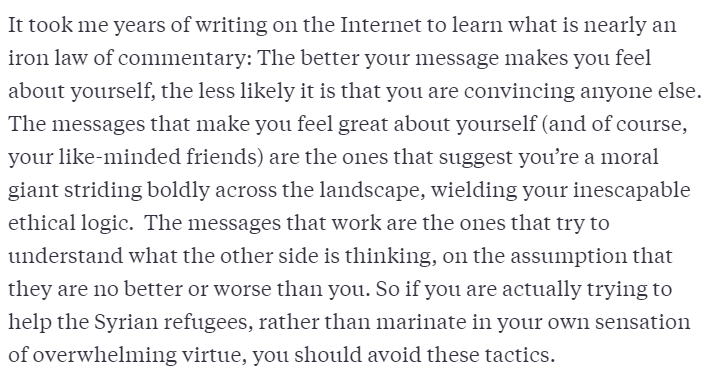
Source: How to Win Friends and Influence Refugee Policy – Bloomberg View.
Celebrating humanity's flourishing through the spread of capitalism and the rule of law
24 Feb 2016 Leave a comment
in Economics of international refugee law, politics - Australia, politics - New Zealand, politics - USA Tags: asylum seekers, cognitive psychology, psychology of persuasion, refugee policy
03 Feb 2015 Leave a comment
in climate change, economics of information, economics of media and culture, environmental economics, global warming, health economics, politics - Australia, politics - New Zealand, politics - USA, Public Choice Tags: anti-vaccination movement, climate alarmists, expressive politics, expressive voting, psychology of persuasion

In the last post, I presented evidence, collected as part of the CCP Vaccine Risk Perception study, that showed that the trope has no meaningful connection to fact.
Those who accept and reject human evolution, those who believe in and those who are skeptical about climate change, all overwhelmingly agree that vaccine risks are low and vaccine benefits high.
The idea that either climate change skepticism or disbelief in evolution denotes hostility to science or lack of comprehension of science is false, too. That’s something that a large number of social science studies show. The CCP Vaccine Risk study doesn’t add anything to that body of evidence.
Vaccination rates are a serious issue. Do those that are trying to lift vaccination rates think they going to get anywhere by calling people stupid, corrupt and in the pay of a multinational.
Of course not. This matter is serious. It’s a real public health risk.
People are persuaded to vaccinate through gentle messages providing facts in a way they can understand that also respects their knowledge, their intellect, and their concerns for the safety of the children. You don’t win people over by insulting them.
The climate alarmists are so insulting because they have no interest in persuading the people that are actually talking to. They are reaching out to members on the audience were are on the margin, and appealing to their political base, including the fundraising base by showing how staunch they are in slaying the Dragon.
Celebrating humanity's flourishing through the spread of capitalism and the rule of law
Scholarly commentary on law, economics, and more
Beatrice Cherrier's blog
Celebrating humanity's flourishing through the spread of capitalism and the rule of law
Celebrating humanity's flourishing through the spread of capitalism and the rule of law
Celebrating humanity's flourishing through the spread of capitalism and the rule of law
Why Evolution is True is a blog written by Jerry Coyne, centered on evolution and biology but also dealing with diverse topics like politics, culture, and cats.
Celebrating humanity's flourishing through the spread of capitalism and the rule of law
Celebrating humanity's flourishing through the spread of capitalism and the rule of law
A rural perspective with a blue tint by Ele Ludemann
DPF's Kiwiblog - Fomenting Happy Mischief since 2003
Celebrating humanity's flourishing through the spread of capitalism and the rule of law
The world's most viewed site on global warming and climate change
Tim Harding's writings on rationality, informal logic and skepticism
A window into Doc Freiberger's library
Let's examine hard decisions!
Commentary on monetary policy in the spirit of R. G. Hawtrey
Thoughts on public policy and the media
Celebrating humanity's flourishing through the spread of capitalism and the rule of law
Politics and the economy
A blog (primarily) on Canadian and Commonwealth political history and institutions
Reading between the lines, and underneath the hype.
Economics, and such stuff as dreams are made on
"The British constitution has always been puzzling, and always will be." --Queen Elizabeth II
Celebrating humanity's flourishing through the spread of capitalism and the rule of law
Celebrating humanity's flourishing through the spread of capitalism and the rule of law
WORLD WAR II, MUSIC, HISTORY, HOLOCAUST
Undisciplined scholar, recovering academic
Celebrating humanity's flourishing through the spread of capitalism and the rule of law
Res ipsa loquitur - The thing itself speaks
Celebrating humanity's flourishing through the spread of capitalism and the rule of law
Researching the House of Commons, 1832-1868
Articles and research from the History of Parliament Trust
Reflections on books and art
Posts on the History of Law, Crime, and Justice
Celebrating humanity's flourishing through the spread of capitalism and the rule of law
Exploring the Monarchs of Europe
Cutting edge science you can dice with
Small Steps Toward A Much Better World
“We do not believe any group of men adequate enough or wise enough to operate without scrutiny or without criticism. We know that the only way to avoid error is to detect it, that the only way to detect it is to be free to inquire. We know that in secrecy error undetected will flourish and subvert”. - J Robert Oppenheimer.
The truth about the great wind power fraud - we're not here to debate the wind industry, we're here to destroy it.
Celebrating humanity's flourishing through the spread of capitalism and the rule of law
Celebrating humanity's flourishing through the spread of capitalism and the rule of law
Economics, public policy, monetary policy, financial regulation, with a New Zealand perspective
Celebrating humanity's flourishing through the spread of capitalism and the rule of law
Restraining Government in America and Around the World
 Utopia, you are standing in it!
Recent Comments