


Celebrating humanity's flourishing through the spread of capitalism and the rule of law
13 Nov 2014 Leave a comment
in politics - USA, Public Choice Tags: Jonathan Gruber, Machiavelli, Obamacare, public choice, Yes Minister, Yes Prime Minister
09 Nov 2014 Leave a comment
in Public Choice Tags: preference falsification, public choice, The fall of communism, The fall of the Berlin Wall, unanticipated revolutions
A. Main Hypotheses
Dynamics of Transition
Current scholarship on political revolutions fails to explain how rapidly and unexpectedly the 1989 revolutions in Central and Eastern Europe developed.
Individual decisions to support the opposition eventually create a snowball effect. The people that join the movement as it grows will later portray themselves as long-time members of the opposition and encourage even more people to switch over. Thus, preference falsification is both the source of a regime’s stability and its downfall. This phenomenon makes it difficult to track anti-government sentiment in repressive regimes, which is why revolutions come as a surprise but seem to have been inevitable.
B. Summary
United In Amazement
The revolutions in Central and Eastern Europe challenged the view that communist totalitarianism is more stable than ordinary authoritarianism.
In retrospect, it all appears like an inevitable consequence of multiple factors (bad leaders, bad economy, and no freedom.) But at the time, academics, statesmen, diplomats, journalists, futurists, and other experts all did not see it coming, and were astounded when it did.
Received Theories of Revolution and their Predictive Weaknesses
Kuran offers a critique of the current literature related to the hypothesis.
- Structuralist theory: A revolution occurs when: 1) a state’s evolving relations with other states and local classes weaken its ability to maintain law and order, and 2) the elites harmed by this situation are powerless to restore the status quo ante yet strong enough to paralyze the government. This theory doesn’t rely on subjective factors like religion, etc.
- Standard theory (Rational-choice): An individual opposed to incumbent regime is unlikely to participate in efforts to remove it, since personal risks outweigh benefits of the movement’s success. He or she will let others make sacrifices to kill the regime, and will still benefit since revolution is a “collective good.”
The standard theory explains why revolution is so rare but not why the 1989 ones occurred, and fails to explain why some people do make the irrational choice to challenge the regime and risk their lives. The structuralist theory explains why conditions were ripe for revolution in Soviet Union, but does not explain why old order collapsed so suddenly at once and why 1989 revolutions were so unexpected.
Preference Falsification and Revolutionary Bandwagons
According to Kuran, “a mass uprising results from multitudes of individual choices to participate in a movement for change; there is no actor named ‘the crowd’ or ‘the opposition.’” (p. 16)
The distinction between an individual’s private and publicly expressed preference is preference falsification.
- Thus, the individual’s choice to join the opposition is based on a trade-off between internal and external payoffs – the internal psychological cost of preference falsification vs. the benefits and harms of siding with the opposition.
- As the opposition grows, the external cost of joining becomes lower than the internal cost of not joining. Everyone has a different revolutionary threshold (i.e. “intellectuals” are less susceptible to social pressure) but even one individual shift to opposition leads to many others, creating a revolutionary bandwagon.
- Since private preferences and thresholds are unknowable, this snowball effect means that society can quickly and quietly reach the brink of revolution.
- Unanticipated revolutions seem predictable in hindsight because once individuals switch to the opposition after the snowball effect, they will claim they were always opposed to the old regime even if they were not. This perpetuates preference falsification and biases post-revolutionary opinions and analysis.
Gradual and abrupt changes in preference are part of a single unified process:
- When public opinion changes enough that people start to think a revolution could be possible, the speed at which people join the bandwagon will accelerate.
- Pressure groups and unorganized groups complement each other in efforts to overthrow the regime. “Where a small pressure group fails to push a bandwagon into motion a slightly better organized or a slightly larger one might.” (pg. 25)
East European Communism and the Wellspring of its Stability
Although oppression under Communism prompted a tiny number of citizens to express dissent through Western and independent publications, uprisings were rare and the few that did occur in Hungary, Czechoslovakia, and East Berlin were quickly crushed. Most people living in Eastern Europe were tolerant of and submissive to the regime. According to Kuran, this was due to 1) official punishment of regime opponents, 2) the need to publicly support the regime, and 3) ignorance of how many people internally shared their antipathy. State propaganda reinforced individuals’ perceptions that they were alone in their dissent. However, once people stopped trying to prove their loyalty and started challenging communism, the regimes began to unravel. Thus, preference falsification is “the wellspring of stability” for Eastern European regimes, which would likely have fallen before 1989 were it not for this phenomenon.
The Revolution
The regimes of Eastern Europe were more vulnerable than publicly expressed opinion made them seem. Even genuine support for the regime was very thin; they could easily be swayed by an alternative to socialism if they thought enough people would support it.
Soviet policies of perestroika and glasnost pointed to growing dissatisfaction with communist leadership, which opened up the possibility of a coup by more hard-line Party leaders. Life under communism had reinforced peoples’ fear of change.
While in retrospect it seems like Gorbachev had engineered the liberalization and ultimate revolution in the Soviet Union, in reality these events occurred in spite of him. Kuran argues they were ignited by several other factors:
- The massive rise in expressed discontent during glasnost lowered everyone’s revolutionary threshold.
- Individual decisions to keep anti-Communist movements nonviolent were crucial to their cohesion and ultimate success.
- Success of anti-government demonstrations in one country inspired them elsewhere, and emboldened those who were on the fence about joining. Each successive revolution took less time to complete.
- Small government concessions, such as in Czechoslovakia, encouraged protesters to make greater demands for freedom.
- Communist officials acquiesced to the opposition. The pressure to not support the status quo is an example of preference falsification in the opposite direction, contributing to the regime’s demise.
The Predictability of Unpredictability
Revolutions that come as a surprise are the product of a long period of gestation. The rapid growth of mass movements is due to interdependent public preferences – it is the result of many rational individual decisions undertaken based on changing incentives. Even though the confluence of so many variables is unpredictable, we can still gain insight into the general processes by which revolutions form. However, it is difficult to gauge peoples’ revolutionary thresholds, especially when state censorship and regulation of public opinion polls makes this information unavailable.
C. Comments
Kuran’s argument about the “element of surprise” in revolution supplements PDT’s framework for understanding the causes of regime change, although he does not tackle the question of differentiating successful revolutionary outcomes from failures once the initial government turnover occurs. Additionally, his analysis of revolution in Eastern Europe shows that seemingly stable authoritarian regimes can actually be on the brink of revolt and thus vulnerable to internal and external pressure. This supports PDT’s idea that boosting a state’s civil society will influence more people to publicly express their internal dissent, giving the opposition movement the strength needed to successfully challenge the regime.
Summarized by Shelli Gimelstein. July, 2013.
Source: Timur Kuran, “Now out of never: The Element of Surprise in the East European Revolution of 1989,” World Politics, Vol. 44, No. 1, October 1991, pp. 7-48
06 Nov 2014 Leave a comment
in Gordon Tullock, Public Choice Tags: Gordon Tullock, public choice

HT: Cafe Hayek
14 Oct 2014 Leave a comment
in organisational economics, personnel economics, Public Choice Tags: agent principal problems, Eric Rasmusen, GRIPS, Japan, Mark Ramseyer, political science, public choice
Gullible gaijin (外人), especially those in the foreign media, foreign ministries and academia think that the bureaucrats rule Japan. Nothing could be further from the truth.
I’ll illustrate this first with the way in which the ruling Liberal Democratic Party (LDP) in Japan exercises a tight control over the courts.
Judges in Japan are career judges starting straight out of a specialised Law School for trainee judges in their late 20s as an assistant judge with various promotions all the way to the top to various courts with different jurisdictions in different places in Japan.
Control over transfers between courts in different parts of Japan as well as over promotions is the key to making sure judges know what is required of them and punishing those judges who step out of line.
Japanese lower court judges are reassigned every three years to different courts in different parts of the country. Most Japanese judges find administrative duties prestigious and branch office assignments embarrassing.
The judicial secretariat supervised by the Supreme Court can moves judges up and down the hierarchy from the High Courts (the courts of appeals) to the District Courts (the trial courts) to the Family Courts and to the branch offices of the District and Family Courts. It routinely sends judges to less prestigious postings. Supreme Court judges are appointed directly by the government in their 60s and must retire at the age of 70.
Every Japanese judge knows that when they are reassigned, the next reassignment is not necessarily as prestigious as the last, depending on how they rule in contentious cases.
J. Mark Ramseyer and Eric B. Rasmusen have written several very good papers and a book on this topic of judicial independence, or more correctly, the lack of judicial independence in Japan.
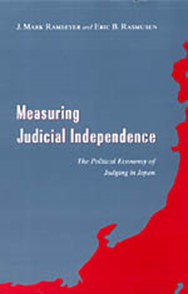
Lower court judges defer to the wishes of the LDP on sensitive political questions because they will do better in their careers. Japan has a judicial career structure that rewards and punishes judges according to their work product, including their rulings in sensitive political cases.
Ramseyer and Rasmusen reviewed the quality of the assignments of 400 judges after deciding politically charged cases, holding constant proxies for effort, intelligence, seniority, and political bias. These political sensitive cases involve judges:
Ramseyer and Rasmusen found that judges who defer to the LDP in politically disputes do better in their career assignments than those who do not. Similarly, judges who grant injunctions against the national (but not local) government have less successful careers.
This distinction is important because the national government wants to keep local governments in line with the laws they pass. This differentiation between issuing injunctions against local governments, but not the national government, shows the detail at which judicial decisions are controlled by the ruling party through favourable assignments and promotions.
Ramseyer and Rasmusen also found that:
If the national government, the ruling LDP, exercises such close control over the courts, it would be surprising that they let the bureaucracy tell them what to do.
The LDP controls the bureaucracy, even though it isn’t apparent, as explained by Mark Ramseyer.

The most reliable agent for your interests is the agent who thinks he in charge because the face has grown to fit the mask. Ramseyer as pointed out that a bureaucracy would act the same whether
Ramseyer and Rosenbluth argue that the institutional framework of government – the rules of the game among political players – decisively shapes the character of political competition and incentives in Japan.
The ruling LDP works within Japanese electoral rules to maximize its success with voters, and within constitutional constraints to enforce its policies on bureaucrats and judges.
The LDP has several ways of keeping the bureaucracy under control:
The LDP keeps bureaucratic action closely in line with its preferences through the control of promotions and three yearly transfers and by encouraging intense rivalry between ministries.
Bureaucrats who do as they are told and anticipate the needs of their political masters in the LDP get the best transfers and are promoted to the top and then win the best post-retirement positions.
Japanese bureaucrats start retiring in their mid 40s so having a favourable post retirement job is vital. The Japanese system is based on back loading of pay. This is a well-known system for ensuring fidelity of agents where effort and performance is more difficult to monitor.
The main payoff been a bureaucrat in Japan is the prize at the end of the road. This prize will be denied for you if you step out of line, don’t do as you’re told and don’t know what is required of you.
My political science professor in Japan at the National Graduate Institute of Policy Studies (GRIPS) introduced me to the work of Mark Ramseyer in 1996. Ramseyer is completely fluent in Japanese and writes in Japanese as well as English on law and economics.
07 Oct 2014 Leave a comment
in applied price theory, election campaigns, politics - New Zealand, politics - USA, Public Choice Tags: 2014 New Zealand general election, campaign finance reform, Leftover Left, median voter theorm, public choice

Two millionaires, one on the left and one on the right, set up parties to get into Parliament in the recent New Zealand election. The millionaire of the left failed abysmally. The millionaire on the right made progress towards getting into Parliament in the 2017 election.
Each spent vast sums of money by New Zealand standards on their party:
By way of context, the maximum that a political party can spend on campaign expenses in the three months prior to the election is $1.1 million, plus $25,000 per electorate seat It is contesting. None of this is spent on radio and television advertising because this is allocated for free by the electoral commission based on previous election performance.
One of the major rationales for election finance regulation is to stop the rich buying elections by flooding the airways and billboards with their call to arms and buying politicians short of campaign donations:
Conventional wisdom holds that money plays a central and nefarious role in American politics.
Underlying this belief are two fundamental assumptions:
(1) elective offices are effectively sold to the highest bidder, and
(2) campaign contributions are the functional equivalent of bribes.
Campaign finance regulations are thus an attempt to hinder the operation of this political marketplace.
John Milyo
New Zealand is a good example of how difficult it is to buy votes if you’re underlying message does not work. This is a key point to remember.
The millionaire of the left, Kim.com, gave money to a far left party in New Zealand, recycled a couple of middle-aged lefties, ran a hard left campaign, and won all of 2000 extra party votes over last time out of electorate of about 2 million.
He came unstuck because his sitting electorate MP lost 3000 votes and lost his seat. If he had kept his seat, his party would have been also entitled to a List MP seat because his party won 1.3% of the party vote. Under the New Zealand system of mixed member proportional representation, if you win a seat in Parliament, you’re entitled to list seats to ensure that your representation in Parliament is equal to your party vote.
The millionaire of the right, Colin Craig, ran a socially conservative, economic nationalist campaign and won 4% of the vote. A party needs 5% of the party vote to get into Parliament if your party does not win an electorate seat.
Both of these parties that did not get into Parliament outspent the winning national party which won 60 of the 121 seats in Parliament.
The failure of Kim.com and Colin Craig to buy their way Parliament should be no surprise. Most systematic studies find no effect of marginal campaign spending on the electoral success of candidates.
For example, see Steven Levitt, “Using Repeat Challengers to Estimate the Effects of Campaign Spending on Electoral Outcomes in the U.S. House,” Journal of Political Economy 102 (1994): 777–798.
Levitt noted that previous studies of congressional spending have found a large positive effect of challenger spending, but little evidence for effects of incumbent spending. Those studies did not adequately control for inherent differences in vote-getting ability across candidates.
Jeff Milyo also found that a more systematic analysis of the electoral fortunes of wealthy candidates found no significant association between electoral or fund-raising success and personal wealth. For example, see Jeffrey Milyo and Timothy Groseclose, “The Electoral Effects of Incumbent Wealth,” Journal of Law and Economics 42 (1999): 699–722.
A range of rich candidates have attempted to buy Senate seats and gubernatorial posts with little success if they were themselves unappealing candidates.

The best explanation to date for the minor effect of campaign spending on electoral success is competent candidates are adept at both convincing contributors to give money and convincing voters to give their vote.
The finding that campaign spending and electoral success are highly correlated exaggerates the importance of money to a candidate’s chances of winning.
Campaign donors give more money to the expected winners because they want to be on the winning side. What lobbyist doesn’t want to be that the best new friend of the incoming minister?
Legislators tend to act in accordance with the interests of donors, but this is not because of a quid pro quo. Instead, donors tend to give to like-minded candidates. See Steven Levitt, “Who are PACs Trying to Influence with Contributions: Politicians or Voters?” Economics and Politics 10, no. 1 (1998): 19–36.
It is a much surer thing to give donations to a party that already agrees with you, rather than persuade someone to change their minds with campaign donations. That is a much less certain bet.
Studies of legislative behaviour indicate that the most important determinants of an incumbent’s voting record are constituent interests, party, and personal ideology. These three factors explain nearly all of the variation in incumbents’ voting records. See Steven Levitt, “How Do Senators Vote? Disentangling the Role of Party Affiliation, Voter Preferences and Senator Ideology,” American Economic Review 86 (1996): 425–441.

As an aside, the hard left campaign was instructive in another regard. The hard left honestly believes that there is a large number of people out willing to vote hard left if only their message was properly funded and got a hearing. These would be hard left voters are currently parking their vote elsewhere, such as with the right wing parties, apparently.
A massively funded hard left campaign in New Zealand won 1.2% of the party vote. In the 2011 election, the same hard left party, when woefully underfunded, won 1.1% of the party vote. Getting the message out appears to have absolutely no effect on the party vote of the hard left. The median voter theory rules.
The Conservative party was much more successful because the Christian parties in New Zealand usually get about 4% of the vote, except when they’re fighting with each other over who was following the Word of God better, which is rather common.
Furthermore, about 10-15% of the New Zealand election is both socially conservative and economically nationalist. They used to be called working-class Tories. Much of this vote currently votes for the New Zealand First Party– a one-man party – and its leader will be 72 at the next election.
HT: Jeff Milyo
04 Oct 2014 Leave a comment
in applied welfare economics, comparative institutional analysis Tags: Arthur Pigou, government failure, market failure, public choice
 Comparative institutional analysis, market failure, government
06 Jul 2014 Leave a comment
in Gordon Tullock, James Buchanan, politics - USA, Public Choice Tags: bicameralism, constitutional design, public choice
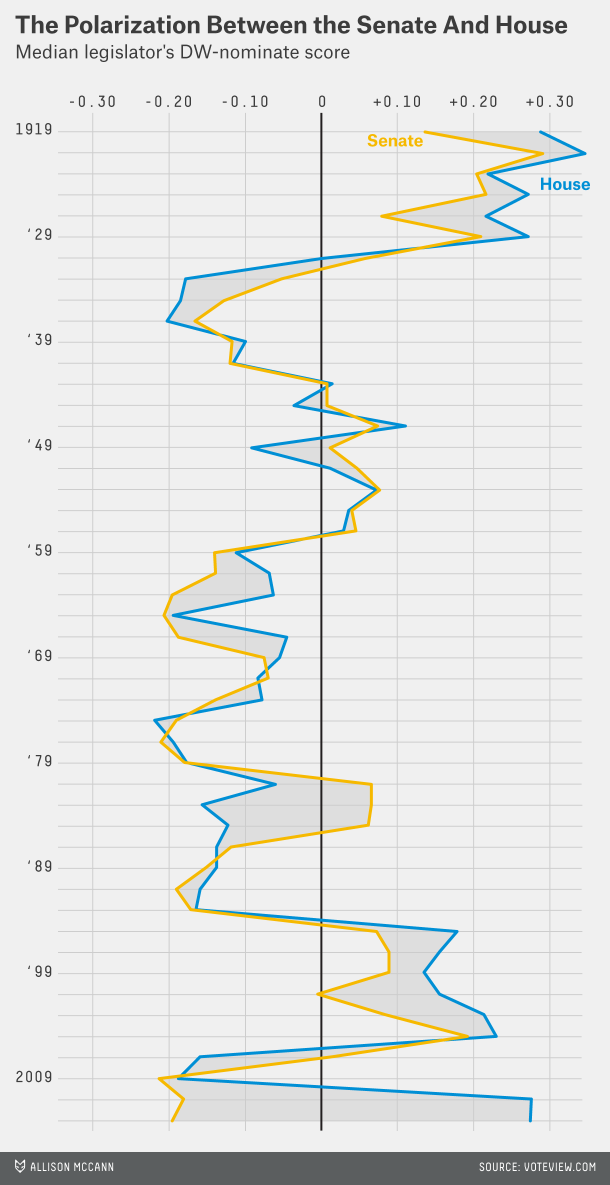
One of the lessons of public choice for constitutional design is there should be two Houses of Parliament and each should be elected by a different method and different geographical basis.
Lower houses tend to be elected in single member constituencies; upper houses tend to be elected in larger multi-member, state-wide or national constituencies by proportional representation.
This diversity in legislative arrangements ensures that more people are participating in decision-making and it is harder to pass new laws without majority support.
The two elected chambers will clash as each exerts its mandate to represent the will of the people who elected it. The laws that pass these two chambers elected by different methods must have substantial popular support.
When upper and lower houses are elected by similar methods, it is much easier to assemble a majority through vote trading and lobbying.
Data via fivethirtyeight.com
Celebrating humanity's flourishing through the spread of capitalism and the rule of law
Scholarly commentary on law, economics, and more
Beatrice Cherrier's blog
Celebrating humanity's flourishing through the spread of capitalism and the rule of law
Celebrating humanity's flourishing through the spread of capitalism and the rule of law
Celebrating humanity's flourishing through the spread of capitalism and the rule of law
Why Evolution is True is a blog written by Jerry Coyne, centered on evolution and biology but also dealing with diverse topics like politics, culture, and cats.
Celebrating humanity's flourishing through the spread of capitalism and the rule of law
Celebrating humanity's flourishing through the spread of capitalism and the rule of law
A rural perspective with a blue tint by Ele Ludemann
DPF's Kiwiblog - Fomenting Happy Mischief since 2003
Celebrating humanity's flourishing through the spread of capitalism and the rule of law
The world's most viewed site on global warming and climate change
Tim Harding's writings on rationality, informal logic and skepticism
A window into Doc Freiberger's library
Let's examine hard decisions!
Commentary on monetary policy in the spirit of R. G. Hawtrey
Thoughts on public policy and the media
Celebrating humanity's flourishing through the spread of capitalism and the rule of law
Politics and the economy
A blog (primarily) on Canadian and Commonwealth political history and institutions
Reading between the lines, and underneath the hype.
Economics, and such stuff as dreams are made on
"The British constitution has always been puzzling, and always will be." --Queen Elizabeth II
Celebrating humanity's flourishing through the spread of capitalism and the rule of law
Celebrating humanity's flourishing through the spread of capitalism and the rule of law
WORLD WAR II, MUSIC, HISTORY, HOLOCAUST
Undisciplined scholar, recovering academic
Celebrating humanity's flourishing through the spread of capitalism and the rule of law
Res ipsa loquitur - The thing itself speaks
Celebrating humanity's flourishing through the spread of capitalism and the rule of law
Researching the House of Commons, 1832-1868
Articles and research from the History of Parliament Trust
Reflections on books and art
Posts on the History of Law, Crime, and Justice
Celebrating humanity's flourishing through the spread of capitalism and the rule of law
Exploring the Monarchs of Europe
Cutting edge science you can dice with
Small Steps Toward A Much Better World
“We do not believe any group of men adequate enough or wise enough to operate without scrutiny or without criticism. We know that the only way to avoid error is to detect it, that the only way to detect it is to be free to inquire. We know that in secrecy error undetected will flourish and subvert”. - J Robert Oppenheimer.
The truth about the great wind power fraud - we're not here to debate the wind industry, we're here to destroy it.
Celebrating humanity's flourishing through the spread of capitalism and the rule of law
Celebrating humanity's flourishing through the spread of capitalism and the rule of law
Economics, public policy, monetary policy, financial regulation, with a New Zealand perspective
Celebrating humanity's flourishing through the spread of capitalism and the rule of law
Restraining Government in America and Around the World


 Utopia, you are standing in it!
Recent Comments