The first citizen initiated binding referenda will be on…

The Conservative Party of New Zealand in the 2014 general election was very much formed around the notion of introducing citizen initiated binding referendums in a country with the Parliament is sovereign. The first referendum is likely to be on one of the following:

· decriminalising marijuana,

· banning smoking,

· voluntary euthanasia,

· a living wage,

· life means life in prison,

· same-sex marriages,

· marriage is between a man and a woman,

· entrenching the Treaty of Waitangi,

· abolishing the Maori seats,

· entrenching the Maori seats,

· stop school closures, and

· capital punishment; and

· future referendums not be binding

Binding referenda are unworkable. Parliament can’t amend them later as we learn from the implementation of the law and unintended consequences arise. Every new law is riddled with unintended consequences and blow-backs.

Do you really want to have to have another referendum to undo a binding referendum that turned out to be a bit of a mistake? One of the few redeeming features of the Parliament that is sovereign – a parliament for can make or unmake any law whatsoever – is it can repeal its mistakes quickly.

The first citizens initiated referendum was held on 2 December 1995. The question was

Should the number of professional fire-fighters employed full-time in the New Zealand Fire Service be reduced below the number employed in 1 January 1995?

Turnout was low as the referendum was not held in conjunction with a general election, and the measure was voted down easily, with just over 12% voting “Yes” and almost 88% voting “No”.

The key to constitutional design is not empowering you and yours – it is how to restrain those crazies to the Left or the Right of you, as the case may be, when they get their hands on the levers of power, as they surely will in three, six or nine years’ time.

The one inevitability of democracy is power rotates – unbridled power and binding referenda lose their shine when you must share that power with the opposing side of politics who put up their own referendum question.

Constitutions are brakes, not accelerators. Much of constitutional design is about checks and balances and the division of power to slow the impassioned majority down.

Constitutional constraints are basically messages from the past to the present that you must think really hard, and go through extra hurdles before you do certain things.

The 18th and 19th century classical liberals were highly sceptical about the capability and willingness of politics and politicians to further the interests of the ordinary citizen, and were of the view that the political direction of resource allocation retards rather than facilitates economic progress.

Governments were considered to be institutions to be protected from but made necessary by the elementary fact that all persons are not angels. Constitutions were to constrain collective authority.

The problem of constitutional design was ensuring that government powers would be effectively limited. The constitutions were designed and put in place by the classical liberals to check or constrain the power of the state over individuals.

The motivating force of the classical liberals was never one of making government work better or even of insuring that all interests were more fully represented. Built in conflict and institutional tensions were to act as constraints on the power and the size of government.
clip_image002

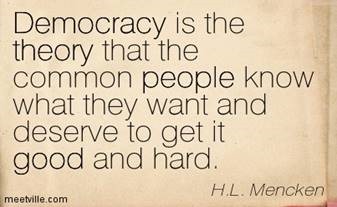
Representative democracy is a division of labour in the face of information overload. John Stuart Mill had sympathy for parliaments as best suited to be places of public debate on the various opinions held by the population and as a watchdog of the professionals who create and administer laws and policy:

Their part is to indicate wants, to be an organ for popular demands, and a place of adverse discussion for all opinions relating to public matters, both great and small; and, along with this, to check by criticism, and eventually by withdrawing their support, those high public officers who really conduct the public business, or who appoint those by whom it is conducted.

Representative democracy has the advantage of allowing the community to rely in its decision-making on the contributions of individuals with special qualifications of intelligence or character. Representative democracy makes a more effective use of resources within the citizenry to advance the common good.

Members of parliament are trustees who follow their own understanding of the best action to pursue in another view. As Edmund Burke wrote:

Parliament is not a congress of ambassadors from different and hostile interests; which interests each must maintain, as an agent and advocate, against other agents and advocates; but parliament is a deliberative assembly of one nation, with one interest, that of the whole; where, not local purposes, not local prejudices ought to guide, but the general good, resulting from the general reason of the whole.

You choose a member indeed; but when you have chosen him, he is not a member of Bristol, but he is a member of parliament. … Our representative owes you, not his industry only, but his judgment; and he betrays instead of serving you if he sacrifices it to your opinion.

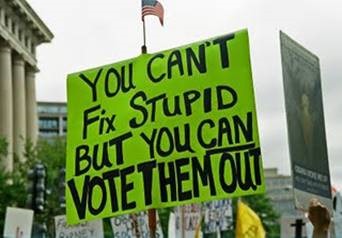
Modern democracy is government subject to electoral checks. Citizens do have sufficient knowledge and sophistication to vote out leaders who are performing poorly or contrary to their wishes. Modern democracy is the power to replace governments at periodic elections.
clip_image006

The power of the electorate to turn elected officials out of office at the next election gives elected officials an incentive to adopt policies that do not outrage public opinion and administer the policies with some minimum honesty and competence.

Richard Posner argued that a representative democracy enables the adult population, at very little cost in time, money or distraction from private pursuits commercial or otherwise:

  1. to punish at least the flagrant mistakes and misfeasance of officialdom,

  2. to assure an orderly succession of at least minimally competent officials,

  3. to generate feedback to the officials concerning the consequences of their policies,

  4. to prevent officials from (or punish them for) entirely ignoring the interests of the governed, and

  5. to prevent serious misalignments between government action and public opinion.

Enough of politics and elections, I have a life to lead. Don’t you? Too many want to remake democracy with the faculty workshop as their model.

clip_image008

Such deliberation has demanding requirements for popular participation in the democratic process, including a high level of knowledge and analytical sophistication and an absence, or at least severe curtailment, of self-interested motive. The same goes for citizen initiated binding referendums.

The reading comprehension level of State of the Union Addresses

Do people tell the truth to opinion poll companies?

The rise of right-wing populism in Western Europe

The shy Tory voter versus the shy Labour voter (waiting for those hard left policies) – updated

The go left young man, go left strategy is a view of many in the Labour Party in New Zealand, Australia and the UK is if they present hard left policies to the electorate, they will mobilise many more votes from people who are currently don’t vote or who are mysteriously parking their vote with the Tory party or other centre parties.

Michael Foot’s attempt at to get out shy Labour voters with a hard left campaign in the 1983 British general election, which lead to his manifesto earning the title the longest suicide note in history.

The eight foot high stone monolith Ed Miliband planned to erect in the garden of number 10 Downing Street, if he could get planning permission, was dubbed the heaviest suicide note in history.

The New Zealand Labour Party went left at the 2014 general election and for its troubles earned its lowest party vote since the party was founded in 1919.

Central to the strategy of the New Zealand Labour Party in the 2014 general election was mobilising non-voters in their working-class electorates.

The median voter theorem be dammed! The New Zealand Labour Party in the 2014 general election honestly believed that hard left policies would induce these non-voters to vote.

These non-voters are called the missing million by the New Zealand left . Almost one million people did not vote in 2014; 250,683 were not enrolled, while 694,120 were enrolled but did not turn out to vote. Many of these voters were thought to be just parking their vote pending the arrival of true believers to lead the Labour Party if the Left over Left is to be believed! Many of these non-voters are younger voters who generally are more likely to vote left.

The Internet – Mana party also spent an immense amount of the $4 million donated by Kim.com in trying to turn out to the youth voter as well.

Chris Trotter was wise and prophetic on go left young man, go left and the shy Labour voters will come:

[T]he Left has been given an extraordinary opportunity to prove that it still has something to offer New Zealand …..

If Cunliffe and McCarten are allowed to fail, the Right of the Labour Party and their fellow travellers in the broader labour movement (all the people who worked so hard to prevent Cunliffe rising to the leadership) will say:

“Well, you got your wish. You elected a leader pledged to take Labour to the Left. And just look what happened. Middle New Zealand ran screaming into the arms of John Key and Labour ended up with a [pitiful] Party Vote …

So don’t you dare try peddling that ‘If we build a left-wing Labour Party they will come’ line ever again! You did – and they didn’t.”

Be in no doubt that this will happen – just as it did in the years after the British Labour Party’s crushing defeat in the general election of 1983. The Labour Right called Labour’s socialist manifesto “the longest suicide note in history” and the long-march towards Blairism … began.

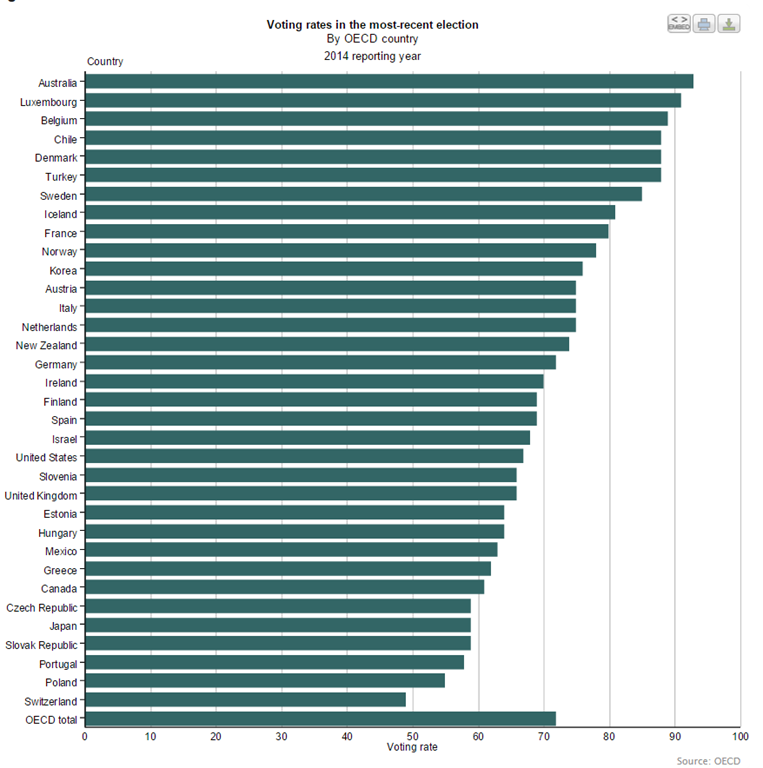
The most obvious flaw in the missing million and non-voter argument where they are waiting for true believers to offer hard left policies is a countries with much higher rates of voter turnouts and compulsory voting are not more likely to have left-wing governments.

image

There is much more evidence of shy Tory voters rather than shy Labour voters.

Shy Tory voters is a name invented by British opinion polling companies in the 1990s. The share of the vote won by the Tories in elections was substantially higher than the proportion of people in opinion polls who said they would vote for the party.

The final opinion polls gave the Tories between 38% and 39% of the vote – 1% behind the Labour Party. In the final results, the Conservatives had a lead of 7.6% over Labour and won their fourth successive general election.

Because of this turnout of shy Tory voters, the Tories won 3 million more votes than the Labour Party. This 14 million votes was more votes than they or any other British political party is ever won in a British general election, breaking the record set by Labour in 1951.

In a subsequent marketing research port, it was found a significant number of Tory party supporters refusing to disclose their voting intentions both the opinion poll companies, and exit polls.

This shy Tory factor is so large that opinion poll companies attempt to account for it in the weights they assign in their opinion polls surveys.

One of the explanations behind the turnout of the shy Tory vote in the 2015 British general election was a fear that a Labour Party minority government would be be holding to the hard left Scottish nationalists.

A number of British media commentators talked about running into many ordinary people expressing that very fear and they were undecided voters. About 20% of British voters were undecided on the eve the election, which is an unusually high amount.

Ironically, Neil Kinnock, the British Labour Party leader in the 1992 election, warned of a shy Tory factor a few days before the current British general election.

Tony Blair was much blunter a few months before the British general election about the relevance of the median voter theorem  to British politics and the future of the British Labour Party. The most electorally successful politician in Labour history said that May’s general election risks becomes one in which a

traditional left-wing party competes with a traditional right-wing party, with the traditional result.

Asked by the Economist magazine if he meant that the Conservatives would win the general election in those circumstances, Mr Blair replied: “Yes, that is what happens.”

The post-mortem by the New Statesman called “10 delusions about the Labour defeat to watch out for” equally blunt about the role of Tony Blair in rescuing British labour from permanent oblivion:

Many of your drinks will be prompted by variations on this perennial theme. Labour accepted the austerity narrative. Labour weren’t green enough. Labour weren’t radical (which has somehow come to be used as a synonym for left-wing).

Given that the last time Labour won an election without Tony Blair was 1974 it’s hard to believe people still think the answer is to move left. But people still do. I sort of love these people for their stubbornness. But I don’t want them picking the next leader.

The shy Tory vote stirred by the fears of a hard left government happened in the 2014 New Zealand general election. On the Monday night for the election that Saturday, the Internet – Mana party board had an hour of television for their Moment of Truth. This included Edward Snowden beamed in  from Moscow put forward a whole range of bizarre conspiratorial theories about NASA surveillance of New Zealand and analysis by base in Auckland.

David Farrar reported that in Tuesday night opinion polling, the National party’s party vote rose from 44% to 47%. In the subsequent general election that Saturday, the national party led all night for the first time. It won as many votes as it did in the previous election when it was expected to lose votes because the national party government was going into its third term.

One reason  for shy Tory voters is expressive voting. People obtain more sense of identity by proclaiming themselves to be a left-wing voter than they do from saying that they are a right-wing voter.

The expressive aspect of voting is “action that is undertaken for its own sake rather than to bring about particular consequences” (Brennan and Lomasky 1993, 25). There is almost never a causal connection between an individual’s vote and the associated electoral outcome. Hence, a vote is not disciplined by opportunity cost.

With no opportunity cost of how you vote in terms of deciding the outcome, people vote expressively to affirm their identity. Voting is about who and what you boo and cheer for and how you present yourself to the world.

Through the fatal conceit and the pretence to knowledge, a left-wing vote allows people to identify with doing good and changing the world for the better. No point in voting that way if you don’t go around thumping your chest proclaiming yourself as doing good for others by voting Left including telling the truth to polling companies.

Labour Party betrays working class again: nanny state obligations to enrol to vote

image

Extraordinary. Political junkies don’t realise that there are people out there that have better things to do with their lives than take an interest in politics.

image

It’s a free society. They are free not to listen, not engage and not vote for anyone. Free speech includes a right not to speak and not to participate. If you disappointed with that political apathy, put forward a party platform that excites them enough to vote. Get out the vote by being worth voting for.

What is more extraordinary is a party that claims to speak for the working class first opposed obligations on welfare benefit receipt regarding looking more intensively for work and paying court fines and so forth, but it is happy to use the same provisions for their own political advantage because they are on the ropes. The New Zealand Labour Party’s party vote at the last election was at record low levels. It is still at the same level in the opinion polls.

As for voter registration drives in working-class electorates, the New Zealand Labour Party has no large donors apart from unions. The reason for this is as their former president, Mike Williams says " if you don’t ask, you don’t get ".

Voter registration is voluntary in the USA and for all its flaws, and I think there are far fewer than people say, Richard Posner could still give an excellent defence of political participation in the USA:

American democracy enables the adult population, at very little cost in time, money or distraction from private pursuits commercial or otherwise, to punish at least the flagrant mistakes and misfeasances of officialdom, to assure an orderly succession of at least minimally competent officials, to generate feedback to the officials concerning the consequences of their policies, to prevent officials from (or punish them for) entirely ignoring the interests of the governed, and to prevent serious misalignments between government action and public opinion.

Too many as Richard Posner has argued well in his writing want to remake democracy with the faculty workshop as their model. Such deliberation has demanding requirements for popular participation in the democratic process, including a high level of knowledge and analytical sophistication and an absence, or at least severe curtailment, of self-interested motives.

Much empirical research demonstrates that citizens have astonishingly low levels of political knowledge. Most lack very basic knowledge of political parties, candidates and issues, much less the sophisticated knowledge necessary to meet the demands of a deliberative democracy.

One reason for these low levels of political knowledge is a large number of people are simply not interested in politics even if they have the time to take an interest.

Because of this political ignorance and apathy, Posner championed Schumpeter’s view of democracy. Schumpeter disputed the widely held view that democracy was a process by which the electorate identified the common good, and that politicians carried this out:

  • The people’s ignorance and superficiality meant that they were manipulated by politicians who set the agenda.
  • Although periodic votes legitimise governments and keep them accountable, their policy programmes are very much seen as their own and not that of the people, and the participatory role for individuals is limited.

Schumpeter’s theory of democratic participation is that voters have the ability to replace political leaders through periodic elections. Citizens do have sufficient knowledge and sophistication to vote out leaders who are performing poorly or contrary to their wishes.

The power of the electorate to turn elected officials out of office at the next election gives elected officials an incentive to adopt policies that do not outrage public opinion and administer the policies with some minimum honesty and competence.

The outcome of Schumpeterian democracy in the 20th century, where governments are voted out rather than voted in, is that most of modern public spending is income transfers that grew to the levels they are because of support from the average voter.

Political parties on the Left and Right that delivered efficient increments and stream-linings in the size and shape of government were elected, and then thrown out from time to time, in turn, because they became tired and flabby or just plain out of touch.

I wouldn’t revel too much on the higher voter turnout  as as yet another saviour on the horizon to bring the Left over Left back from the political wilderness. The most votes ever won by a political party in the UK was 14 million by John Major’s Tory party in 1992 when the shy Tories came out in force to re-elected the incumbent government much the surprise of the opinion polls.

Higher voter turnout is not necessarily always a good thing in terms of good governance. William Shughart found that voter participation increases in gubernatorial elections in the USA when evidence of corruption mounts. Candidates, political parties, and interest groups have incentives to invest in mobilising support on Election Day.

Those who stand to gain from being office through their corruption invest considerable resources in mobilising voter turnout that is in their favour. Corruption increase the value of winning public office and strengthens the demand-side efforts to build winning coalitions.

In a prophetic article at the dawn of the Internet, Robert Tollison, William F. Shughart II, and Robert McCormick wrote in 1999 about how voting is not the only way in which people express their political preferences effectively.

Observers of American democracy complain that voter turnout and voter registration are low and had been low from 50 years. Tollison, Shughart, and  McCormick reminded these critics that:

Voters now have more political information available to them than ever before, and they are no longer confined to expressing their political preferences at the polls once every two or four years.

Newly available technologies have lowered voters’ costs of becoming informed about political issues and of communicating with their political representatives.

Voter registration and voter turnout is lowest among young people who also happen to be the most Internet savvy. This is not surprising considered the prophetic observation of Tollison, Shughart, and  McCormick in 1999 that:

What is more important, the opinions voters form on the basis of the information available to them can be communicated to policy makers rapidly and effectively.

E-mails, faxes, and phone calls are substitutes for ballots. By the time an election rolls around, politicians and policy makers already know what the voters think and, hence, their wishes have already been incorporated into laws and policies.

Tollison, Shughart, and  McCormick asked why vote when you have already influenced political outcomes through alternative means between elections such as social media:

Having affected policy outcomes, voters are naturally less interested in voting on candidates. Low turnout rates on election day may paradoxically be evidence of greater voter participation in the political process.

In fact, we are fast approaching a return to the town meeting, where individuals register their preferences on specific policy proposals and politicians can assess the intensities of those preferences by reading their e-mail. Indeed, voters can vote as much and as often as they want in the information age.

It is not surprising therefore in this prophetic article that Tollison, Shughart, and  McCormick predicted that politicians would pay close regard to social media, and if they did, democracy works:

As long as politicians are good agents who read their faxes and e-mails correctly, voters will correspondingly have less need to go to the polls.

Voters will vote only when their representatives ignore their electronic opinions. Indeed, that is the implicit threat.

And because voters don’t have to go to the barricades to voice those opinions, political discourse should become more civil and political protests less frequent and disruptive.

HT: Nick Kearney

A bit of an election upset in the UK?

The first laws of economics and politics

Image

In a most unpredictable election, 1 in 4 voters still undecided on election day

via General Election 2015: Britain prepares to go to the polls | Daily Mail Online.

Most politicians don’t want to know about this

The effectiveness of environmentalists in mobilising public opinion

The essence of the environmental movement summed up

Democrat voters are turning against the idea of lower prices for ordinary families

UKIP are a bunch of fellow travellers

Further evidence of the Anti-Science Left

The right of the political spectrum is less likely to accept scientific conclusions if they involve excessive regulation of the economy. The anti-vaccination infestation of left-wing thinking shows that they are not immune to magical thinking and therefore should not be so smug.

Previous Older Entries Next Newer Entries

Bassett, Brash & Hide

Celebrating humanity's flourishing through the spread of capitalism and the rule of law

Truth on the Market

Scholarly commentary on law, economics, and more

The Undercover Historian

Beatrice Cherrier's blog

Matua Kahurangi

Celebrating humanity's flourishing through the spread of capitalism and the rule of law

Temple of Sociology

Celebrating humanity's flourishing through the spread of capitalism and the rule of law

Velvet Glove, Iron Fist

Celebrating humanity's flourishing through the spread of capitalism and the rule of law

Why Evolution Is True

Why Evolution is True is a blog written by Jerry Coyne, centered on evolution and biology but also dealing with diverse topics like politics, culture, and cats.

Down to Earth Kiwi

Celebrating humanity's flourishing through the spread of capitalism and the rule of law

NoTricksZone

Celebrating humanity's flourishing through the spread of capitalism and the rule of law

Homepaddock

A rural perspective with a blue tint by Ele Ludemann

Kiwiblog

DPF's Kiwiblog - Fomenting Happy Mischief since 2003

The Dangerous Economist

Celebrating humanity's flourishing through the spread of capitalism and the rule of law

Watts Up With That?

The world's most viewed site on global warming and climate change

The Logical Place

Tim Harding's writings on rationality, informal logic and skepticism

Doc's Books

A window into Doc Freiberger's library

The Risk-Monger

Let's examine hard decisions!

Uneasy Money

Commentary on monetary policy in the spirit of R. G. Hawtrey

Barrie Saunders

Thoughts on public policy and the media

Liberty Scott

Celebrating humanity's flourishing through the spread of capitalism and the rule of law

Point of Order

Politics and the economy

James Bowden's Blog

A blog (primarily) on Canadian and Commonwealth political history and institutions

Science Matters

Reading between the lines, and underneath the hype.

Peter Winsley

Economics, and such stuff as dreams are made on

A Venerable Puzzle

"The British constitution has always been puzzling, and always will be." --Queen Elizabeth II

The Antiplanner

Celebrating humanity's flourishing through the spread of capitalism and the rule of law

Bet On It

Celebrating humanity's flourishing through the spread of capitalism and the rule of law

History of Sorts

WORLD WAR II, MUSIC, HISTORY, HOLOCAUST

Roger Pielke Jr.

Undisciplined scholar, recovering academic

Offsetting Behaviour

Celebrating humanity's flourishing through the spread of capitalism and the rule of law

JONATHAN TURLEY

Res ipsa loquitur - The thing itself speaks

Conversable Economist

Celebrating humanity's flourishing through the spread of capitalism and the rule of law

The Victorian Commons

Researching the House of Commons, 1832-1868

The History of Parliament

Articles and research from the History of Parliament Trust

Books & Boots

Reflections on books and art

Legal History Miscellany

Posts on the History of Law, Crime, and Justice

Sex, Drugs and Economics

Celebrating humanity's flourishing through the spread of capitalism and the rule of law

European Royal History

Exploring the Monarchs of Europe

Tallbloke's Talkshop

Cutting edge science you can dice with

Marginal REVOLUTION

Small Steps Toward A Much Better World

NOT A LOT OF PEOPLE KNOW THAT

“We do not believe any group of men adequate enough or wise enough to operate without scrutiny or without criticism. We know that the only way to avoid error is to detect it, that the only way to detect it is to be free to inquire. We know that in secrecy error undetected will flourish and subvert”. - J Robert Oppenheimer.

STOP THESE THINGS

The truth about the great wind power fraud - we're not here to debate the wind industry, we're here to destroy it.

Lindsay Mitchell

Celebrating humanity's flourishing through the spread of capitalism and the rule of law

Alt-M

Celebrating humanity's flourishing through the spread of capitalism and the rule of law

croaking cassandra

Economics, public policy, monetary policy, financial regulation, with a New Zealand perspective

The Grumpy Economist

Celebrating humanity's flourishing through the spread of capitalism and the rule of law

International Liberty

Restraining Government in America and Around the World