There were no meaningful peace proposals by the belligerent governments until 1916.
In late 1916 a series of peace proposals were suddenly put forward, all of them without exception advocating compromises. They contained no demands for unconditional surrender or a dictated peace.
There was Reichstag peace resolution on 19 July 1917. The resolution called for no annexations, no indemnities, freedom of the seas, and international arbitration. It was ignored by the German High Command and by the Allied Powers.
Pope Benedict XV tried to mediate with his Peace Note of August 1917 calling for a return to the pre-war borders.
On November 14, 1917, Lord Landsdowne, a minister in the Asquith cabinet, put forward a letter to the Daily Telegraph on the need for peace negotiations.
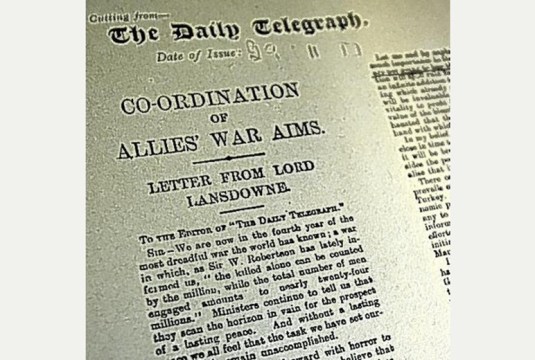
The Landsdowne memorandum titled "Coordination of Allies’ War Aims" recommended a serious investigation of the possibility of a peace and advocated that a statement be made by the British government indicating that the destruction of the German Empire was not her goal. Landsdowne said:
We are not going to lose this war, but its prolongation will spell ruin for the civilised world, and an infinite addition to the load of human suffering which already weighs upon it…
We do not desire the annihilation of Germany as a great power …
We do not seek to impose upon her people any form of government other than that of their own choice…
We have no desire to deny Germany her place among the great commercial communities of the world.
Landsdowne favoured a peace on the basis of pre-war status quo. The fall of the Asquith government and the installation of the Lloyd George Cabinet on December 16 put an end to Landsdowne’s activities.
The problem with the negotiation of the end of a war is the securing of credible assurances that the peace is lasting rather than just a chance for the other side to rebuild and come back to attack from a stronger position.
- When on the advance, the peace feelers of the advancing powers were on basis of keeping conquered territories.
- When in retreat, the peace proposals of the retreating powers were on the basis of returning to the pre-war borders.
One side will think that the other’s promise not to re-start a war is credible only if the other state would be better off by keeping its promise not to re-start a war than by breaking its promise.
France fortified its border with Germany in the 1920s because of a lack of trust that the peace would endure. Germany was disarmed after 1918 so that the day which it would be a threat again was well into the future.
 Utopia, you are standing in it!
Recent Comments