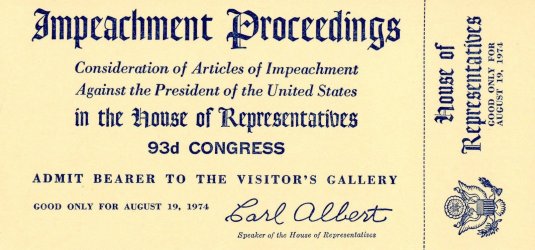
Pre-printed ticket for House of Representatives consideration of Richard Nixon’s impeachment, August 1974—never used because Nixon resigned: pic.twitter.com/7bLcp2Xh0f
— Michael Beschloss (@BeschlossDC) July 27, 2018
Celebrating humanity's flourishing through the spread of capitalism and the rule of law
29 Jul 2018 Leave a comment
in politics - USA, Public Choice Tags: Richard Nixon
19 Jun 2018 Leave a comment
in economics of crime, law and economics, politics - USA Tags: bribery and corruption, Richard Nixon
26 Dec 2016 Leave a comment
in constitutional political economy, economic history, labour economics, politics - USA Tags: economics of constitutional law, Frank Easterbrook, Richard Nixon, Robert Bork, Watergate scandal
12 May 2015 Leave a comment
in constitutional political economy, economic history, economics of crime, law and economics, politics - Australia, politics - New Zealand, politics - USA, Public Choice Tags: 1960s, activists, civil disobedience, Democratic Party, George Wallace, nonviolent protest, Richard Nixon, riots, Vietnam war, violent protests
Monkey Cage blogged on a very timely study on the impact of violent and nonviolent protests on voting behaviour. Non-violent protest in the 60s enticed sympathy and increased voter support for the Democratic Party in the 1964, 1968 to 1972 presidential elections:
Black-led nonviolent protests… exhibit a statistically significant positive relationship with county-level Democratic vote-share in the same period.
This is not surprising because nonviolent protest acknowledge fidelity to law and democratic equality. No one likes to be bullied and one of the purposes of the secret ballot is to prevent voters from being bullied because no one knows how you voted.
Indeed, there is a long history of anonymous pamphleteering, which has evolved into anonymous trolling as a way of people expressing their political views without facing backlash from both the majority and a vindictive minority.
In a democracy, it’s up to me to persuade you to change your mind – that what you took for granted for so long is not so. That’s how liberal democracies work: by trying to persuade each other and voting.
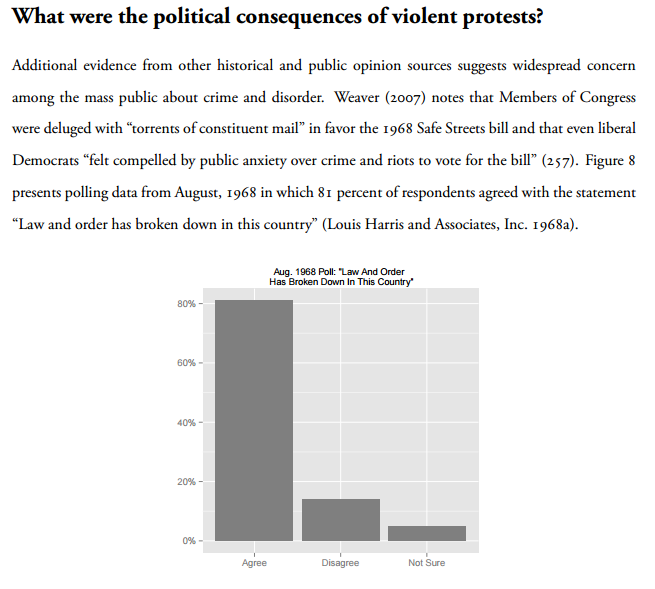
Violent protests had the exact opposite effect to peaceful protests on Democratic Party voting shares in the 1964, 1968 in 1972 presidential elections. There was a law and order backlash among voters against what were relatively widespread rioting and civil disorder:
…black-led protests in which some violence occurs are associated with a statistically significant decline in Democratic vote-share in the 1964, 1968 and 1972 presidential elections.
This is a roundabout way of saying that a Republican won the 1968 election on a law and order platform, not a Democrat on a peace platform. The country was convinced, including Liberal Democrats, that law and order had broken down and that the Democratic Party could not restore law and order.
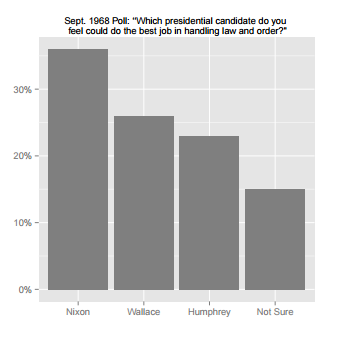
In the 1968 presidential election, there is a third party candidate, George Wallace, who won won almost ten million popular votes and 46 electoral votes, including in the electoral college on an even harsher law and order platform than Nixon.
Wallace was a racist Southern Democrat the Democratic Party would prefer us to forget and a nasty political opportunist to boot. His political rhetoric included the only words four letter words the protesters didn’t know was work and soap.
As I recall warmed over Marxism, the idea of violent protests is to provoke a law and order backlash, initially with popular support of the working class. The resulting police repression will overreach and cause the proletariat to breakthrough their false consciousness to see that capitalists for whom they are and rise up to overthrow them.

Rise up ye workers, rise up for you have nothing to lose but your chains. These days that call to the barricades would have to be rise up ye workers, rise up for you have nothing to lose what your smart phone and air points.
30 Apr 2015 Leave a comment
in labour economics, labour supply, occupational choice, politics - USA Tags: conscription, peace movements, Richard Nixon, Vietnam war
The Vietnam anti-war movement were primarily the result of the draft: hell no, we won’t go and the burning of draft cards. Richard Nixon was as cunning a rat who ever occupied the Oval Office. He was elected in 1968 to end the Vietnam war and to end the draft.
Nixon had an intuitive economic understanding that the anti-war movement’s rioting in the streets and campuses was very much motivated by private gain. In particular, the threat of being drafted. The notion that revolutions and political movements are motivated by private gain is not new.
Vietnamisation changed everything. In 1969, Nixon started the process of phasing down the sending of further combat troops to Vietnam and the phasing down of the draft. US troop withdrawal started on July 1st 1969 with completion dates – December 1970, June 1971 and December 1972.
By the beginning of 1972, over 400,000 U.S. military personnel had been withdrawn, virtually all combat troops. The protests were against ending up in the jungle – not up the rear with the gear. There were 24,000 US troops in Vietnam in 1972. This compares to 560,000+ in 1969.
A Vietnam vet told me that when he returned to his U.S. campus in 1971 for graduate studies, it was very quite compared to 1969 because the spectre of the draft had gone in their minds.

The anti-war movement was really motivated by hell no, we won’t go. As soon as the prospect of going to Vietnam faded away, so did the anti-war movement.
24 Mar 2014 Leave a comment
in labour economics, politics - USA, Public Choice, war and peace, welfare reform Tags: Bill Clinton, Daniel Sutter, Jimmy Carter, Nixon paradox, Only Nixon could go to China, Richard Nixon, Ronald Reagan, Tyler Cowen
The secret of winning the swing vote is having policies slightly different from your opponent. Recall Tyler Cowen and Daniel Sutter’s Why Only Nixon Could Go to China in Public Choice.

Cowen and Sutter say that a policy could depend on information – on which policies or values everyone could potentially agree, or on which agreement is impossible.
Politicians, who value both re-election and policy outcomes, realise the nature of the issue better through inside and secret information and superior analytical skills (or access to those skills), whereas voters do not have access to such information base or skills.
Only a right-wing president can credibly signal the desirability of a left-wing course of action. A left-wing president’s rapprochement with China would be dismissed as a dovish sell-out. The Nixon paradox held because citizens could vote retrospectively on the issue.
Left-wing parties adopt right-wing policies because they are good ideas that will get them re-elected. Bob Hawke, Tony Blair, and Bill Clinton were firmly camped over the middle-ground.
Only centre-left economic reformers can credibly signal the desirability of their economic reforms because of the brand name capital they invested in distributional concerns and protecting the poor.
Because of their proven record and brand name, they do not jeopardise their support or credibility by seemingly departing from their core values. They must have done so because it was the right thing to do given events and the long-term interests of the lower-income groups they represent.
Bill Clinton balanced the budget and introduced sweeping welfare reforms in 1996 after vetoing two earlier bills because this finally fulfilled his 1992 campaign promise to “end welfare as we have come to know it”. As he signed the bill on August 22, 1996, Clinton stated that the act:
gives us a chance we haven’t had before to break the cycle of dependency that has existed for millions and millions of our fellow citizens, exiling them from the world of work. It gives structure, meaning and dignity to most of our lives.
Jimmy Carter was a bigger deregulator than Reagan. Obama uses drones far more often than Bush did.
Major labour law reforms were passed in Germany under a left-wing government after decades of 10% unemployment rates and average German unemployment spells for about a year. The key part of these reforms came into play just before the global financial crisis hit and was a major reason for the unemployment rate in Germany falling despite the onset of GFC.
Why Only Nixon Could Go to China also explains why hawks such as Reagan and Begin and other right wing party leaders were able to negotiate peace treaties that eluded more dovish politicians who ran on ‘peace now’ slogans.
Reagan signed the Intermediate-Range Nuclear Forces treaty, walked with Gorbachev in Red Square and seriously offered complete mutual nuclear disarmament in Reykjavik in 1986. Any other American President who offered complete mutual nuclear disarmament would have been impeached.

Hawks also have the right negotiating stance. Robert Aumann argues that:
If you are ready for war, you will not need to fight. If you cry ‘peace, peace,’ you will end up fighting… What brings war is that you signal weakness and concessions.
Only then will both sides negotiate because they know that the other side is willing to walk away and perhaps not come back for a long time. Unless it gets reasonable offers that will be binding on both sides for a long time because both win more for honouring their promises rather than threatening war again soon.
Left-wing politicians can deliver economic reforms because they can deliver new voting blocs to the realignment of political coalitions. This new bloc of centre-left voters and some members of existing political and special interest groupings benefit from regrouping and joining new political coalitions that push through the reforms. An ageing society, budget deficits, technological innovations and shifts in production cost structures and in consumer demand can all make the existing political coalitions less rewarding than in the past.
Celebrating humanity's flourishing through the spread of capitalism and the rule of law
Scholarly commentary on law, economics, and more
Beatrice Cherrier's blog
Celebrating humanity's flourishing through the spread of capitalism and the rule of law
Celebrating humanity's flourishing through the spread of capitalism and the rule of law
Celebrating humanity's flourishing through the spread of capitalism and the rule of law
Why Evolution is True is a blog written by Jerry Coyne, centered on evolution and biology but also dealing with diverse topics like politics, culture, and cats.
Celebrating humanity's flourishing through the spread of capitalism and the rule of law
Celebrating humanity's flourishing through the spread of capitalism and the rule of law
A rural perspective with a blue tint by Ele Ludemann
DPF's Kiwiblog - Fomenting Happy Mischief since 2003
Celebrating humanity's flourishing through the spread of capitalism and the rule of law
The world's most viewed site on global warming and climate change
Tim Harding's writings on rationality, informal logic and skepticism
A window into Doc Freiberger's library
Let's examine hard decisions!
Commentary on monetary policy in the spirit of R. G. Hawtrey
Thoughts on public policy and the media
Celebrating humanity's flourishing through the spread of capitalism and the rule of law
Politics and the economy
A blog (primarily) on Canadian and Commonwealth political history and institutions
Reading between the lines, and underneath the hype.
Economics, and such stuff as dreams are made on
"The British constitution has always been puzzling, and always will be." --Queen Elizabeth II
Celebrating humanity's flourishing through the spread of capitalism and the rule of law
Celebrating humanity's flourishing through the spread of capitalism and the rule of law
WORLD WAR II, MUSIC, HISTORY, HOLOCAUST
Undisciplined scholar, recovering academic
Celebrating humanity's flourishing through the spread of capitalism and the rule of law
Res ipsa loquitur - The thing itself speaks
Celebrating humanity's flourishing through the spread of capitalism and the rule of law
Researching the House of Commons, 1832-1868
Articles and research from the History of Parliament Trust
Reflections on books and art
Posts on the History of Law, Crime, and Justice
Celebrating humanity's flourishing through the spread of capitalism and the rule of law
Exploring the Monarchs of Europe
Cutting edge science you can dice with
Small Steps Toward A Much Better World
“We do not believe any group of men adequate enough or wise enough to operate without scrutiny or without criticism. We know that the only way to avoid error is to detect it, that the only way to detect it is to be free to inquire. We know that in secrecy error undetected will flourish and subvert”. - J Robert Oppenheimer.
The truth about the great wind power fraud - we're not here to debate the wind industry, we're here to destroy it.
Celebrating humanity's flourishing through the spread of capitalism and the rule of law
Celebrating humanity's flourishing through the spread of capitalism and the rule of law
Economics, public policy, monetary policy, financial regulation, with a New Zealand perspective
Celebrating humanity's flourishing through the spread of capitalism and the rule of law
Restraining Government in America and Around the World
 Utopia, you are standing in it!
Recent Comments