

Celebrating humanity's flourishing through the spread of capitalism and the rule of law
29 Jul 2014 Leave a comment
in applied price theory, economics, economics of education, personnel economics Tags: intellectuals, Richard Posner, Thomas Sowell
29 Jun 2014 Leave a comment
in law and economics, Richard Epstein, Richard Posner Tags: patents, Richard Epstein, Richard Posner
09 Jun 2014 Leave a comment
in organisational economics, Richard Posner Tags: Richard Posner

27 Mar 2014 Leave a comment
in Armen Alchian, behavioural economics, industrial organisation, labour economics, market efficiency Tags: Armen Alchian, behavioural economics, rational behaviour, rational choice economics, Richard Posner
Armen Alchian would ask “If something is so optimal, why don’t we see it then?”
The best way Alchian related this discipline on thinking was to point to something like the question of optimal taxes. If optimal taxes are so optimal, why don’t we see more of these optimal taxes in practice?
There must be other costs left out of your optimal tax analysis. There might be less obvious costs in the political system in organising support or other changes that are required that are overlooked, making optimal taxes such a ‘low-cost’ option. Most objectives look better than they are if you ignore some of the costs of achieving those objectives.
Alchian asserted that “whatever is, is efficient.”
The key point is why are we weighing only some costs and not others? Why are these costs (involved in minimizing particular dead-weight losses that would be involved in setting a particular optimal tax) less important than other types of costs (those involved in informing people of what the options are or of organizing them to go and try to adopt the alternative option)? Optimal taxes are also decidedly less optimal if they allow governments to raise more revenue, and the extra revenue is not spent wisely.

Alchian’s analysis of institutions and processes spent a lot of time showing that many often puzzling institutions and practices arose to lower various costs of decision making and transacting in the market and within organisations and groups. Many of these costs are far from obvious and must be teased out through difficult, time-consuming analysis.
Alchian was a great teacher. He taught in the Socratic Method. He posed countless questions to force his students to think harder and deeper.
Behavioural economics is an example of a whole field that expanded not by thinking harder and deeper using standard economic tools. It explains anomalous behaviour and seemingly irrational choices as the result of cognitive quirks or short-sightedness and a range of people’s other shortcomings. That is easier than spending a few more decades getting to the bottom of the matter.
George Stigler in the 1960s made a marvellous critique of what became behavioural economics back in the early 1960s by saying that in every decade for the last 150 years, economists dabbled in psychology.
Stigler said that they missed the point of economics as a method. He argued that the simple hypothesis of rational behaviour is so powerful because it can account for so much of human behaviour. Stigler adds this in his Tanner Lectures in 1981:
Members of other social sciences often remark, in fact I must say complain, at the peculiar fascination that the logic of rational decision-making exerts upon economists.
It is such an interesting logic: it has answers to so many and varied questions, often answers that are simultaneously reasonable to economists and absurd to others. The paradoxes are not diminished by the delight with which economists present them…
The power of self-interest, and its almost unbelievable delicacy and subtlety in complex decision areas, has led economists to seek a large role for explicit or implicit prices in the solution of many social problems.
Richard Posner went further and argued that behavioural economics may not be a science in Popper’s sense of falsifiability.
Posner referred to Cardinal Bellarmine’s famous description of what he saw in Galileo’s telescope which was pointing to the moons rotating around Saturn. Cardinal Bellarmine explained it as a trick of the devil.
Behavioural economics, in Richard Posner’s view, is close to Cardinal Bellarmine’s trick of the devil methodology because it explains anomalies away either as cognitive quirks or as rational behaviour. Nothing is an anomaly for behavioural economics so nothing can falsify it. Instead of the devil making me do it, a cognitive quirk made me do it.
Posner’s key point was:
Rational-choice economics makes the analyst think hard. Faced with anomalous behaviour, the rational-choice economist, unlike the behavioural economist, doesn’t respond, “Of course, what do you expect?” Troubled, puzzled, challenged; he wracks his brains for some theoretical extension or modification that will accommodate the seeming anomaly to the assumption of rationality.
Rather than attribute odd behaviour to cognitive quirks or short-sightedness, the better explanation is the behaviour is not fully understood.
19 Mar 2014 1 Comment
in F.A. Hayek, market efficiency, occupational choice, organisational economics, personnel economics Tags: academic bias, compensating differences, Hayek, intellectuals, Richard Posner, Robert Nozick, Schumpeter
The expansion of jobs for graduates from the 1960s onwards increased the choices for well-educated people more disposed to the market of working outside the teaching profession. Those left behind in academia were even more of the Leftist persuasion than earlier in the 20th century.
Dan Klein showed that in the hard sciences, there were 159 Democrats and 16 Republicans at UC-Berkley. Similar at Stanford. No registered Republicans in the sociology department and one each in the history and music departments. For UC-Berkeley, an overall Democrat:Republican ratio of 9.9:1. For Stanford, an overall D:R ratio of 7.6:1. Registered Democrats easily outnumber registered Republicans in most economics departments in the USA. The registered Democrat to Republican ratio in sociology departments is 44:1! For the humanities overall, only 10 to 1.
The left-wing bias of universities is no surprise, given Hayek’s 1948 analysis of intellectuals in light of opportunities available to people of varying talents:
People are guided into different occupations based on their net agreeableness and disagreeableness including any personal distaste that they might have for different jobs and careers. There is growing evidence of the role of personality traits in occupational choice and career success.
The theories of occupational choice, compensating differentials and the division of labour suggest plenty of market opportunities both for caring people and for the more selfish rest of us:
Schumpeter explained in Capitalism, Socialism, and Democracy that it is “the absence of direct responsibility for practical affairs” that distinguishes the academic intellectual from others “who wield the power of the spoken and the written word.”
Schumpeter and Robert Nozick argued that intellectuals were bitter that the skills so well-rewarded at school and at university with top grades were less well-rewarded in the market.
Richard Posner also had little time for academics who say they speak truth to power:
18 Mar 2014 Leave a comment
in Joseph Schumpeter, Public Choice, Richard Posner Tags: elections, electoral cycles, Joseph Schumpeter, political mandates, retrospective voting, Richard Posner
“American democracy,” writes Richard Posner, “enables the adult population, at very little cost in time, money or distraction from private pursuits commercial or otherwise, to punish at least the flagrant mistakes and misfeasances of officialdom, to assure an orderly succession of at least minimally competent officials, to generate feedback to the officials concerning the consequences of their policies, to prevent officials from (or punish them for) entirely ignoring the interests of the governed, and to prevent serious misalignments between government action and public opinion.”
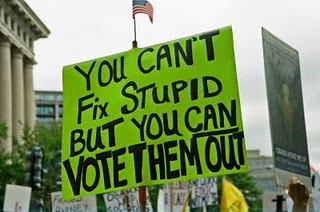
Too many, in Richard Posner’s view, want to remake democracy with the faculty workshop as their model. Such deliberation has demanding requirements for popular participation in the democratic process, including a high level of knowledge and analytical sophistication and an absence, or at least severe curtailment, of self-interested motives.
Much empirical research demonstrates that citizens have astonishingly low levels of political knowledge. Most lack very basic knowledge of political parties, candidates and issues, much less the sophisticated knowledge necessary to meet the demands of a deliberative democracy.
Posner champions Joseph Schumpeter’s view of democracy as a superior alternative to the unrealistic visions of deliberative democracy.

Schumpeter disputed the widely held view that democracy was a process by which the electorate identified the common good, and that politicians carried this out:
Schumpeter’s theory of democratic participation is that voters have the ability to replace political leaders through periodic elections. Citizens do have sufficient knowledge and sophistication to vote out leaders who are performing poorly or contrary to their wishes. The power of the electorate to turn elected officials out of office at the next election gives elected officials an incentive to adopt policies that do not outrage public opinion and administer the policies with some minimum honesty and competence.
The outcome of Schumpeterian democracy in the 20th century, where governments are voted out rather than voted in, is that most of modern public spending is income transfers that grew to the levels they are because of support from the average voter.

Political parties on the Left and Right that delivered efficient increments and streamlinings in the size and shape of government were elected, and then thrown out from time to time, in turn, because they became tired and flabby or just plain out of touch.
Celebrating humanity's flourishing through the spread of capitalism and the rule of law
Scholarly commentary on law, economics, and more
Beatrice Cherrier's blog
Celebrating humanity's flourishing through the spread of capitalism and the rule of law
Celebrating humanity's flourishing through the spread of capitalism and the rule of law
Celebrating humanity's flourishing through the spread of capitalism and the rule of law
Why Evolution is True is a blog written by Jerry Coyne, centered on evolution and biology but also dealing with diverse topics like politics, culture, and cats.
Celebrating humanity's flourishing through the spread of capitalism and the rule of law
Celebrating humanity's flourishing through the spread of capitalism and the rule of law
A rural perspective with a blue tint by Ele Ludemann
DPF's Kiwiblog - Fomenting Happy Mischief since 2003
Celebrating humanity's flourishing through the spread of capitalism and the rule of law
The world's most viewed site on global warming and climate change
Tim Harding's writings on rationality, informal logic and skepticism
A window into Doc Freiberger's library
Let's examine hard decisions!
Commentary on monetary policy in the spirit of R. G. Hawtrey
Thoughts on public policy and the media
Celebrating humanity's flourishing through the spread of capitalism and the rule of law
Politics and the economy
A blog (primarily) on Canadian and Commonwealth political history and institutions
Reading between the lines, and underneath the hype.
Economics, and such stuff as dreams are made on
"The British constitution has always been puzzling, and always will be." --Queen Elizabeth II
Celebrating humanity's flourishing through the spread of capitalism and the rule of law
Celebrating humanity's flourishing through the spread of capitalism and the rule of law
WORLD WAR II, MUSIC, HISTORY, HOLOCAUST
Undisciplined scholar, recovering academic
Celebrating humanity's flourishing through the spread of capitalism and the rule of law
Res ipsa loquitur - The thing itself speaks
Celebrating humanity's flourishing through the spread of capitalism and the rule of law
Researching the House of Commons, 1832-1868
Articles and research from the History of Parliament Trust
Reflections on books and art
Posts on the History of Law, Crime, and Justice
Celebrating humanity's flourishing through the spread of capitalism and the rule of law
Exploring the Monarchs of Europe
Cutting edge science you can dice with
Small Steps Toward A Much Better World
“We do not believe any group of men adequate enough or wise enough to operate without scrutiny or without criticism. We know that the only way to avoid error is to detect it, that the only way to detect it is to be free to inquire. We know that in secrecy error undetected will flourish and subvert”. - J Robert Oppenheimer.
The truth about the great wind power fraud - we're not here to debate the wind industry, we're here to destroy it.
Celebrating humanity's flourishing through the spread of capitalism and the rule of law
Celebrating humanity's flourishing through the spread of capitalism and the rule of law
Economics, public policy, monetary policy, financial regulation, with a New Zealand perspective
Celebrating humanity's flourishing through the spread of capitalism and the rule of law
Restraining Government in America and Around the World

 Utopia, you are standing in it!
Recent Comments