Do violent protests win votes for your cause?

Monkey Cage blogged on a very timely study on the impact of violent and nonviolent protests on voting behaviour. Non-violent protest in the 60s enticed sympathy and increased voter support for the Democratic Party in the 1964, 1968 to 1972 presidential elections:

Black-led nonviolent protests… exhibit a statistically significant positive relationship with county-level Democratic vote-share in the same period.

This is not surprising because nonviolent protest acknowledge fidelity to law and democratic equality. No one likes to be bullied and one of the purposes of the secret ballot is to prevent voters from being bullied because no one knows how you voted.

Indeed, there is a long history of anonymous pamphleteering, which has evolved into anonymous trolling as a way of people expressing their political views without facing backlash from both the majority and a vindictive minority.

In a democracy, it’s up to me to persuade you to change your mind – that what you took for granted for so long is not so. That’s how liberal democracies work: by trying to persuade each other and voting.
image

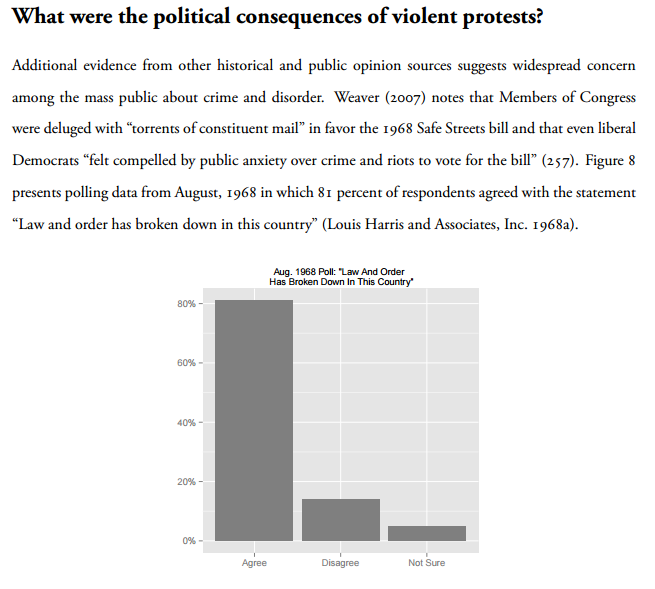
Violent protests had the exact opposite effect to peaceful protests on Democratic Party voting shares in the 1964, 1968 in 1972 presidential elections. There was a law and order backlash among voters against what were relatively widespread rioting and civil disorder:

…black-led protests in which some violence occurs are associated with a statistically significant decline in Democratic vote-share in the 1964, 1968 and 1972 presidential elections.

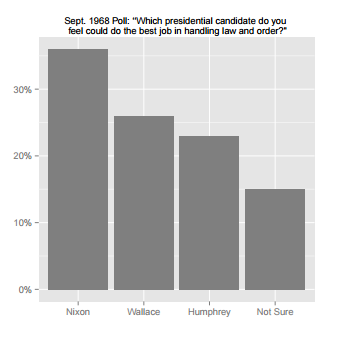
This is a roundabout way of saying that a Republican won the 1968 election on a law and order platform, not a Democrat on a peace platform. The country was convinced, including Liberal Democrats, that law and order had broken down and that the Democratic Party could not restore law and order.
image

In the 1968 presidential election, there is a third party candidate, George Wallace, who won won almost ten million popular votes and 46 electoral votes, including in the electoral college on an even harsher law and order platform than Nixon.

Wallace was a racist Southern Democrat the Democratic Party would prefer us to forget and a nasty political opportunist to boot. His political rhetoric included the only words four letter words the protesters didn’t know was work and soap.

As I recall warmed over Marxism, the idea of violent protests is to provoke a law and order backlash, initially with popular support of the working class. The resulting police repression will overreach and cause the proletariat to breakthrough their false consciousness to see that capitalists for whom they are and rise up to overthrow them.

Rise up ye workers, rise up for you have nothing to lose but your chains. These days that call to the barricades would have to be rise up ye workers, rise up for you have nothing to lose what your smart phone and air points.

A simple model of crime waves, riots and revolution

In ‘A simple model of crime waves, riots, and revolutions’, Alexander Tabarrok puts forward a model of crime waves that applies not only to crime but also to phenomena like riots, strikes, and revolutions.

  • In each of these cases, the probability of being punished is a decreasing function of the total amount of the activity.
  • The probability that a rioter is apprehended falls the more rioters there are.
  • The probability that a striker or a revolutionary is punished is less the greater the number of strikers and revolutionaries. This is true even if the revolution or strike fails.

The standard model of crime analyses a criminal’s decisions as if they were unrelated to the decisions of other criminals.

The game-theoretic approach examines the entire system of criminal decisions exploring the implications of interdependence.

As crime increases, police resources become strained at the margin and the probability of punishment falls, causing other criminals to increase their criminal activities.

As others turn to crime, the probability of punishment falls even further, giving each individual an additional reason to increase his criminal activities.

Joining into a revolution or a riot has the same calculus of independence. You are less likely to be caught and punished if you will face in the crowd.

This interdependence in the probability of detection, arrest and punishment lowers the cost of participation. Not surprisingly, judges of been aware of this for some time and have hand out severe punishments such as after the 2011 London riots. These riots fell away sharply once these penalties were handed out and more police were on the streets to catch rioters.

Truth on the Market

Scholarly commentary on law, economics, and more

The Undercover Historian

Beatrice Cherrier's blog

Matua Kahurangi

Celebrating humanity's flourishing through the spread of capitalism and the rule of law

Temple of Sociology

Celebrating humanity's flourishing through the spread of capitalism and the rule of law

Velvet Glove, Iron Fist

Celebrating humanity's flourishing through the spread of capitalism and the rule of law

Why Evolution Is True

Why Evolution is True is a blog written by Jerry Coyne, centered on evolution and biology but also dealing with diverse topics like politics, culture, and cats.

Down to Earth Kiwi

Celebrating humanity's flourishing through the spread of capitalism and the rule of law

NoTricksZone

Celebrating humanity's flourishing through the spread of capitalism and the rule of law

Homepaddock

A rural perspective with a blue tint by Ele Ludemann

Kiwiblog

DPF's Kiwiblog - Fomenting Happy Mischief since 2003

The Dangerous Economist

Celebrating humanity's flourishing through the spread of capitalism and the rule of law

Watts Up With That?

The world's most viewed site on global warming and climate change

The Logical Place

Tim Harding's writings on rationality, informal logic and skepticism

Doc's Books

A window into Doc Freiberger's library

The Risk-Monger

Let's examine hard decisions!

Uneasy Money

Commentary on monetary policy in the spirit of R. G. Hawtrey

Barrie Saunders

Thoughts on public policy and the media

Liberty Scott

Celebrating humanity's flourishing through the spread of capitalism and the rule of law

Point of Order

Politics and the economy

James Bowden's Blog

A blog (primarily) on Canadian and Commonwealth political history and institutions

Science Matters

Reading between the lines, and underneath the hype.

Peter Winsley

Economics, and such stuff as dreams are made on

A Venerable Puzzle

"The British constitution has always been puzzling, and always will be." --Queen Elizabeth II

The Antiplanner

Celebrating humanity's flourishing through the spread of capitalism and the rule of law

Bet On It

Celebrating humanity's flourishing through the spread of capitalism and the rule of law

History of Sorts

WORLD WAR II, MUSIC, HISTORY, HOLOCAUST

Roger Pielke Jr.

Undisciplined scholar, recovering academic

Offsetting Behaviour

Celebrating humanity's flourishing through the spread of capitalism and the rule of law

JONATHAN TURLEY

Res ipsa loquitur - The thing itself speaks

Conversable Economist

Celebrating humanity's flourishing through the spread of capitalism and the rule of law

The Victorian Commons

Researching the House of Commons, 1832-1868

The History of Parliament

Articles and research from the History of Parliament Trust

Books & Boots

Reflections on books and art

Legal History Miscellany

Posts on the History of Law, Crime, and Justice

Sex, Drugs and Economics

Celebrating humanity's flourishing through the spread of capitalism and the rule of law

European Royal History

Exploring the Monarchs of Europe

Tallbloke's Talkshop

Cutting edge science you can dice with

Marginal REVOLUTION

Small Steps Toward A Much Better World

NOT A LOT OF PEOPLE KNOW THAT

“We do not believe any group of men adequate enough or wise enough to operate without scrutiny or without criticism. We know that the only way to avoid error is to detect it, that the only way to detect it is to be free to inquire. We know that in secrecy error undetected will flourish and subvert”. - J Robert Oppenheimer.

STOP THESE THINGS

The truth about the great wind power fraud - we're not here to debate the wind industry, we're here to destroy it.

Lindsay Mitchell

Celebrating humanity's flourishing through the spread of capitalism and the rule of law

Alt-M

Celebrating humanity's flourishing through the spread of capitalism and the rule of law

croaking cassandra

Economics, public policy, monetary policy, financial regulation, with a New Zealand perspective

The Grumpy Economist

Celebrating humanity's flourishing through the spread of capitalism and the rule of law

International Liberty

Restraining Government in America and Around the World

Environmental and Urban Economics

Celebrating humanity's flourishing through the spread of capitalism and the rule of law