
The relative contributions of Thomas Schelling and the peace movement to the risks of war
26 May 2014 1 Comment
in Thomas Schelling, war and peace Tags: arms races, deterrence, disarmament, mutually assured destruction, peace movements, Robert Aumann
Thomas Schelling (and Robert Aumann) did terrible things such as work out how not to blunder into wars and how to deter wars rather than have to actually fight them.
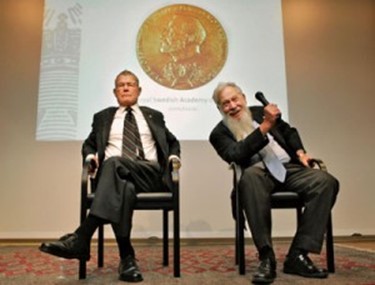
Schelling’s unique contribution at the Rand Corporation involved viewing strategic situations as bargaining processes.
Focusing on the stand-off between the United States and the Soviet Union, Schelling observed that the two superpowers had both shared and opposing interests.
Their shared interests involved avoiding a nuclear war, while their opposing interests concerned dominating the other. Conflict and cooperation became inseparable.
Iran and Israel are moving down that same path if both have nuclear weapons.
Schelling focused in particular on how the United States and Soviet Union could arrive at and stick to bargains by means of deterrence and compellence.
Deterrence involves dissuading the other from doing something, while compellence referred to persuading the other to do something.
- Deterrence and compellence are supported by threats and promises.
- Threats are costly when they fail and successful when they are not carried out.
- Promises are costly when they succeed and successful when they are carried out. A threat is cheaper than a promise because you do not have to carry it out if your threats work in intimidating others to do what you want.
Since the exploitation of potential force is better than the application of force, it is key to use threats and promises while avoiding having to act upon these.
The challenge is to communicate threats and promises in a credible manner.
The ability to hurt people is conducive to peace, while the ability to destroy weapons increases the risk of war. This is the paradox of deterrence. A country needs a credible second-strike capacity to deter a pre-emptive first strike. A country needs its missiles to survive such an attack.
Populations are better protected by protecting the missiles. By protecting the missiles rather than their cities, each side was offering their populations as a hostage to the other.
With each side holding the other’s cities as hostage, neither has an incentive to strike first. This is much safer than having each side worried about their weapons been destroyed and they therefore use them before they are destroyed in some minor crisis.
That is one of Schelling’s many contributions to peace.
What were the contributions of the peace movements?
Robert Aumann argued well that the way to peace is like bargaining in a medieval bazaar. Never look too keen, and bargain long and hard. Aumann argues that:
If you are ready for war, you will not need to fight. If you cry ‘peace, peace,’ you will end up fighting…
What brings war is that you signal weakness and concessions.
Countries are more likely to cooperate if they have frequent interactions and have a long time horizon. The chances of cooperation increase when it is backed by the threat of punishment.
Disarmament, Aumann argues, “would do exactly the opposite” and increase the chances of war. He gave the example of the Cold War as an example of how their stockpiles of nuclear weapons and fleets of bombers prevented a hot war from starting:
In the long years of the cold war between the US and the Soviet Union, what prevented “hot” war was that bombers carrying nuclear weapons were in the air 24 hours a day, 365 days a year? Disarming would have led to war.
Aumann has quoted the passage from the biblical Book of Isaiah:
Isaiah is saying that the nations can beat their swords into ploughshares when there is a central government – a Lord, recognized by all.
In the absence of that, one can perhaps have peace – no nation lifting up its sword against another.
But the swords must continue to be there – they cannot be beaten into ploughshares – and the nations must continue to learn war, in order not to fight!
The Crusader State versus the Foreign Policy of the Old Right
26 Apr 2014 Leave a comment
in Thomas Schelling, war and peace Tags: Ivan Eland, Murray Rothbard, Old Right, Robert Aumann, Robert Taft
The foreign policy of the Old Right of the Republican Party is undergoing a revival through the now retired Congressmen Ron Paul and now his son, Senator Rand Paul. They are the joint heirs of the Old Right of the Republican Party and Senator Robert A. Taft.

In The Republican Road Not Taken: The Foreign-Policy Vision of Robert A. Taft Michael T. Hayes argues that Taft was isolationist, which is opposition to binding commitments by the U.S. that would create new, or expand existing, obligations to foreign nations. Like many Americans of his era – the 1940s and early 1950s – Taft gladly would have:
let the rest of the world go its own way if it would only go without bothering the United States
Taft advocated what he called the policy of the free hand, whereby the United States would avoid entangling alliances and interferences in foreign disputes:
- This policy permitted government leaders the freedom of action to decide in particular cases whether a vital U.S. interest warranted involvement.
- Taft correctly pointed to features of the United Nations that would prevent its serving as a real force for peace and equality under the law.
- He challenged the Truman administration’s assessment of the Soviet military threat against Western Europe.
- He anticipated correctly that a steady rise in defence outlays could lead to a “garrison state” and the erosion of civil liberties.
- Taft was prescient in warning that even well-meaning internationalism would degenerate over time into a form of imperialism that would breed resentment against the United States around the globe, eventually endangering U.S. national security.
In Putting “Defense” Back into U.S. Defense Policy, Ivan Eland argues for an urgent rethinking of America’s national interests:
- America’s natural geo-strategic position places it at a natural advantage, rendering unnecessary a forward defence posture.
- A non-interventionist foreign policy would mean lower defence budgets.
- An America less willing to get involved in complex overseas disputes unrelated to its vital interests would also be less likely to make enemies around the world.
Further to the Libertarian Right, in Where the Left goes wrong on Foreign Policy the late Murray Rothbard asked whether:
- The Left is prepared to accept a foreign policy in which the United States government allies itself with no one and retires from the world scene, leaving all international encounters to the private realm of free trade, travel, and cultural and social exchange.
- That is what a policy of genuine non-interventionism and anti-imperialism would mean: a world in which the US government no longer tries to push other people around, on behalf of any cause, anywhere.
One area of agreement between classical liberals and the new left used to be opposition to foreign aid. Foreign aid was a system to subsidise US exports and prop up client states.
Rothbard used a revisionist perspective on foreign policy to argue that:
- Taking the twentieth century as a whole, the single most warlike, most interventionist, most imperialist government has been the United States;
- The main thrust of Soviet foreign policy was to preserve what it already has at home and abroad, not to jeopardise it;
- A conservative Soviet government is capable of dangerous militaristic actions, but these are acts of imperial protectionism, not revolutionary or aggrandisement;
- National communist movements were not monolithic but independent-minded – the wars between china, the USSR and China and Vietnam are examples; and
- There vast differences between the various communist regimes throughout the globe spell the difference between life and death for a large part of their subject populations.
History did not perhaps hold up well on Soviet intentions for Rothbard, and Thomas Schelling and Robert Aumann are better writers on how if you want peace, you must prepare for war, but the Old Right did have a point about the crusader state.
In The Empire Has No Clothes U.S. Foreign Policy Exposed, Eland argued that:
In a post–Cold War world, taking into account only the security of American citizens, their property, and U.S. territory, the benefits of an interventionist foreign policy have declined, and the costs have escalated dramatically.
Americans continue to pay excessive taxes to defend countries that are rich enough to defend themselves or to occupy conquered countries in the world’s backwaters (e.g., Iraq and Afghanistan)…
Their sons and daughters are killed on remote foreign battlefields for reasons even remoter from U.S. vital interests.
Crusader states can stumble into wars that they had no intention of fighting both in terms of scale and length. Remember World War 1 where everyone thought they would be home by Christmas after a negotiated settlement.
Tom Schelling looked at going to war as an emergent process. He argues that what a country does today in a crisis affects what one can be expected to do tomorrow. To quote Schelling:
A government never knows just how committed it is to action until the occasion when its commitment is challenged.
Nations, like people, are continually engaged in demonstrations of resolve, tests of nerve, and explorations for understandings and misunderstandings….
This is why there is a genuine risk of major war not from ‘accidents’ in the military machine but through a diplomatic process of commitment that is itself unpredictable.
Schelling goes on to argue wars to save face are, nonetheless, rational:
It is often argued that ‘face’ is a frivolous asset to preserve, and that it is a sign of immaturity that a government can’t swallow its pride and lose face.
But there is also the more serious kind of ‘face’, the kind that modern jargon is known as a country’s ‘image’, consisting of other countries’ beliefs (their leaders’ beliefs, that is) about how the country can be expected to behave.
It relates not to a country’s ‘worth’ or ‘status’ or even ‘honor’, but to its reputation for action.
If the question is raised whether this kind of ‘face’ is worth fighting over, the answer is that this kind of face is one of few things worth fighting over.
Robert Aumann argues well that the way to peace is like bargaining in a medieval bazaar. Never look too keen, and bargain long and hard. Aumann argues that:
If you are ready for war, you will not need to fight. If you cry ‘peace, peace,’ you will end up fighting… What brings war is that you signal weakness and concessions.
 Utopia, you are standing in it!
Recent Comments